
A practical attachment budget has four layers:
Attachment + truck integration + capacity impact + operating changeCurrent public examples range from roughly $1,300 for one aftermarket sideshifter to more than $9,000 for a heavy rotator. Complex clamps and specialty handlers are often quote-based. The cheapest attachment is not necessarily the lowest-cost system if it reduces residual capacity or requires another truck to handle heavier loads.
Forklift attachments are valuable when they eliminate a repeatable handling problem.
A sideshifter can eliminate dozens of small truck repositioning moves. A fork positioner can eliminate repeated manual adjustment. A carton clamp can remove pallets from an appliance or white-goods workflow. A push/pull can replace pallets with slip sheets. A multiple-load handler can reduce travel by carrying two or more unit loads per trip.
But every attachment changes the truck.
The attachment has weight, thickness, hydraulic requirements and its own operating limitations. That means the correct ROI calculation begins with the forklift-plus-attachment combination, not the accessory invoice.
Attachment value map
The attachment should remove a repeatable handling cost
Reduce repositioning, manual fork adjustment and alignment time.
Handle loads that standard forks cannot move efficiently or without damage.
Use slip sheets where pallet cost, cube or export logistics justify the system.
Move more than one pallet per trip where aisle, truck and load profile allow it.
The attachment can add weight, move the load center forward, reduce truck capacity, require another hydraulic function and change operator training. Calculate the complete truck-plus-attachment system before calling the upgrade productive.
Current forklift attachment price examples
Public attachment pricing is much less standardized than forklift pricing. Many OEM and specialist systems are sold through dealer quotation because carriage class, capacity, opening range, hydraulics and truck compatibility materially change the final configuration.
Several current U.S. listings are still useful as market anchors:
| Current public example | Configuration | Published asking price |
|---|---|---|
| Cascade 55F-SSS-A051 | Aftermarket sideshifter | $1,299.62 |
| Cascade 6056294 | OEM fork positioner | $1,915.49 |
| Cascade Class III sideshift fork positioner | 10,000-lb used/current listing | $2,617.24 |
| Cascade 45E-PHS | 4,500-lb push/pull for slip sheet | $3,324.99 |
| Cascade 90F | Used 9,000-lb paper roll clamp | $7,124.99 |
| Yale-compatible aftermarket rotator | 7,200-lb rotator | $9,488.48 |
These examples should not be averaged into one national attachment price. They differ in condition, carriage class, capacity, brand and function.
Confirm hoses, valves, auxiliary hydraulic functions, controls, mounting, labor, freight, revised data plate, operator training and commissioning before comparing two quotes.
A $1,300 sideshifter can become a larger installed project
The current Modern Group listing for the Cascade 55F-SSS-A051 aftermarket sideshifter is approximately $1,299.62.
That price is a useful component reference. It does not tell you whether the target truck already has:
- the correct carriage class;
- an available hydraulic function;
- compatible hoses;
- correct hydraulic flow and pressure;
- appropriate controls;
- a manufacturer-approved capacity configuration.
Retrofitting a truck that was attachment-ready at purchase can be much simpler than converting a basic truck that lacks the required hydraulic circuit.
What a sideshifter actually buys
Toyota's current attachment guidance describes a sideshifter as a way to move the forks and load laterally without repositioning the entire forklift.
Cascade's current F-Series sideshifter offers configurations up to 15,000 lb, with mounting classes II–IV and approximately 4–12 inches of sideshift stroke depending on configuration.
The economic benefit is typically:
- fewer forward/reverse corrections;
- faster pallet alignment;
- less rack/contact risk;
- easier trailer loading;
- less operator steering effort.
The value is highest when alignment corrections occur hundreds of times per shift.
Calculate sideshifter labor payback from seconds, not guesses
Annual labor time saved
moves/day × seconds saved/move × operating days ÷ 3,600
Then:
Annual labor-value opportunity
hours saved × loaded labor cost/hour
Do not assume every second becomes payroll savings. In a busy operation, saved time may become additional throughput rather than fewer paid hours.
A sideshifter payback example
8 seconds saved on 300 pallet placements/day
300 × 8 sec × 250 days = 600,000 seconds.
600,000 ÷ 3,600 = 166.7 hours/year.
At an illustrative loaded labor value of $30/hour: $5,001/year of labor-time capacity.
Inputs are illustrative. Measure actual alignment time before and after the attachment.
The stronger sideshifter ROI may be damage avoidance
A sideshifter can improve alignment without repeatedly steering the truck toward rack, trailers or product.
Track before/after:
- rack impact incidents;
- pallet damage;
- product damage;
- trailer-wall contact;
- fork-entry damage;
- claims or rework associated with poor placement.
If alignment-related damage is already near zero, do not invent a damage-saving benefit simply to make the attachment look attractive.
Fork positioner cost can be similar to a sideshifter—or much higher
The Modern Group currently lists a Cascade OEM fork positioner around $1,915.49.
Current used-market examples vary substantially. One Class III Cascade sideshifting fork positioner rated around 10,000 lb is listed at approximately $2,617.24.
Another refurbished Cascade fork-positioner listing is around $7,900, demonstrating why configuration and condition matter.
Do not publish one “fork positioner average” from those incompatible products.
Fork positioners solve a different problem from sideshifters
A sideshifter moves both forks laterally as one carriage.
A fork positioner changes the spacing between the forks hydraulically.
Toyota's current guidance says fork positioners let the operator adjust fork spacing for different pallet sizes without leaving the seat.
That can remove:
- manual fork adjustment;
- operator dismounts;
- walking around the truck;
- pin/lock handling;
- incorrect fork-spacing setup.
Fork positioners pay off fastest in variable-load operations
The strongest applications change frequently between:
- standard pallets;
- wide pallets;
- narrow skids;
- containers;
- different customer pallet standards.
A warehouse handling only one pallet format all day may gain little from hydraulic fork spacing.
Measure how often operators actually adjust forks
Fork-positioner annual time opportunity
adjustments/day × minutes per manual adjustment × operating days
Include only genuine manual-adjustment events.
If operators already leave the forks at one fixed spacing for the entire shift, the theoretical productivity benefit does not exist.
Fork positioners can have a safety and ergonomics benefit too
Manual fork adjustment may require the operator to leave the seat and physically move heavy fork assemblies.
Hydraulic positioning can reduce that manual handling.
That does not remove the need for:
- proper fork inspection;
- correct locking / positioning;
- operator training;
- capacity verification.
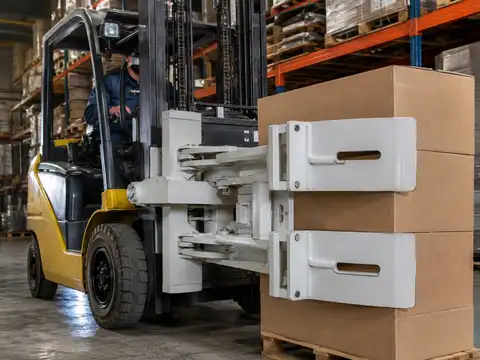
Carton clamps can eliminate pallets from the handling unit
Cascade's current J-Series carton-clamp family spans approximately 1,750–4,850 lb depending on model.
Clamp-equipped forklifts are common in:
- appliances;
- white goods;
- electronics;
- boxed furniture;
- other large unitized cartons.
The business case can come from removing pallets, reducing handling steps and increasing trailer/container cube.
Current used carton-clamp pricing is extremely wide
Current U.S. marketplace examples include:
- used Cascade carton-clamp units around $2,800–$3,950;
- a 2017 used Cascade carton clamp at approximately $3,375;
- a 2019 Cascade white-goods clamp listed around $12,708.
Those units differ in age, capacity, pad configuration and application. The spread is evidence that clamp pricing is configuration-specific, not a credible $/attachment national average.
Clamp ROI can disappear if product damage rises
A carton clamp creates value only when clamp force is correctly controlled.
Too little force can drop or shift the load. Too much force can crush cartons or damage appliances.
Cascade's current carton-clamp line includes damage-reduction options intended to control clamp force and product handling.
A clamp business case should therefore measure:
- pallet savings;
- trailer-cube improvement;
- handling time;
- product-damage rate;
- claims;
- training and setup.
Paper roll clamps are high-value specialty attachments
Paper roll clamps need:
- appropriate arm geometry;
- roll-diameter range;
- clamp-force control;
- rotation capability where required;
- capacity appropriate to roll weight.
One current used Cascade 90F 60-inch paper roll clamp rated around 9,000 lb is advertised at approximately $7,124.99.
A paper mill should not treat that one used listing as the cost of a new engineered roll-handling system.
Paper-roll payback is usually damage and handling based
The economic comparison is often:
specialized clamp handling versus another handling method that risks roll-edge or surface damage.
If one damaged roll represents thousands of dollars of product, damage prevention can dominate attachment acquisition cost.
Rotators are often several-thousand-dollar attachments
A current Modern Group listing for a 7,200-lb aftermarket Yale-compatible rotator is approximately $9,488.48.
Current marketplace listings for smaller generic 4,500–5,000-lb rotators can also appear around the mid-$4,000s to $8,000-plus.
Brand, side-shift integration, capacity, carriage class and hydraulic requirements all change the price.
Rotators pay when rotation replaces a separate machine or manual process
Typical use cases include:
- dumping bins;
- scrap handling;
- food-processing containers;
- foundry boxes;
- agricultural bins;
- load inversion / repositioning.
The best ROI comparison is not “rotator vs standard forks.”
It is: rotator-equipped forklift vs the entire current rotation/dumping process.
Push/pull attachments enable slip-sheet handling
OSHA's current forklift-attachment guidance lists slip-sheet attachments among common powered-industrial-truck attachments and notes that they can eliminate the need for pallets in the handling process.
One current Cascade 45E-PHS 4,500-lb push/pull listing is approximately $3,324.99.
A separate used Cascade push/pull is currently advertised around $995.
Again, those are individual equipment listings, not a new-equipment price range.
Push/pull ROI starts with the pallet system
Potential benefits include:
- lower pallet purchase cost;
- less pallet return logistics;
- lower unit-load height;
- better container / trailer cube;
- reduced pallet weight;
- export-shipping simplification.
The trade-offs can include:
- slip-sheet material cost;
- supplier/customer compatibility;
- specialized truck availability;
- operator training;
- slower handling in poorly standardized loads;
- reduced flexibility when ordinary pallets arrive unexpectedly.
A slip-sheet payback formula
Annual pallet-system savings
pallets avoided × net pallet cost avoided + return-logistics savings + verified freight/cube savings − slip-sheet cost − incremental attachment operating cost
Use the company's actual pallet-loss and return data.
Do not assume every pallet can become a slip sheet
Slip-sheet systems require compatible:
- product packaging;
- floor / rack handling;
- receiving customers;
- upstream suppliers;
- warehouse equipment;
- shipping processes.
Pallet elimination is a supply-chain decision, not only a forklift attachment purchase.
Multiple-load handlers attack travel cost
A multiple-load handler lets a forklift handle more than one unit load in one cycle.
Cascade currently offers multiple-load handlers as a dedicated attachment family, commonly used in beverage, manufacturing and high-throughput distribution.
If one truck moves two pallets per trip instead of one, travel can be reduced significantly in the right process.
But throughput does not automatically double.
Why two pallets per trip does not mean 2× productivity
A multiple-load cycle can require:
- more precise alignment;
- larger staging space;
- wider turning envelope;
- more load/unload positioning time;
- compatible pallet dimensions;
- higher truck capacity;
- different trailer pattern.
Measure full cycle time before assuming a 100% throughput gain.
Multiple-load payback formula
Travel productivity value
baseline truck-hours for target volume − attachment truck-hours for same volume
Multiply the difference by the relevant truck/operator hourly cost, then subtract additional attachment maintenance and capacity costs.
One less forklift can make attachment ROI very strong
Attachment removes one peak-fleet requirement
Baseline process needs six forklifts at peak.
Verified multiple-load process handles the same work with five.
The attachment business case can include the avoided truck acquisition/lease, maintenance, energy and potentially one operator position if the labor model genuinely changes.
Do not count an operator saving unless staffing actually falls or productive labor is redeployed to measurable work.
Fork extensions are inexpensive—but often misunderstood
Fork extensions increase the usable fork length for certain longer loads.
They do not increase forklift capacity.
Longer effective forks can move the load center forward and reduce what the truck can safely handle.
Cheap acquisition price does not remove the need to verify:
- fork length;
- extension length;
- load center;
- truck capacity;
- manufacturer instructions;
- load support.
Carpet poles, drum handlers and specialty forks can be highly application specific
Current marketplaces show used carpet-pole attachments around the low-$1,000 area in some configurations.
That does not mean every specialty attachment is inexpensive.
Long poles, heavy-duty spreaders, booms and custom fork systems can materially alter:
- load center;
- truck capacity;
- visibility;
- turning envelope;
- stability.
The more unusual the load geometry, the more important engineered approval becomes.
The hidden cost: attachments can reduce forklift capacity
OSHA's current powered-industrial-truck eTool explains that attachments can reduce capacity because:
- the attachment itself adds weight;
- the attachment can move the load farther forward;
- the combined center of gravity changes.
This is one of the most financially important facts in attachment selection.
OSHA's own nameplate example: 5,000 lb becomes 4,500 lb
OSHA currently shows a data-plate example where a forklift is rated 5,000 lb with standard forks but 4,500 lb with the sideshifter attachment.
That is an example, not a universal 10% derating rule.
The actual residual capacity depends on:
- truck;
- attachment weight;
- attachment effective thickness;
- load center;
- lift height;
- mast;
- manufacturer calculations.
The revised truck/attachment capacity belongs on the manufacturer-approved data plate. Use that rated value, not a rule of thumb.
A capacity loss can force the purchase of a larger forklift
The $2,000 attachment creates a $40,000 truck problem
Existing forklift: 5,000-lb nominal capacity.
Routine loads: 4,700 lb.
Proposed attachment reduces approved combination capacity below 4,700 lb.
The attachment can no longer be treated as a standalone $2,000 project. The operation may need a higher-capacity truck.
Integral attachments can preserve more net capacity
Cascade's current integral-carriage guidance says integral designs can improve net capacity because they reduce effective thickness compared with some hang-on configurations.
Cascade specifically offers integral:
- sideshifters;
- fork positioners;
- sideshifting fork positioners.
Integral design can be attractive when residual capacity is more valuable than easy attachment removal.
Hang-on attachments buy flexibility
Hang-on attachments can be easier to:
- retrofit;
- remove;
- transfer between compatible trucks;
- service separately;
- sell in the used market.
The trade-off can be additional effective thickness and therefore a greater capacity-factor penalty than a tightly integrated design.
Attachment weight is not the only capacity issue
Two attachments of equal weight can affect truck capacity differently if one places the load farther forward.
The effective center-of-load relationship matters because forklift stability is based on moments, not just total pounds.
This is why a heavy attachment mounted close to the carriage can sometimes preserve more capacity than a lighter but deeper attachment.
Hydraulic functions can become a hidden retrofit cost
Standard forks need no hydraulic attachment function.
Common attachments can require:
- one auxiliary hydraulic function;
- two or more functions;
- hose reels;
- mast hoses;
- valves;
- solenoids;
- electronic function selectors;
- special controls.
A truck pre-plumbed from the factory may accept the attachment cheaply. A retrofit can require much more labor and hardware.
Ask whether the truck has a third and fourth function
Before buying a used attachment, document:
- truck make/model/serial;
- carriage class;
- mast;
- existing auxiliary functions;
- hydraulic flow/pressure;
- hose routing;
- control arrangement;
- battery/energy implications for electric attachments.
“Fits Class II carriage” does not automatically mean “plug-and-play on this forklift.”
Electric attachments can reduce hydraulic complexity in some applications
Cascade currently markets electric attachment technologies alongside conventional hydraulic solutions.
Electric actuation can change:
- installation architecture;
- hose requirements;
- control integration;
- maintenance;
- energy consumption.
The correct comparison is system-specific rather than assuming electric is automatically cheaper or simpler.
OSHA requires manufacturer approval when capacity or safe operation is affected
OSHA 29 CFR 1910.178(a)(4) states that modifications and additions affecting capacity or safe operation must not be performed without the manufacturer's prior written approval, and the applicable capacity / operation / maintenance plates, tags or decals must be changed accordingly.
That requirement belongs in the attachment project schedule.
OSHA also requires attachment identification on the truck
Under 29 CFR 1910.178(a)(5), when a truck uses a front-end attachment that was not factory installed, the user must request marking that identifies the attachment and shows the approximate truck-and-attachment weight at maximum elevation with the load laterally centered.
OSHA also requires nameplates and markings to remain legible.
Do not operate from the old capacity plate after adding an attachment
A common project mistake is:
- install attachment;
- verify that it physically works;
- keep operating from the old 5,000-lb plate.
Physical fit is not the capacity approval process.
The revised truck-and-attachment rating needs to be documented as required.
Operators need attachment-specific training
OSHA's powered-industrial-truck training topics specifically include:
- fork and attachment adaptation;
- attachment operation;
- use limitations;
- vehicle capacity;
- vehicle stability.
OSHA's attachment guidance also says operators should be retrained when a new attachment is added.
Training time is part of implementation cost.
An unloaded truck with an attachment is treated as partially loaded
OSHA specifically notes that a forklift equipped with an attachment must be operated as a partially loaded truck even when it is not carrying product.
The attachment itself changes the vehicle's mass and center of gravity.
This is another reason operator behavior should change after installation.
Visibility can worsen with clamps and specialty handlers
Attachments can obstruct:
- fork tips;
- pallet entry;
- rack beams;
- pedestrians;
- forward travel sightlines.
OSHA's attachment guidance lists visibility and altered truck performance among the considerations created by specialized attachments.
Camera systems can help some applications, but they do not remove the need for safe travel procedures.
Attachment maintenance must be added to the PM program
OSHA advises including attachments in scheduled inspection and maintenance.
Depending on attachment type, inspection can include:
- load-bearing components;
- welds;
- hooks / carriage engagement;
- hydraulic cylinders;
- hoses;
- pads;
- bushings;
- bearings;
- rotator gearboxes;
- clamp arms;
- fork locking / positioning systems.
Specialty attachments can contain expensive wear parts
Current Cascade replacement-part listings illustrate that clamp pads, cylinders and attachment components can themselves cost hundreds or thousands of dollars.
A current OEM Cascade clamp pad, for example, is listed around $1,335.51 in one current parts catalog.
That is one part number—not a universal clamp-pad replacement cost.
Include expected wear parts in attachment TCO for high-use applications.
The attachment can increase tire and front-end wear
Added front-end weight and changed load center can increase demand on:
- drive tires;
- steer tires indirectly through handling pattern;
- mast rollers;
- chains;
- hydraulics;
- carriage components.
Compare maintenance history before and after installation if the attachment becomes permanent.
Attachment ROI should use incremental economics
The attachment is worthwhile when the process with the attachment is financially better than the process without it.
A practical annual model is:
Annual attachment value
labor/productivity value + verified damage reduction + equipment avoided + pallet/freight savings − attachment maintenance − incremental energy / consumables
Simple payback
Attachment payback period
total installed attachment cost ÷ annual net attachment value
Simple payback is useful for screening. For large fleet conversions, finance may prefer NPV or lifecycle cash flow.
Include total installed cost in the numerator
Include:
- attachment purchase;
- freight;
- mounting hardware;
- hoses;
- valves / controls;
- installation labor;
- manufacturer / engineering approval where required;
- new data plate / labeling;
- operator training;
- commissioning;
- production interruption during retrofit.
Do not count the same benefit twice
If 150 saved operator hours let the warehouse handle peak volume without overtime, count the avoided overtime.
Do not also count the same 150 hours as full regular labor elimination unless staffing actually changes.
ROI models become unreliable when “time saved,” “labor saved” and “throughput gained” are all monetized separately from the same minutes.
Measure before and after instead of debating assumptions
The strongest attachment projects run a controlled trial.
Capture baseline:
- cycle time;
- moves/hour;
- operator dismounts;
- damage rate;
- pallet consumption;
- truck-hours;
- downtime;
- fuel/kWh if relevant.
Then repeat the measurement with the attachment.
Rental attachments can be useful for validation
Cascade currently maintains a rental-attachment program alongside new and remanufactured equipment.
Rental can be useful when:
- the application is new;
- volume is seasonal;
- the attachment will support one customer contract;
- the company wants to validate product damage;
- truck compatibility still needs to be proven.
A short trial can prevent an expensive permanent attachment from becoming shelf inventory.
Used attachments can be attractive when compatibility is exact
Current markets contain many used Cascade clamps, push/pulls, positioners and specialty attachments at substantial discounts from complex new systems.
Before buying used, verify:
- serial number;
- carriage class;
- capacity;
- attachment weight;
- effective thickness;
- opening range;
- hydraulic requirements;
- fork compatibility;
- wear;
- parts support;
- manufacturer approval for the target truck.
A cheap incompatible attachment has near-zero value
$995 used push/pull that the fleet cannot deploy
Purchase price looks attractive. Target trucks lack suitable hydraulics. Customers do not accept slip-sheet loads. Truck capacity after installation misses the required load.
The “cheap” attachment becomes idle inventory rather than a productivity asset.
Remanufactured can be a middle ground
Cascade currently sells remanufactured attachment products as part of its U.S. offering.
Reman can be attractive when:
- new lead time is long;
- the application is standard;
- warranty is acceptable;
- the attachment has known service support;
- the capital budget is constrained.
Compare warranty, wear components and delivered configuration—not simply reman vs new sticker price.
When a sideshifter usually pays
- operators make frequent lateral alignment corrections;
- rack clearances are tight;
- trailer loading requires precise placement;
- product/rack damage from alignment is measurable;
- the truck already has compatible hydraulics;
- residual capacity remains adequate.
When a fork positioner usually pays
- fork spacing changes many times per shift;
- pallet / skid widths vary;
- manual fork adjustment consumes meaningful time;
- operator dismounts are frequent;
- the process values fast load-changeover.
When a clamp usually pays
- product can be handled safely without a pallet;
- pallet cost is material;
- damage controls are validated;
- trailer/container cube improves;
- the product mix is stable enough to keep the attachment busy.
When a rotator usually pays
- dumping/rotation is a repeatable process;
- another machine or manual step can be eliminated;
- the truck retains adequate capacity;
- the attachment handles the load geometry correctly;
- maintenance and gearbox wear are included in TCO.
When a push/pull usually pays
- pallet elimination has real annual value;
- suppliers/customers can handle slip sheets;
- export/container cube matters;
- load packaging is compatible;
- the operation can standardize the system at sufficient volume.
When a multiple-load handler usually pays
- the same lane moves repeated identical pallets;
- long travel is a large share of cycle time;
- truck capacity supports multiple loads;
- aisles / docks support the wider handling envelope;
- the higher throughput can remove fleet or labor pressure.
When an attachment does not pay
Avoid buying because:
- a dealer demo looked impressive;
- another warehouse uses it;
- the attachment is available used at a discount;
- it might be useful someday;
- operators asked for it but no process data was collected.
An attachment should solve a measured recurring problem.
The attachment can create a new fleet-standardization problem
A specialty attachment permanently tied to one truck can create:
- single-point-of-failure risk;
- special training;
- unique spare parts;
- reduced ability to swap trucks;
- rental-replacement difficulty.
For mission-critical specialty handling, consider whether:
- a second attachment is needed;
- a backup compatible truck exists;
- dealer rental coverage is available;
- the attachment can transfer quickly.
Quick-disconnect capability can have value
If one truck performs several roles, faster attachment changes can reduce downtime between tasks.
But repeated attachment changeovers can also create:
- hose wear;
- connection contamination;
- operator/setup errors;
- data-plate confusion if combinations differ;
- storage requirements for removed attachments.
Frequent changeover deserves its own standard work.
Attachments can change aisle requirements
The attachment can increase:
- effective truck length;
- load length;
- load width;
- turning envelope;
- clearance requirements.
A fork positioner or clamp that solves one productivity issue should not be installed before confirming the truck still fits the rack aisle and trailer.
Attachments can change the correct forklift size
If the final truck/attachment combination needs:
- more capacity;
- higher hydraulic flow;
- larger carriage class;
- more battery capacity;
- greater stability margin;
it can be cheaper to specify the right forklift and attachment together than to retrofit the wrong base truck later.
Factory-order attachments can simplify integration
When buying a new truck, ask the dealer to quote:
- factory-integrated attachment;
- dealer-installed hang-on attachment;
- required hydraulic functions;
- final rated capacity;
- battery impact;
- final warranty;
- lead time.
The lowest attachment price can lose if the retrofit later requires extra controls and capacity approval.
Normalize attachment quotes before choosing
| Quote line | What to confirm |
|---|---|
| Attachment | Make, model, serial, capacity, opening range |
| Mounting | Carriage class, integral vs hang-on |
| Hydraulics | Functions, hoses, valves, flow/pressure |
| Controls | Levers, switches, solenoids, electronic interface |
| Capacity | Final approved truck/attachment rating |
| Installation | Labor, travel, commissioning |
| Compliance | Approval, revised data plate / markings |
| Training | Operator attachment-specific instruction/evaluation |
| Maintenance | PM tasks, wear parts, warranty |
| Freight | Inbound and future service freight |
A five-step attachment approval process
- Define the handling problem. Measure time, damage, pallet cost or throughput constraint.
- Confirm truck compatibility. Capacity, carriage, hydraulics, load center and aisle.
- Get the complete installed quote. Do not compare accessory-only prices.
- Run a controlled trial where possible. Measure actual improvement.
- Complete approval, marking and training. Put the combination into the PM and operator program.
The practical recommendation
Start with a simple question:
What repetitive cost disappears if this attachment works?
For a sideshifter, it may be alignment time and impact damage. For a positioner, manual fork adjustment. For a clamp, pallets and product-handling steps. For a push/pull, pallet logistics. For a multiple-load handler, truck travel.
Then compare that annual value with the complete installed attachment cost and the cost of any capacity or maintenance penalty.
An attachment pays when it improves the whole handling process. It does not pay simply because it makes the forklift more capable.
Frequently asked questions
How much does a forklift sideshifter cost?
One current Modern Group aftermarket Cascade sideshifter is listed around $1,299.62. Installed cost can be higher once hydraulics, labor and capacity approval are included.
How much does a forklift fork positioner cost?
One current Cascade OEM fork positioner is listed around $1,915.49. Current used and refurbished examples range much higher depending on class and capacity, so there is no useful single national price.
How much does a forklift push/pull attachment cost?
A current Cascade 45E-PHS 4,500-lb push/pull is advertised around $3,324.99. Used examples can be much cheaper.
How much does a forklift rotator cost?
Current public examples for full-size rotators are often several thousand dollars. One 7,200-lb aftermarket Yale-compatible rotator is currently listed around $9,488.48.
How much does a carton clamp cost?
Current used Cascade examples range from roughly the high-$2,000s into five figures depending on age, capacity and white-goods/carton configuration. New engineered clamps are commonly quote-based.
Does a forklift attachment reduce capacity?
It often can. OSHA explains that attachment weight and forward movement of the load center can reduce capacity. OSHA's own data-plate example shows a 5,000-lb forklift rated at 4,500 lb with a sideshifter.
Do I need a new forklift data plate after adding an attachment?
OSHA requires capacity/operation/maintenance plates, tags or decals to be changed when modifications or additions affect capacity or safe operation, and requires attachment identification for relevant non-factory front-end attachments.
Do forklift attachments require manufacturer approval?
OSHA 29 CFR 1910.178(a)(4) requires prior written manufacturer approval for modifications and additions that affect capacity or safe operation.
Do forklift operators need new training for an attachment?
OSHA training topics include fork and attachment adaptation, operation, limitations, capacity and stability. OSHA's attachment guidance says operators should be retrained when a new attachment is added.
Is a sideshifter worth it?
It often is when operators make frequent alignment corrections, rack or trailer clearance is tight, or alignment-related damage is material. Measure seconds saved per pallet placement and before/after damage.
Is a fork positioner worth it?
It is strongest in operations that change fork spacing frequently. Warehouses handling one standard pallet width all day may recover little value.
Are used forklift attachments worth buying?
They can be, but compatibility is critical. Verify carriage class, hydraulics, capacity, effective thickness, wear, parts support and approval for the target truck.
Sources and methodology
Warehouse Fieldbook uses current U.S. public equipment listings only as price snapshots and does not average incompatible attachments into a national cost. Cascade and Toyota sources provide current functional and product context. OSHA provides the controlling U.S. safety requirements used for attachment approval, capacity/nameplate changes, operator training and inspection. Payback scenarios are illustrative formulas; real attachment ROI should use measured site cycle times, damage, pallet use, labor and truck-capacity data.
- The Modern Shop — current Cascade aftermarket sideshifter price example
- The Modern Shop — current Cascade OEM fork-positioner price example
- Equipt — current Cascade Class III sideshift fork-positioner listing
- Equipt — current Cascade 4,500-lb push/pull price example
- Equipt — current Cascade attachment marketplace examples
- The Modern Shop — current 7,200-lb rotator price example
- The Modern Shop — current Cascade OEM clamp-pad price example
- Cascade — current U.S. forklift attachment product families
- Cascade — current J-Series carton-clamp capacity and damage-control options
- Cascade — current integral-carriage net-capacity guidance
- Conger / Cascade — F-Series sideshifter capacity, mounting and stroke
- Toyota Material Handling — sideshifter and fork-positioner functions
- Toyota Material Handling — current attachment and clamp application context
- OSHA — 29 CFR 1910.178 attachment approval, markings and powered-industrial-truck requirements
- OSHA — forklift attachment capacity, stability, visibility, training and maintenance guidance
- OSHA — data-plate example showing capacity change with sideshifter
- OSHA — attachment, capacity and stability operator-training topics