
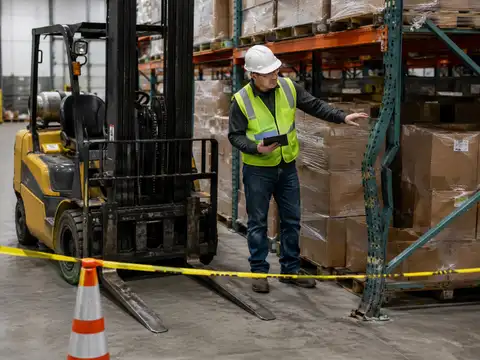
Stop, isolate, document and escalate before anyone treats the damage as cosmetic.
A forklift strike can damage more than the visible face of one upright. Base plates, anchors, bracing, beam connectors, adjacent components, pallets and stored loads can all be part of the incident. Protect people first, remove the affected rack area from normal use and preserve the condition for a competent technical assessment.
Rack-impact response
From Forklift Contact to Safe Reopening
The response is a controlled sequence, not a visual “dent check.” Each gate answers a different question: people, stability, evidence, engineering, repair and release.
Stop vehicle movement, keep people away from the affected rack and address injuries or immediate falling-load hazards before investigating property damage.
Barricade the affected bay/aisle as the site risk requires. Do not allow normal picking, put-away or pedestrian access through a potentially unstable area.
Photograph the point of impact, rack configuration, loads, anchors, guards, truck and surrounding aisle before parts are moved or damage is disguised.
Check the struck upright plus baseplate/anchors, bracing, beam connections, adjacent components, pallets and displaced loads. Escalate uncertain damage.
Do not improvise straightening, welding, drilling or component substitution. Follow the rack manufacturer or qualified rack-engineering repair direction.
Confirm required repair, anchors/locks/components, configuration/load documentation and incident actions are complete before removing the isolation.
The first 15 minutes: protect people before protecting inventory
If anyone is injured or a collapse/falling load is occurring, follow the site's emergency response process. Do not enter beneath unstable product to recover inventory or photograph damage.
Lower the load/forks when this can be done safely, neutralize controls, set the brake and shut down as appropriate. If the impact may have damaged the truck, keep it out of service until it is safe.
Isolate enough of the aisle/bay to control the actual hazard. The correct boundary depends on load condition, rack configuration and apparent instability; there is no universal barricade distance for every impact.
Bring in the rack manufacturer, qualified rack inspector or engineer when required by damage severity, uncertainty, local policy or the repair method.
OSHA requires stored material to remain stable and secure
OSHA 29 CFR 1910.176(b) says storage of material shall not create a hazard and materials stored in tiers must be stable and secure against sliding or collapse.
OSHA's current warehousing standards page also lists ANSI MH16.1 for industrial steel storage racks as a national consensus standard.
ANSI MH16.1-2023 is the current RMI storage-rack standard
RMI currently publishes ANSI MH16.1-2023, Design, Testing, and Utilization of Industrial Storage Racks.
RMI says the standard specifies minimum requirements for structural design, testing and utilization of covered industrial steel storage racks.
RMI's current standard listing also notes an owner post-installation inspection requirement among changes carried into the modern standard.
The standard is not a generic “dent tolerance chart” that lets an unqualified employee clear every forklift strike by eye.
RMI's rack-safety guidance treats repair and replacement as prompt safety work
RMI's Rack Safety maintenance and repair guidance states that when rack repairs or replacements are necessary, they should be conducted promptly and thoroughly to maintain a safe working environment.
RMI also publishes inspection and maintenance materials addressing damage assessment and repair-versus-replace decisions.
A current rack-manufacturer guide recommends inspection immediately after a forklift collision
Steel King's current Pallet Rack Safety guide says inspection frequency is situation-dependent and specifically advises inspection
immediately after an event that increases the likelihood of rack damage, such as a forklift collision.
The same guide says inspection frequency should increase with higher inventory throughput, traffic or rack activity.
Steel King guidance is useful evidence of current U.S. rack-safety practice, but it is still manufacturer guidance. If your facility uses another rack system, obtain that system's documentation and engineering direction rather than copying Steel King repair criteria into a different product.
Do not inspect only the dent
| Inspection zone | What to look for | Why it matters after impact |
|---|---|---|
| Front upright / column | Dents, kinks, tears, twist, local buckling, scraped paint, permanent bow or prior repair. | The visible strike location can have reduced local column strength. |
| Baseplate / floor anchors | Shifted/torn baseplate, loose/missing/damaged anchors, cracked concrete, displaced shims. | Fork impact near floor level can disturb how the frame transfers load into the slab. |
| Horizontal / diagonal bracing | Bends, twist, broken welds/fasteners, pulled connections or missing members. | Frame bracing participates in upright stability; damage can be away from the direct dent. |
| Beam-to-column connection | Beam disengagement, distorted connector, broken weld, missing/loose safety lock or bolt. | Impact can partially unseat a beam even when the beam face looks normal. |
| Load beam | Permanent deformation, twist, impact marks, cracked weld/connector, abnormal loaded position. | A struck upright can transfer motion to attached beams and stored loads. |
| Row spacer / ties / adjacent frame | Movement, deformation or loose/missing connection on the next frame/row. | The struck frame does not operate structurally in isolation in many rack configurations. |
| Decking / pallet supports | Shifted deck, displaced support, bent wire/channel, pallet no longer fully supported. | A rack impact can create a product-fall hazard even without obvious frame failure. |
| Pallet / stored load | Broken pallet, leaning load, stretch-wrap failure, pallet pushed too far or partially off support. | OSHA requires stored materials to remain stable/secure against sliding or collapse. |
| Rack protection | Guard/column protector shifted, anchor damage, hidden column damage behind protector. | A damaged guard may have absorbed energy while transmitting some load to the floor/rack. |
| Forklift / attachment | Fork/attachment damage, mast/carriage contact, tire/wheel damage, leaks or safety-system faults. | A significant rack hit may also leave the powered industrial truck unsafe. |
Steel King's current guidance specifically calls out anchors, bracing and beam connections
Steel King's rack safety material tells inspectors to check:
- foot/base plates and whether they are properly anchored;
- horizontal/diagonal bracing for bending, twisting or broken welds;
- missing, damaged or misaligned components;
- beam seating, broken welds, loose bolts and safety clips/locks;
- beam dents, distortion and impact evidence.
That is why the article does not reduce rack impact response to “measure the dent.”
There is no universal Warehouse Fieldbook dent limit
Some rack manufacturers, engineering services and standards use dimensional criteria as part of damage assessment.
Warehouse Fieldbook deliberately does not publish one universal inch/mm threshold that supposedly clears every rack system after collision.
The profile, steel, rack geometry, loading, beam spacing, connection, anchors, seismic design and damage location matter.
Use the applicable rack manufacturer's criteria or qualified engineering assessment.
Unload the rack only through a safe unloading plan
Steel King's pallet rack user manual tells users to unload damaged racks immediately and contact Steel King or its distributor for replacement parts.
If the rack/load is visibly unstable, do not automatically send another forklift or employee under/next to the affected loads simply because the rack must be unloaded. Escalate the unloading method to the rack manufacturer, qualified rack professional or other competent technical authority appropriate to the site so product can be removed without worsening the instability or exposing people.
Do not improvise straightening, welding or component substitution
Steel King's own user manual is explicit for its products
do not cut, weld or otherwise modify a rack component without Steel King written approval.
For a different manufacturer's rack, obtain that manufacturer's repair rules or a properly engineered repair.
A field repair may be acceptable when designed for the specific rack and damage; an improvised weld is not the same thing.
Capture the evidence before the aisle returns to normal
Record what happened—not what people think happened.
Date/time, exact rack bay/level, forklift ID, travel direction, attachment, load carried, point of contact, witnesses and whether product shifted/fell.
Photograph the full bay and close-up details.
Capture upright, baseplate/anchors, braces, beam connectors, safety locks, row spacers/ties, decking/supports, pallets, loads and protection devices.
Separate new impact from old damage where evidence allows.
Review earlier inspection photos, repair tags, work orders and repeated-hit locations. Previous damage can change both engineering and root-cause analysis.
Document the temporary safe state.
Record barricades, unloaded locations, equipment lockout/out-of-service status, inspector escalation and the person authorized to release the area.
The forklift operator requires refresher training after an accident or near miss
OSHA 1910.178(l)(4) requires refresher training and evaluation so an operator has the knowledge and skills needed for safe operation.
One listed trigger is when the operator has been involved in an accident or near-miss incident.
OSHA also requires relevant refresher training when:
- the operator is observed operating unsafely;
- an evaluation reveals unsafe operation;
- the operator is assigned to a different truck type;
- a workplace condition changes in a way that could affect safe operation.
Inspect the forklift before returning it to service when the impact could have damaged it
OSHA 1910.178(p)(1) says a powered industrial truck found to need repair, be defective or in any way unsafe shall be taken out of service until restored to safe operating condition.
OSHA 1910.178(q)(1) similarly says a power-operated industrial truck not in safe operating condition must be removed from service, with repairs made by authorized personnel.
Repair the cause, not just the upright
After the rack is safe, reconstruct the operating conditions that produced the hit.
Check:
- actual clear aisle width;
- floor-stacked pallets or obstructions reducing the designed aisle;
- truck turning envelope with the actual load/attachment;
- rack bay visibility and lighting;
- pedestrian interaction that forced evasive movement;
- end-of-row / cross-aisle exposure;
- fork height during travel or pallet entry;
- load overhang / damaged pallets;
- speed / cornering behavior;
- whether the truck type or rack layout recently changed.
Use Warehouse Aisle Width Guide and Forklift Turning Radius & Aisle Planning when the event suggests an aisle or maneuvering mismatch.
Rack protection is a prevention control—not a repair
Steel King currently describes column protectors and rack-end guards as impact protection for vulnerable rack areas.
If a guard is installed after an incident, it should address future impact exposure; it does not make existing rack damage structurally disappear.
When repeated hits occur in the same location, treat that as a system signal to investigate geometry, traffic and protection.
A rack layout review may be part of the corrective action
If the impact occurred because the rack row geometry no longer matches current trucks, pallets or throughput, use How to Plan a Pallet Rack Layout before simply replacing the same upright in the same exposed condition.
Use work-order history to identify repeated rack-impact locations
Rack impact should enter the maintenance history as more than “replaced upright.”
Record:
- bay/location;
- truck type;
- impact direction;
- load/attachment;
- repair type/cost;
- downtime;
- root cause;
- corrective action;
- repeat-event status.
This turns rack damage from isolated repair spend into a leading indicator for layout, operator, traffic or protection problems.
The broader failure-mode logic in Preventive vs Reactive Warehouse Equipment Maintenance is useful for deciding where prevention or protection investments are justified.
Reopen the bay only after three closeout gates
Required rack components, anchors, connectors, locks, braces and load-support elements are restored under the applicable manufacturer/engineering direction.
Loads/pallets are stable, aisle/access is restored, the forklift is safe, and temporary controls have not hidden another hazard.
Inspection/repair evidence, operator refresher/evaluation, root cause and release authorization are documented before the barricade disappears.
Do not reopen solely because the replacement upright is installed
Before releasing the area, verify:
- the correct rack component/repair system was installed;
- anchors/baseplate/shims are correct for the repair scope;
- beam connections and safety locks/bolts are complete;
- bracing and adjacent members are not carrying unresolved damage;
- rack configuration/load information still matches the approved system;
- pallets/product are stable and correctly supported;
- rack protection does not interfere with equipment clearances;
- the struck forklift is safe to return to service;
- the PIT operator's required refresher training/evaluation has been addressed;
- the root cause has an owner and due date.
Incident-response audit
- Injuries / emergency response addressed.
- Forklift stopped in safe condition.
- Immediate falling-load/collapse hazard assessed from a safe location.
- Affected rack/aisle isolated from normal traffic.
- Temporary exclusion owner identified.
- Bay / row / level / location recorded.
- Date/time recorded.
- Forklift ID / type recorded.
- Attachment recorded.
- Load carried recorded.
- Travel direction / maneuver recorded.
- Witnesses / camera evidence preserved where applicable.
- Wide photos of rack configuration.
- Close photos of point of impact.
- Upright/column damage inspected.
- Baseplate inspected.
- Anchors inspected.
- Concrete/slab around anchors checked for impact-related distress.
- Horizontal/diagonal bracing inspected.
- Beam-to-column connectors inspected.
- Beam safety locks/bolts inspected.
- Load beams inspected.
- Row spacers/ties/adjacent frames inspected.
- Decking/pallet supports inspected.
- Pallets/load stability inspected.
- Rack protection inspected.
- Previous damage/repair history reviewed.
- Applicable rack manufacturer/design documentation identified.
- Qualified rack professional/engineer escalation completed where required.
- Safe unloading sequence determined.
- Improvised straightening/welding prohibited.
- Repair/replacement disposition documented.
- Correct replacement/engineered repair installed.
- Rack load/configuration documentation reconfirmed.
- Forklift inspected after impact as appropriate.
- Unsafe/defective forklift kept out of service.
- Operator accident/near-miss refresher training triggered.
- Operator evaluation completed/documented.
- Actual aisle width checked.
- Obstructions/floor stacking checked.
- Turning envelope / truck / attachment fit checked.
- Visibility / lighting reviewed.
- Speed / traffic / pedestrian interaction reviewed.
- Load/pallet condition reviewed.
- Repeated-hit location history checked.
- Rack protection / end-of-row protection reviewed.
- Corrective-action owner assigned.
- Technical release complete.
- Operational release complete.
- Administrative closeout complete before reopening.
Why rack damage cannot be declared safe by a calculator
A calculator that asks for dent depth, upright width or impact speed and then declares the rack “safe” would create false precision.
Rack acceptance depends on the system design, section properties, loading, configuration, connection, anchors, damage mode and manufacturer/ engineering criteria.
The useful tool here is the response board and closeout checklist, not a pseudo-engineering score.
The decision rule
After a forklift hits pallet rack, stop normal use of the affected area until the hazard is understood. Keep people out of the potential collapse/falling-load zone, document the event, inspect the complete rack load path and the truck, and use the rack manufacturer or qualified rack professional to determine repair/replacement and a safe unloading method. Do not improvise structural repairs. Under OSHA 1910.178, the PIT accident/near-miss also triggers relevant refresher training and evaluation. Reopen only when the rack, stored load, truck and corrective actions have been technically and administratively closed.
Frequently asked questions
What should I do immediately after a forklift hits pallet rack?
Protect people first, stop the forklift, isolate the affected rack area from normal traffic, preserve evidence and have the rack/load condition assessed before normal picking or put-away resumes.
Can I keep using a rack if the forklift dent looks small?
Do not clear it by appearance alone. The visible dent can be only part of the damage. Inspect the upright, baseplate/anchors, bracing, beam connections, adjacent members and loads using the applicable manufacturer/engineering criteria.
Does OSHA have a universal rack-dent limit?
OSHA 1910.176(b) requires stored material to remain stable and secure against sliding/collapse, but Warehouse Fieldbook does not identify a single OSHA numeric dent tolerance that clears every pallet-rack system. Use the applicable rack design, manufacturer guidance and qualified assessment.
Does a forklift accident require refresher training?
Yes. OSHA 1910.178(l)(4)(ii)(B) lists involvement in an accident or near-miss incident as a trigger for relevant refresher training and evaluation.
Should the damaged rack be unloaded?
Steel King's user manual instructs users to unload damaged Steel King racks and contact the manufacturer/distributor. If instability makes unloading hazardous, plan the unloading method so employees and lift trucks are not exposed to a second incident.
Can a warehouse straighten a bent rack upright?
Do not improvise straightening. Use the applicable rack manufacturer's approved repair/replacement procedure or an engineered repair system appropriate to the rack and damage.
Can a damaged pallet-rack upright be welded?
Do not assume field welding is permitted. Steel King, for example, says not to cut, weld or otherwise modify its rack components without written approval. Other rack systems require their own manufacturer/engineering direction.
What parts of pallet rack should be inspected after an impact?
Inspect the struck upright, baseplate/anchors, bracing, beam connectors, beams, safety locks/bolts, row spacers/ties, adjacent frames, decking/supports, pallets, stored loads and rack protection.
Should the forklift also be inspected after hitting a rack?
Yes when the impact could have damaged the truck, forks, attachment, mast/carriage, steering, tires or other safety-related systems. OSHA requires an unsafe or defective powered industrial truck to be taken out of service until restored to safe condition.
When can the warehouse reopen the damaged rack bay?
After the required technical disposition and repair/replacement are complete, loads are stable, the truck is safe, required operator refresher/evaluation is addressed, and the designated authority closes the temporary isolation.
How can repeated rack impacts be prevented?
Analyze repeated-hit locations for aisle width, turning envelope, obstructions, visibility, lighting, traffic, truck/attachment changes, load overhang and rack protection. Do not treat repeated upright replacement as a complete corrective action.
Is ANSI MH16.1 an OSHA regulation?
No. OSHA's current warehousing page lists ANSI MH16.1 among national consensus standards and explicitly says those listed standards are not OSHA regulations.
Sources and methodology
OSHA 1910.176(b) supplies the secure-storage requirement that stored materials not create a hazard and remain stable/secure against sliding or collapse. OSHA 1910.178(l)(4) supplies the powered-industrial-truck refresher-training/evaluation trigger after an accident or near miss; 1910.178(p)/(q) supplies the unsafe-truck out-of-service and authorized-repair boundaries. OSHA's current warehousing standards page lists ANSI MH16.1 as a national consensus rack standard while explicitly distinguishing such standards from OSHA regulations. RMI's current standard catalog identifies ANSI MH16.1-2023 as the current industrial storage-rack standard and notes its owner post-installation inspection requirement. RMI's rack safety maintenance/repair guidance supports prompt, thorough repair/replacement when necessary. Steel King's current Pallet Rack Safety guide supplies immediate post-forklift-collision inspection guidance and the component-level inspection examples; its Pallet Rack User Manual supplies the manufacturer-specific unload, replacement and no-unapproved-cut/weld/modify instructions. Warehouse Fieldbook adds no universal rack-damage tolerance or calculator.
- OSHA — 29 CFR 1910.176 Handling Materials — General
- OSHA — 29 CFR 1910.178 Powered Industrial Trucks
- OSHA — Warehousing: Standards and Enforcement
- Rack Manufacturers Institute / MHI — current RMI standards catalog, including ANSI MH16.1-2023
- Rack Manufacturers Institute / MHI — Rack Safety Episode 3: Maintenance and Repair
- Steel King — Pallet Rack Safety guide
- Steel King — Pallet Rack User Manual