
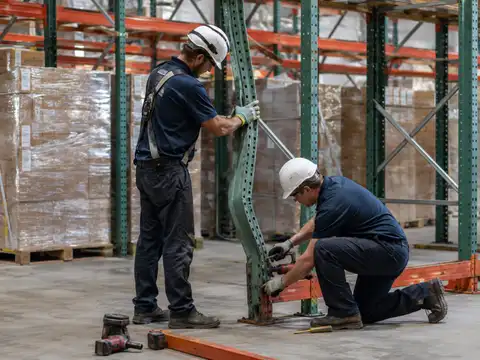
There is no credible single national repair rate per bay or pallet position. For one current real-world reference, Damotech publishes this May 2026 example:
$1,065 repair kit vs $2,130 upright replacementThat is indicative provider pricing for a standard 24-inch column repair, not a national average. The final decision depends on damage location, engineering, rack model, freight, unloading, installation and operational disruption.
A damaged pallet-rack upright can create a surprisingly expensive maintenance event even when the replacement steel itself costs only a few hundred dollars. Product may have to be removed, adjacent bays closed, lifts brought in, beams dismantled, matching parts sourced and crews scheduled around warehouse operations.
That is why the useful repair question is not simply “how much is a new upright?” It is what does it cost to return this exact location to service, and how likely is the same damage to happen again?
Why material price is misleading
The upright is often the cheapest part of the repair event
*Damotech's May 2026 indicative example for a standard 24-inch column repair. Its repair method assumes minimal unloading. Actual project pricing varies with rack configuration, location, freight, labor and repair scope.
A current repair-vs-replacement cost example
Damotech published an unusually transparent comparison in May 2026 for a standard 24-inch column repair. Its example prices an engineered DAMO PRO repair kit against replacing the upright with an OEM frame.
| Cost component | Engineered repair kit | OEM upright replacement |
|---|---|---|
| Parts | $440 | $300 |
| Freight | $500 | $1,200 |
| Equipment rental | $0 | $300 |
| Unload | $0 | $60 |
| Dismantle | $0 | $120 |
| Installation | $125 | $150 |
| Provider example subtotal | $1,065 | $2,130 |
The table is valuable because it exposes the cost stack. The repair-kit part is actually more expensive than the replacement upright in Damotech's own example: $440 versus $300. The total repair event is cheaper because the provider assumes much lower freight and almost no unloading, equipment rental or dismantling.
Damotech is a rack-repair manufacturer and installer comparing its own engineered product with OEM replacement. Treat the numbers as a transparent commercial case study—not as a neutral national price survey. Obtain project-specific bids.
Retail upright prices show why “the frame only costs $300” is misleading
Current August 2026 retail listings reinforce the same point. Global Industrial currently lists several pallet-rack upright frames from roughly $170 to $320 for common bolted and welded configurations, while a heavier 16-foot structural frame example is about $446.
Those are material prices. They do not include identifying the exact compatible frame, shipping a long steel component, unloading pallets, disassembling the bay, removing anchors, installing the replacement or returning product to storage.
A $300 upright can become a $2,000 maintenance event
If the part costs $300 but freight, access equipment, product handling, dismantling and labor add another $1,500–$2,000, procurement achieved little by negotiating $40 off the frame. The real saving comes from reducing the work required to restore the bay.
The first action after rack damage is not getting a repair quote
RMI's rack-repair guidance begins with assessment. When damaged rack is discovered, the affected structure should be isolated and a qualified professional rack engineer should evaluate the system before the repair solution is selected.
RMI's updated repair guideline describes the process as damage assessment, reporting and recordkeeping, development of an engineered repair or replacement solution, and proper installation of that solution.
That sequence matters financially too. Ordering a repair kit before establishing whether the surrounding frame is sound can turn a small repair purchase into wasted material.
Repair kits are primarily an upright-damage solution
Forklift impacts frequently damage the lower portion of aisle-facing rack columns. Engineered repair kits are designed around that pattern: the damaged lower section can be reinforced or removed and replaced with engineered steel while much of the original frame remains in place.
Damotech's May 2026 guidance describes engineered repair as particularly well suited to localized damage in the lower 8–12 feet when the remainder of the frame is structurally sound.
RMI does not endorse repairing every damaged upright. It says the decision follows professional assessment, and replacement can be the better solution when an identical component is readily available or damage is too extensive for a repair.
When repair is usually economically attractive
Repair deserves serious consideration when:
- damage is localized near the lower portion of an upright;
- the surrounding frame remains suitable for continued service;
- unloading the bay would be operationally disruptive;
- the exact OEM frame has a long lead time;
- the damaged location has experienced repeat forklift impacts;
- an engineered repair kit is available for the specific configuration;
- the rack still has substantial remaining useful life.
RMI explicitly states that, depending on rack style and damage type, an engineered repair kit can be considerably less expensive than replacing the complete frame.
When replacement is usually stronger
Replacement moves ahead when:
- damage extends high through the frame;
- multiple columns or braces are compromised;
- the overall frame geometry is distorted;
- corrosion or deterioration affects more than one local area;
- the exact OEM component is already stocked on site;
- the rack is near a broader replacement or reconfiguration project;
- repair cost approaches the total cost of replacement.
RMI's October 2024 guidance specifically notes that replacing damaged parts with identical new components can sometimes be the more economical solution. Some warehouse operators stock spare uprights and beams for that reason.
Spare uprights can completely change the economics
The Damotech comparison uses $1,200 of freight for an OEM replacement upright. A warehouse that already owns the exact compatible spare frame does not incur that sourcing scenario.
RMI recommends considering spare components as part of the original rack purchase. Ordering them with the system can reduce unit cost and eliminate manufacturer lead time when damage occurs later.
Replacement with an on-site spare
Take Damotech's illustrative OEM scenario and remove the $1,200 freight line because the exact frame is already in the maintenance inventory. The comparison shifts dramatically. Repair may still reduce unloading and dismantling, but replacement is no longer carrying the same logistics penalty.
This is why “repair is always cheaper” is not a credible rule. Maintenance inventory, rack type and site logistics can change the answer.
Downtime can be more valuable than the steel
Damotech currently states that its engineered column repairs typically install in roughly 30–60 minutes, while OEM upright replacement can take several hours to days per upright depending on rack levels and interference such as sprinkler infrastructure.
RMI also notes that in certain engineered repair situations, specialized support equipment can allow the work to proceed without fully unloading the rack. That is not permission to leave product loaded during any repair; it is an option that depends on the specific engineered procedure.
The economic value can be substantial in a high-throughput facility. A blocked bay may remove only a few pallet positions, but closing both sides of a busy aisle or moving dozens of pallets can consume far more labor than the repair itself.
Calculate rack-repair downtime explicitly
Add these operating costs to the repair quote:
- labor to unload product;
- temporary storage space;
- additional forklift travel;
- lost pallet positions while the bay is out of service;
- night/weekend premium labor;
- aisle closure and traffic rerouting;
- reloading and inventory verification;
- supervision and safety setup.
These costs are site-specific, which is why they should not be hidden inside a universal “repair cost per upright.”
A simple downtime example
The $500 repair difference can disappear in one shift
Repair option A costs $1,500 and closes the location for one hour. Replacement option B costs $1,000 but requires six hours of unloading, aisle restrictions and reloading. If the five extra hours consume more than $500 of internal labor and operational capacity, the higher contractor invoice can still be the cheaper total event.
Beam damage is a different repair decision
A damaged horizontal beam does not automatically need an upright repair kit. When the rack is unmodified and the exact OEM beam is available, replacement with an identical compatible component can be straightforward.
RMI emphasizes that replacement components should match the original design configuration and construction. Mixing rack components based solely on appearance or “teardrop” style can create an uncertain structural system.
For procurement, the useful question is whether the correct beam can be identified and sourced quickly. If it can, beam replacement may be simpler than attempting a field repair.
Bracing and baseplate damage can expand the scope
A forklift strike may deform more than the front column. Horizontal or diagonal braces, baseplates and anchor locations can also be affected. Damotech offers repair systems for single legs, double legs and damaged bracing precisely because the repair scope changes with the damaged components.
The more of the frame geometry that is compromised, the weaker a simple “price per post” budget becomes. A complete frame replacement can become the cleaner engineering and commercial solution.
Field welding is not the cheap shortcut it appears to be
Cutting a plate and welding it onto a damaged column can look inexpensive from a maintenance perspective, but RMI cautions that field welding introduces additional risks and requirements. Bolted engineered repair kits avoid ignition hazards and some of the environmental and weld-quality issues associated with performing structural welding inside a warehouse.
If welding is proposed, the repair still needs appropriate engineering and qualified execution. “Our maintenance technician can weld it” is not a cost strategy for structural rack.
The ability to physically straighten, weld or reinforce steel does not establish that the repaired rack has recovered the intended structural behavior and load capacity.
Straightening a bent upright is also not a default repair
Source Equipment's February 2026 repair guidance, citing RMI principles, says straightening should only be considered when a supervising storage-rack design engineer can confirm that the component retains the required steel properties and load-bearing capacity.
Bending a damaged column back until it looks straight is therefore not equivalent to restoring an engineered structure.
Repair should restore capacity—not “upgrade” one leg in isolation
RMI explains that engineered repair kits must match the existing rack configuration and restore the original load capability. Damotech states the same principle for its current kits: the repaired upright returns to its manufacturer-specified capacity rather than becoming a higher-capacity rack system simply because heavier steel was installed at the bottom.
This matters because the capacity of the rack depends on the entire system: columns, bracing, beam elevations, loads, anchors and configuration work together.
Repeated damage changes the repair-vs-replace calculation
A rack location hit once is a component problem. A row end hit every year is a systems problem. Replacing the same upright repeatedly may restore capacity each time without addressing the traffic pattern that keeps creating the repair bill.
Damotech's current repair products incorporate heavy-impact protection into the repaired section and use that as a major part of their lifecycle-cost argument. RMI separately recommends tracking damage history because repeated impacts can identify areas where additional protection or operational changes are required.
Three hits at the same row end
If a warehouse pays $2,000 every few years to replace one exposed upright, the correct next purchase may not be another identical frame. An engineered repair plus a protection or traffic-control strategy can be economically stronger if it prevents the fourth event.
The 10-year comparison is where vendor assumptions matter most
Damotech extends its May 2026 example over ten years by assuming the OEM-replaced upright suffers two additional impact incidents at the same location. Under that assumption, its repair-kit total remains $1,065 while repeated OEM replacement reaches $6,390.
That is useful as a sensitivity scenario, but the assumption is doing much of the work. If the location is never hit again, the 10-year difference is much smaller. If it is hit five more times, the value of prevention becomes much larger.
A warehouse should therefore use its own damage history rather than copy the provider's recurrence assumption.
A better repair ROI formula
For a high-risk location, compare:
Expected 5-year rack-damage cost
Initial corrective work + expected repeat incidents + downtime + product handling + protection + inspection / engineering
Build the formula separately for engineered repair and OEM replacement. The lower five-year expected cost is a better decision metric than the lowest first invoice.
Repairing ten uprights is not ten times one repair
Multi-location work can create economies in travel, engineering, mobilization and installation. It can also create much larger operational disruption if many adjacent bays need to be unloaded simultaneously.
For a batch repair project, ask contractors to separate:
- engineering / site assessment;
- repair kit or replacement component cost;
- freight;
- crew mobilization;
- per-location installation;
- lifting / support equipment;
- unloading requirements;
- aisle closure assumptions;
- anchors and baseplate work;
- rack protection;
- documentation and closeout.
This structure makes it easier to see whether a vendor's “volume discount” comes from cheaper parts or simply assumes the warehouse handles more of the unloading and traffic management itself.
Repair cost in a freezer can be a different project
Cold-storage work adds operating and access constraints. Product movement can be more disruptive, maintenance crews work in a harsher environment and the rack may have corrosion-protection requirements that differ from a dry warehouse.
Damotech currently states that its bolt-on repair systems can be engineered for cold storage and installed without on-site welding, which can be particularly useful where a hot-work process would create additional operational complications.
The cost comparison should still be site-specific. A freezer location with a full spare upright stored on site can have different economics from a dry warehouse waiting months for an obsolete OEM frame.
Old or unidentified rack can make repair more valuable—or more complicated
An older rack system may have discontinued components. That can make exact OEM replacement slow or impossible, increasing the appeal of an engineered third-party repair.
At the same time, missing documentation makes engineering more important. RMI says undocumented or reconfigured systems should be evaluated as complete structures rather than assuming a visually matching part will restore capacity.
Repairing obsolete rack can therefore be economical, but only after the rack is identified and its configuration understood well enough to engineer the solution.
What a useful rack-repair quote should show
A procurement-ready quote should identify:
- exact damaged location;
- rack manufacturer / profile where known;
- damage being corrected;
- repair kit or OEM component proposed;
- engineering included;
- repair length / configuration;
- anchor and baseplate scope;
- whether beams or pallets must be unloaded;
- required lifts or support equipment;
- freight;
- installation labor;
- aisle closure duration;
- repair documentation;
- warranty;
- optional impact protection;
- explicit exclusions.
Without those details, two repair quotes cannot be compared reliably.
Three numbers to track after every repair
1. Total event cost
Parts + freight + labor + operational handling + protection.
2. Hours the storage location was unavailable
This exposes the real operating burden of different repair methods.
3. Repeat damage by location
This identifies row ends or aisle sections where protection, layout or forklift behavior needs to change.
After a year, those three metrics are more valuable than a folder full of disconnected repair invoices.
What not to do after rack damage
- do not continue loading a visibly damaged location while waiting for the annual inspection;
- do not hammer or bend an upright straight and call it repaired;
- do not weld reinforcement without engineered direction;
- do not mix unidentified components because the connector appears similar;
- do not increase beam loads because a repaired column looks stronger;
- do not treat repainting as evidence that structural capacity was restored.
The cheap shortcut is only cheaper if it restores the rack properly. Structural uncertainty is deferred cost, not savings.
The practical repair-vs-replace decision
| Condition | Usually investigate first |
|---|---|
| Localized lower-column damage | Engineered repair kit |
| Exact spare OEM frame already on site | OEM replacement |
| Frame distorted high up | Replacement / engineering review |
| Several braces and columns damaged | Replacement / broader repair design |
| Repeated impact at same location | Repair + impact-prevention strategy |
| OEM rack discontinued | Engineered third-party repair assessment |
| Damage history or capacity unknown | Engineer assessment before pricing the fix |
Frequently asked questions
How much does pallet rack repair cost?
There is no reliable national flat rate. One current May 2026 Damotech example prices a standard 24-inch engineered column repair at $1,065 and OEM upright replacement at $2,130 under its stated assumptions. Actual project cost varies with configuration, freight, labor and operational disruption.
How much does a replacement pallet-rack upright cost?
Material-only retail examples in August 2026 range from roughly $170 to $450 for several common and heavy-duty frame sizes. Delivered and installed replacement cost can be much higher because the bay may need unloading, dismantling and reassembly.
Is repairing an upright cheaper than replacing it?
Often, but not always. RMI says engineered repair kits can be considerably less expensive than complete frame replacement depending on rack style and damage. Replacement can be more economical when an identical spare component is already available or damage is too extensive for a local repair.
How long does a pallet rack repair take?
RMI says an experienced professional can install some bolted repair kits in as little as 30 minutes, depending on damage type and location. Damotech currently states approximately 30–60 minutes for its engineered column repairs.
Can rack be repaired without unloading pallets?
In certain engineered situations, yes. RMI notes that specialized support devices can sometimes allow repair without fully unloading the system, but only when the professional engineer overseeing the repair determines that procedure is appropriate.
Should a bent upright be straightened?
Not as a generic maintenance fix. Straightening requires engineering approval confirming that the repaired component can retain the necessary material properties and load-bearing capacity.
Can I weld a plate onto a damaged rack upright?
Structural field welding is not a casual repair. It requires appropriate engineering, qualified welding and control of hot-work and weld-quality risks. Bolted engineered repair kits avoid many of those issues.
When should the whole upright be replaced?
Replacement becomes more likely when damage extends high through the frame, multiple structural members are compromised, the frame is distorted, or an identical OEM replacement is readily available and economically attractive.
Sources and methodology
Warehouse Fieldbook reviewed current May 2026 repair-vs-replacement guidance from Damotech, February 2026 repair guidance from Source Equipment, current retail upright prices and Rack Manufacturers Institute repair guidance. Vendor pricing examples are identified as vendor examples rather than converted into a national average. Technical repair decisions are grounded in RMI guidance and framed as engineering decisions rather than DIY instructions.
- Damotech — May 2026 repair vs OEM replacement cost comparison
- Damotech — engineered repair-kit installation and operating characteristics
- Source Equipment — February 2026 repair-vs-replace decision framework
- Rack Manufacturers Institute — engineered repair-kit guidance and economics
- Rack Manufacturers Institute — repair vs identical component replacement
- Rack Manufacturers Institute — damaged-rack assessment and repair process
- Global Industrial — current upright-frame retail pricing example
- Global Industrial — current heavy structural upright-frame pricing example