
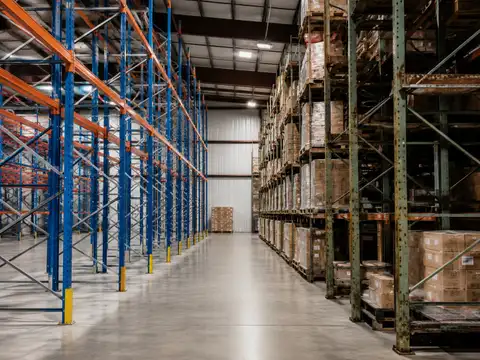
For a standard selective-rack project, used equipment can be one of the easiest ways to reduce capital cost. Current 2026 market references show:
Used selective: roughly $20–$60 per positionComparable new selective rack commonly starts around $50–$200 per position depending on configuration. But the used price is usually material-only, and the cheapest lot is not necessarily the cheapest installed warehouse.
There is a simple version of the new-versus-used decision: buy used because steel does not need to be shiny to hold inventory. There is also a more useful version: buy used when the available rack already matches the dimensions, capacity, quantity and condition your layout requires.
That second sentence is where most of the economics live. Pallet rack is modular, but it is not interchangeable in the casual sense of the word. Different manufacturers use different beam connectors, frame profiles and capacities. An attractive liquidation lot can save tens of thousands of dollars if it fits the project—or force a compromised layout and expensive freight if it does not.
Decision guide
Used wins on price. New wins on control.
Compare delivered and installed cost per usable pallet position, not the seller's material price. Used rack only saves money if it still produces the layout and capacity you need.
What used pallet racking costs in 2026
Conesco's March 2026 U.S. cost guide publishes new and used prices by rack type. For selective roll-formed rack, it gives approximately $50–$200 new versus $20–$50 used per pallet position. For selective structural rack, it gives roughly $80–$250 new versus $30–$75 used.
Warehouse Cubed's current used-rack guide provides another useful market check. It says used selective systems commonly land around $40–$60 per pallet position, with used uprights roughly $50–$130+ each and standard eight-foot beams about $15–$35 each. It explicitly notes that those figures are material-only and exclude freight and installation.
| Rack type | New / position | Used / position | Published savings potential |
|---|---|---|---|
| Selective roll-formed | $50–$200 | $20–$50 | 50–70% |
| Selective structural | $80–$250 | $30–$75 | 40–60% |
| Double-deep | $80–$300 | $40–$100 | About 50% |
| Drive-in | $115–$500 | $85–$160 | 30–50% |
| Push-back | $150–$450 | $100–$250 | 40–60% |
| Pallet flow | $200–$500 | $120–$300 | 40–50% |
These are supplier-published planning ranges, not a national transaction database. They are useful because they show an important pattern: the used market is most straightforward for ordinary selective rack. Dynamic and high-density systems still trade used, but the component set is more specialized and should be evaluated more carefully.
Compare delivered material, inspection, sorting, missing components, installation and the number of usable positions the final layout creates. A 60% discount on steel can become a much smaller project-level saving.
A 1,000-position example shows why used gets attention
Suppose a warehouse needs 1,000 selective pallet positions. At $100 per position, new material is a $100,000 purchase. At $45 used, the material subtotal is $45,000—a $55,000 difference before freight and installation.
The obvious $55,000 saving
New material: $100,000.
Used material: $45,000.
Headline saving: $55,000.
If the used lot then adds $12,000 of extra freight, $6,000 of sorting and replacement components, and $5,000 of additional installation handling, the practical saving falls to $32,000. Still attractive—but very different from the original headline.
The point is not that used rack hides inevitable extra costs. A nearby, well-sorted liquidation lot can be extremely economical. The point is to calculate the advantage at the project level rather than the seller's yard gate.
Freight can erase the used-rack bargain
Pallet rack is heavy, bulky steel. Warehouse Cubed specifically warns that shipping used rack across the country can destroy the apparent saving and recommends sourcing inventory near the installation when possible.
This is one of the unusual markets where geography can matter almost as much as condition. A slightly more expensive lot 80 miles away may be cheaper delivered than a bargain liquidation several states away.
Conesco's pricing guide also states that its published rack figures are FOB, meaning freight from the seller's location is the buyer's responsibility. That detail is easy to miss when comparing a used quote with a new delivered proposal.
$5 cheaper per position can lose after shipping
A local used lot at $50 per position costs $25,000 for 500 positions. A distant lot at $45 costs $22,500. The material saving is only $2,500. If long-distance freight adds more than that difference, the “cheaper” rack is already more expensive before installation.
Used rack is inventory, not a custom product
New rack can be specified around the warehouse: exact upright heights, beam lengths, frame depths, capacities and quantities can be ordered to suit the intended layout. Used equipment reverses the process. The available lot already exists, and the designer has to decide whether it fits.
That distinction becomes important in buildings where column spacing, sprinkler elevations, clear height or aisle geometry leave little tolerance. A rack that is 18 inches shorter than the ideal configuration can waste a full storage level across hundreds of bays.
Saving $30 per position on the equipment is not attractive if the compromise reduces usable capacity enough to require another aisle or another lease bay.
Layout fit is the hidden financial test
Before pricing any used lot, build the desired storage concept without regard to the available inventory. Establish the approximate frame height, depth, beam length, levels and pallet-position target the operation actually needs.
Then test the used inventory against that requirement. If it fits closely, the discount is real. If the layout has to be redesigned extensively around the lot, calculate the cost of lost pallet positions.
Cheaper steel, 120 fewer positions
New rack costs $120,000 and creates 1,000 usable positions. A used lot costs only $65,000 but its frame and beam configuration creates 880 positions in the same building. The $55,000 equipment saving has also removed 120 storage locations. The right decision now depends on the value of those positions, not the steel discount.
Condition is not a cosmetic issue
Used rack has a service history. It may have spent ten years in a quiet reserve area or ten years beside a high-traffic shipping lane. Paint condition alone does not tell you which.
Conesco advises buyers to look for straight uprights, undamaged beams, intact footplates and legible load-capacity information, and to avoid visible bending, cracks or significant corrosion. Those are sensible screening points, but a professional condition assessment should go beyond a quick visual impression when the system's history is uncertain.
RMI's rack-damage guidance is relevant here even though it was written around installed systems and repair decisions. RMI emphasizes formal assessment of rack damage and, where structural repair or replacement is involved, professional engineering input. Used rack with questionable structural damage should not be treated as discounted inventory that simply needs repainting.
Damage that matters most
The highest-value components to inspect carefully are the ones that establish structural capacity and connections:
- upright columns for bends, twists or impact damage;
- horizontal and diagonal frame bracing;
- baseplates and anchor areas;
- beam connectors and locking devices;
- beams for permanent deformation;
- welds for cracking or damage;
- corrosion, especially where section loss may have occurred;
- dynamic-system rails, carts or rollers where applicable.
The objective is not to teach a buyer to certify steel by eye. It is to identify why used inventory from a reputable supplier with traceable information deserves a different value than an undocumented pile of components from a warehouse clearance.
Compatibility is where mixed used rack gets risky
Selective rack looks similar across brands, but beam-to-upright connections are manufacturer-specific. Some product families are commonly encountered in the same market and may have compatible-looking geometry, but visual similarity is not enough to establish structural compatibility.
Conesco notes that mixing can be possible in some roll-formed selective systems but specifically advises verifying compatibility before ordering. Structural rack is less forgiving. For a serious project, identify the manufacturer and system rather than assuming “teardrop rack is teardrop rack.”
A warehouse should know what frames and beams it owns, what capacities apply and which components belong together. Saving money by mixing undocumented pieces can make future inspections, repairs and replacements much harder.
Documentation can be worth paying more for
A new rack project normally begins with a defined specification and therefore has a clearer path to capacity information, drawings and manufacturer documentation. Used equipment can also have good documentation—but buyers need to ask for it.
Useful records include manufacturer identification, component model/profile, rated capacities, prior drawings where available, installation information and any documented repairs. The more engineered the system, the more valuable that history becomes.
Documentation matters later. If a beam is damaged five years from now, knowing exactly what system is installed makes it much easier to source a compatible replacement and evaluate the rack correctly.
Used selective rack is a different decision from used pallet flow
Ordinary selective rack has relatively few component types: frames, beams, anchors and accessories. The secondary market is deep, and suppliers can often assemble large quantities of common configurations.
A used push-back or pallet-flow system contains specialized moving components. Carts, rails, rollers, brakes and lane geometry need to match the new application. Conesco's March 2026 guide still shows meaningful used discounts for these systems, but the inspection and configuration burden is higher.
My threshold for buying used would therefore be lower for common selective rack and higher for dynamic or heavily engineered storage. The more proprietary components involved, the more the used discount needs to compensate for compatibility, replacement-parts and commissioning risk.
New rack wins when the building is expensive
This sounds backwards because new rack costs more. But an expensive warehouse places a high value on every lost pallet position. If a custom new design can exploit clear height, unusual column spacing or a narrow-aisle plan materially better than available used inventory, paying more for steel can reduce the total occupancy cost.
Consider a building where custom frames add one extra storage level across 600 positions. If used rack cannot reach that elevation efficiently, the new system may create hundreds of positions without adding floor area.
This is why the selective pallet racking cost guide emphasizes cost per usable position rather than cost per bay. Customization has economic value when it extracts more capacity from a constrained building.
Used rack wins when the requirement is ordinary
Used selective rack is particularly compelling when the job is boring—in the best sense. Standard pallets, ordinary beam lengths, common frame depth, moderate height and a rectangular warehouse create exactly the conditions in which large secondary-market inventories can fit without compromising the layout.
The buyer gets little benefit from paying a factory to produce a unique configuration if a clean, documented used lot nearby already provides what the operation needs.
This is also where speed can matter. Conesco states that used inventory is typically available for delivery in roughly two to three weeks in its current market guidance. New-system lead times vary with manufacturer and market conditions, so do not treat any generic lead-time estimate as a promise; compare the actual availability offered by bidders.
Cash flow can matter more than percentage savings
A growing warehouse may not be choosing between a perfect new system and an identical used one. It may be choosing between 600 new positions today and 1,000 used positions within the same capital budget.
If the used system fits the operation, freeing $50,000 or $100,000 can fund forklifts, dock work, conveyors or inventory instead. That opportunity cost is legitimate. Capital equipment does not need to be new simply because the business can afford it.
The opposite is also true: tying up cash in a bargain system that limits capacity or needs early replacement is not frugal. The objective is not minimum purchase price; it is maximum economic usefulness per dollar invested.
Installation can narrow the gap
Used rack still has to be staged, assembled, aligned and anchored. If components arrive organized and in good condition, installation can be straightforward. If they arrive mixed, crews can spend paid time sorting beams, matching frames, rejecting damage and locating missing hardware.
Warehouse Cubed notes that installation cost depends on layout complexity, floor condition and whether existing rack must first be dismantled. Conesco's 2026 cost guide publishes a very broad $20–$250 per-position installation range across rack projects.
For a direct installation-cost discussion, use the pallet rack installation cost guide rather than hiding labor inside the used-vs-new comparison.
Used rack can also be an environmental choice—but do not oversell it
Reusing serviceable steel avoids manufacturing a replacement system solely because the original owner no longer needs it. That is a sensible circular-use benefit. It should not be used to excuse poor condition or an inefficient layout.
A rack system that has to be shipped across the country, heavily modified and replaced early is not automatically the better environmental or financial choice. Reuse is strongest when the equipment is suitable, local and capable of a long second service life.
A practical used-rack buying process
- Design the requirement first. Establish frame depth, approximate height, beam length, load and position count.
- Search by system, not just price. Identify manufacturer, connection style, capacity and quantity.
- Inspect condition. Reject damaged structural components rather than budgeting cosmetic repair.
- Verify compatibility and documentation. Know what components belong together and what capacities apply.
- Price delivered cost. Add freight before ranking sellers.
- Test the real layout. Count usable positions created by the actual used inventory.
- Add installation and missing accessories. Include anchors, guards, decking and replacement parts.
- Compare the finished project with new. Only then calculate the saving.
When I would buy new
New rack is usually the stronger option when:
- the layout depends on exact custom dimensions;
- clear height is valuable enough that losing a level would be expensive;
- loads are unusually heavy or structurally demanding;
- the system is dynamic, proprietary or highly engineered;
- complete documentation is a high priority;
- the business expects to standardize future expansions around one system;
- available used inventory is distant, fragmented or poorly documented.
When I would seriously prefer used
Used rack can be the economically better choice when:
- the project uses common roll-formed selective rack;
- a large matching lot is available locally;
- the condition and identity of components are clear;
- the layout loses little or no usable capacity;
- the warehouse needs capacity quickly;
- capital preservation has meaningful value elsewhere in the operation.
In those conditions, paying factory-new prices can add little operational value. The rack's job is to provide safe, suitable storage capacity—not to look untouched.
Frequently asked questions
How much cheaper is used pallet racking?
Current 2026 U.S. supplier guidance shows approximately 30–70% material savings depending on rack type. Used roll-formed selective rack shows some of the largest discounts, with one guide publishing $20–$50 used versus $50–$200 new per position.
What does used selective pallet rack cost?
Conesco publishes roughly $20–$50 per position for used roll-formed selective rack. Warehouse Cubed reports many current configurations around $40–$60 per position. Freight and installation are normally additional.
Is used pallet racking safe?
Used rack can be suitable for continued service when the components are correctly identified, compatible, appropriately designed for the new application and in acceptable condition. Damaged or questionable structural components require proper assessment; an online article cannot certify used steel.
Can I mix new and used pallet rack components?
Sometimes, but compatibility must be verified rather than assumed from appearance. Beam connectors and structural details vary by manufacturer and system.
Does used rack come with capacity labels?
It may, but do not assume every used lot retains complete labeling or documentation. Ask for manufacturer/system identification and capacity information before purchase, particularly where the history of the equipment is unclear.
Is used high-density rack worth buying?
It can be, but push-back, pallet-flow and other dynamic systems require more scrutiny because carts, rails, rollers and other specialized components have to match the intended configuration and load.
What matters most when comparing new and used?
Compare delivered and installed cost per usable pallet position after layout, freight, condition, missing components and installation are included. That metric captures more of the real warehouse economics than material price alone.
Sources and methodology
Warehouse Fieldbook reviewed current 2026 U.S. supplier pricing for new and used rack, current secondary-market component ranges and RMI guidance on assessment of damaged storage rack. Pricing is presented as supplier-published planning ranges, not as a national transaction average. Structural condition and compatibility are treated as professional assessment questions rather than something an online buyer checklist can certify.
- Conesco — March 2026 new vs used cost ranges by rack type
- Warehouse Cubed — current used selective rack and component pricing
- Warehouse Cubed — new vs used rack pricing by bay
- East Coast Storage Equipment — new rack pricing and used-market context
- Rack Manufacturers Institute — assessment and repair/replacement guidance
- RMI Rack Safety — professional assessment of damaged structural rack