
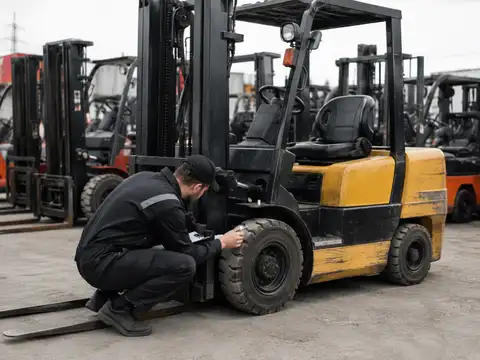
When the application is light or secondary and the condition is verifiable.
Used equipment can deliver strong value when utilization is modest, the truck is correctly specified, the service path is clear and the acquisition discount remains meaningful after immediate catch-up work.
Best case: known history + correct spec + independent/dealer inspection + parts support + measurable ownership-cost advantage.When you need used economics with more controlled technical risk.
Factory/dealer reconditioned equipment can add systematic inspection, component replacement and written warranty. The actual program and exclusions matter more than the word “certified.”
Best case: warranty scope, inspection process and service support are documented before the PO.When the truck is high-use, poorly documented or mismatched to the application.
A low asking price cannot repair the wrong mast, capacity, truck type, attachment rating, battery architecture, hazardous-location designation or service-support problem.
Worst case: unknown history + high duty + obsolete parts + missing plate + major immediate repairs.Used equipment is worth buying only after three gates
- Application gate: would you select this exact model/spec if it were new?
- Integrity gate: can you verify condition, history, markings, attachments and safety-critical systems?
- Economic gate: does used remain cheaper after reconditioning, maintenance, downtime and resale?
Used vs new ownership gap
Used Equipment Acquisition Margin Calculator
Compare two user-defined ownership scenarios. No market price, useful life, repair rate, depreciation curve, battery life or resale percentage is preloaded.
Purchase + freight/setup/commissioning.
Purchase + reconditioning + power catch-up + setup.
Enter comparable purchase assumptions.
Upfront + annual maintenance/downtime − entered resale value.
Upfront + annual maintenance/downtime − entered resale value.
Enter comparable ownership assumptions.
Used annual maintenance+downtime minus new annual maintenance+downtime.
Break-even allowance created by day-one/resale economics over the entered holding period.
Used purchase price vs new purchase price only. It ignores reconditioning and ownership cost.
Those depend on the buyer, transaction and tax/accounting treatment. Add them in a finance model when they are decision-relevant rather than hard-coding them here.
Toyota's current 2026 guidance puts utilization near the center of the decision
Toyota's April 13, 2026 Forklift Buying Guide says used forklifts can be a strong option when equipment is needed only a few hours per day.
Toyota says if the forklift will run four or more hours per day, consider a new model.
Toyota's four-hours-per-day statement is current manufacturer purchasing guidance, not an OSHA threshold, industry standard or universal economic cutoff. A low-hour but mission-critical truck can justify new equipment; a well-supported used truck can also perform more intensive duty when its condition and economics support it.
Toyota's current used-equipment page broadens the same logic
Toyota currently positions used forklifts / warehouse equipment especially for:
- secondary shifts;
- seasonal support;
- lighter-duty applications;
- flexible fleet expansion;
- faster equipment availability.
Its current used inventory can include:
- electric forklifts;
- reach trucks;
- pallet jacks;
- order pickers;
- internal-combustion forklifts.
Toyota also explicitly says inspection and reconditioning processes may vary by dealer and equipment type.
That is why “dealer used” is not enough due diligence by itself.
Ask for evidence before inspecting the paint
| Document / evidence | What you want to verify | Why it changes the deal |
|---|---|---|
| Model / serial / data plate | Truck identity, rated capacity, mast/load information and attachments match the actual unit. | Wrong/missing plate creates a capacity/safe-operation problem—not a cosmetic defect. |
| Hour meter / telemetry | Hours are plausible relative to age, wear, controller data and service records. | An hour meter is useful evidence, but should not be the only condition signal. |
| Service history | PM cadence, recurring failures, major component replacement, impacts and deferred repairs. | History converts “unknown used risk” into asset-specific repair exposure. |
| Attachment records | Attachment is identified and capacity/marking implications are correctly addressed. | Clamps, sideshifters and other front-end attachments can change effective capacity. |
| Battery / charger records | Battery age/test condition, chemistry, voltage, Ah, charger compatibility and ownership/inclusion. | An electric truck can be cheap while its power system is near a major replacement event. |
| Warranty | Start date, term, hours, major components, wear exclusions, labor/travel and claim process. | “Certified” is useful only when the written coverage has economic value. |
| Parts / service support | Local technician coverage, parts availability, obsolete components and lead times. | Purchase price cannot compensate for a critical asset that cannot be repaired quickly. |
OSHA makes the data plate a deal-critical item
OSHA 1910.178(a)(6) says the user shall ensure all nameplates and markings are in place and maintained in a legible condition.
OSHA's sample powered-industrial-truck checklist also calls for checking that the nameplate information matches:
- model;
- serial number;
- attachments.
Resolve truck identity, attachment configuration and capacity documentation before relying on the unit for production. If the used truck has been modified, the documentation question can become more important than the cosmetic condition.
Unauthorized modifications can turn a cheap truck into an unusable truck
OSHA 1910.178(a)(4) says modifications and additions that affect capacity and safe operation shall not be performed by the customer/user without manufacturer's prior written approval, with plates/tags/decals changed accordingly.
OSHA 1910.178(a)(5) separately addresses non-factory front-end attachments and truck marking.
Inspect the used equipment in four layers
Look for cracks, deformation, poor repairs, weld evidence, mast play, fork wear and impact damage. Investigate repairs rather than assuming fresh paint means good structure.
Test cold and warm. Listen for unusual noise and verify smooth controlled operation under representative conditions.
Wear items create immediate catch-up cost. Leaks or mismatched wear can reveal deeper neglect.
Verify the actual truck and attachment configuration, not merely that the unit starts and drives.
Toyota's inspection checklist identifies many of the same high-value checks
Toyota's current pre-operation checklist includes:
- fluid levels;
- leaks, cracks and visible defects;
- mast chains / chain tension;
- tire condition;
- fork condition at the heel / retaining pin;
- load backrest;
- legible safety decals / nameplates;
- operator manual;
- seat belts / horns;
- brakes / steering / operational controls.
That checklist is designed for operating inspection, not a complete pre-purchase condition assessment.
Use it as a minimum operating screen, then add technician condition testing.
Test the truck in the application you are actually buying it for
Toyota's April 2026 buying guide recommends a demo or short-term rental before purchase.
For used equipment, that principle is especially valuable.
If practical and permitted by the seller or dealer, validate:
- aisle fit;
- lowered mast height through doors/trailers;
- lift height;
- rated capacity with actual attachment;
- ramp / dock transition;
- turning / visibility;
- operator ergonomics;
- battery runtime / charging fit for electric equipment.
Hours matter, but condition and duty history matter more
Two trucks with the same hour meter can have very different remaining economic life.
Ask:
- were the hours single-shift or continuous?
- cold storage, freezer, dust or corrosive environment?
- smooth slab or yard / rough surface?
- frequent dock-plate impacts?
- heavy loads / high lift?
- attachment-intensive duty?
- operator impact history?
- PM performed on hours or calendar?
Hour meter is one variable in the condition model, not the model itself.
For electric used equipment, treat the battery as a separate asset
Toyota's current used equipment page specifically lists battery and tire assessments among services that may be available through dealers.
For an electric forklift, determine:
- is the battery included?
- chemistry / voltage / Ah?
- manufacture / in-service date?
- capacity test or diagnostic evidence?
- watering / damage history for flooded lead-acid?
- BMS / diagnostic status for lithium?
- charger included and compatible?
- connector / cable condition?
Then model likely battery catch-up with Forklift Battery Replacement Cost and charger scope with Forklift Battery Charger Cost.
Used, dealer-prepared and factory-reconditioned are not the same product
Lowest structure around the transaction.
Condition may be good, but the buyer carries more responsibility for inspection, history verification and post-purchase catch-up work.
Professional inspection and support can reduce uncertainty.
Toyota says dealer services may include inspection, maintenance evaluation, reconditioning, battery/tire assessment, performance testing and service-history review.
A defined rebuilding process can shift more condition risk back to the seller/manufacturer.
Crown's current Encore program says structural/electrical components, drive units, hydraulics and brakes are systematically inspected, tested and replaced as needed.
Crown's current Encore program gives a concrete reconditioned benchmark
Crown currently says every Encore lift truck receives extensive operational and safety inspections.
Crown currently publishes:
- 1-year warranty on major components with no hour limit;
- 90-day warranty on wearable parts.
Crown also says Encore trucks are eligible for factory service and support.
Replacement parts and prior repairs need scrutiny
OSHA 1910.178(q)(5) requires replacement parts to be equivalent as to safety with those used in the original design.
OSHA 1910.178(q)(6) also restricts alterations from the original configuration, with specific provisions for permitted changes.
During inspection, investigate:
- nonstandard counterweights;
- welded structural repairs;
- non-original attachment installations;
- disabled interlocks;
- substituted electrical components;
- missing guarding;
- removed warning labels.
Used does not remove the daily examination requirement
OSHA 1910.178(q)(7) says industrial trucks shall be examined before being placed in service, at least daily.
For round-the-clock use the examination is required after each shift.
If the truck is unsafe, OSHA requires removal from service until safe operating condition is restored.
Model immediate catch-up before signing the PO
Common day-one used costs can include:
- tires / load wheels;
- forks / chains / rollers;
- hydraulic hoses / seals;
- brakes / steering components;
- seat / restraint / safety devices;
- PM catch-up / fluids / filters;
- battery replacement or rehabilitation;
- charger / connector changes;
- attachment correction / plate documentation;
- freight and commissioning;
- operator familiarization/training for a different truck type.
Put these in the used scenario before comparing it with new equipment.
Maintenance history should change the price you are willing to pay
The Warehouse Equipment Maintenance Budget Planner gives a structure for translating service history into annual maintenance OPEX.
For a used asset ask:
- what has already been replaced?
- what keeps failing?
- what is currently due?
- what is deferred?
- what major components are original?
A truck with higher hours but recent documented major component work can be economically stronger than a lower-hour unit with unknown history.
Choose maintenance strategy at acquisition—not after the first breakdown
Use Preventive vs Reactive Warehouse Equipment Maintenance to classify the used asset by failure mode.
A low-cost redundant pallet jack can tolerate more reactive exposure than a single high-reach truck that gates an entire storage zone.
Where used equipment tends to fit best
Utilization is moderate, downtime has alternatives and immediate availability may be more valuable than receiving a factory-new unit.
Used can work when condition is excellent, warranty/service are strong and the ownership-cost margin remains meaningful.
A small purchase discount can disappear quickly if downtime, obsolete parts or major-component uncertainty is high.
When the used asking price is misleading
A used unit can look inexpensive while carrying:
- a near-end-of-life battery;
- no compatible charger;
- tires / forks / chains due now;
- unknown attachment capacity;
- obsolete control electronics;
- high parts lead times;
- no written warranty;
- freight that is material relative to purchase price;
- immediate PM / safety catch-up.
This is why the calculator reports both sticker discount and holding-period cost.
The break-even repair allowance is more useful than a generic “used saves X%” claim
Suppose used starts with a meaningful day-one advantage.
That advantage creates a finite allowance for extra annual maintenance and downtime.
If expected used repair/downtime exceeds that allowance over the holding period, the used deal loses its ownership advantage.
This is a cleaner decision than assuming used equipment always costs 20%, 30% or another invented percentage less to own.
Fixed conveyor and automation need a different used-equipment diligence level
The OSHA powered-industrial-truck rules above apply to covered industrial trucks, not automatically to every conveyor, sorter or fixed automation system.
For used fixed equipment add:
- controls / PLC obsolescence;
- safety guarding / controls engineering;
- layout compatibility;
- mechanical/electrical installation;
- software / controls licenses;
- integration with upstream/downstream equipment;
- OEM support / spare modules;
- commissioning / acceptance testing.
Used mobile equipment and used automation are not the same acquisition problem.
Used-equipment acquisition audit
- Exact application / duty defined.
- Required truck/equipment type confirmed.
- Required capacity.
- Load center / attachment requirements.
- Required lift height.
- Lowered mast / overhead clearance.
- Aisle / turning fit.
- Indoor/outdoor / tire type.
- Hazardous-location designation where applicable.
- Model / serial verified.
- Nameplate present and legible.
- Nameplate matches model / serial / attachment configuration.
- Modification history reviewed.
- Manufacturer approvals for capacity/safe-operation modifications reviewed.
- Attachment identification / truck markings reviewed.
- Hour meter / telemetry data captured.
- Hours checked against service records / wear.
- Service history obtained.
- Recurring repairs identified.
- Major component replacements identified.
- Open repair backlog identified.
- Frame / mast / carriage inspected.
- Forks / chains / rollers inspected.
- Hydraulic cylinders / hoses / leaks inspected.
- Steering / brakes / travel tested.
- Safety devices / interlocks / horn / restraint tested.
- Tires / wheels inspected.
- Battery condition test / age obtained where applicable.
- Charger compatibility / inclusion confirmed.
- Connector / cable condition checked.
- IC engine / fuel-system condition checked where applicable.
- Parts availability checked.
- Local technician support checked.
- Known obsolete components identified.
- Written reconditioning scope obtained.
- Written warranty obtained.
- Warranty wear/labor/travel/hour exclusions reviewed.
- Representative load / lift test completed where appropriate.
- Facility demo / fit trial completed where practical.
- Used purchase price.
- Immediate reconditioning cost.
- Battery/charger catch-up cost.
- Freight / commissioning cost.
- Annual used maintenance estimate.
- Annual new maintenance estimate.
- Downtime difference modeled only if supportable.
- Expected holding period selected.
- Used/new resale assumptions documented.
- Used ownership-cost advantage calculated.
- Break-even extra annual used burden reviewed.
- Financing/tax/accounting modeled separately if material.
Model the ownership gap, not just purchase price
The key used equipment question is not merely how much cheaper the asking price is.
It is whether the discount survives the holding period.
The calculator deliberately does not preload:
- a used-equipment discount;
- a new-equipment premium;
- expected useful life;
- maintenance multiplier;
- battery replacement date;
- downtime value;
- resale percentage.
All economic assumptions come from the specific equipment and buyer.
The decision rule
Buy used when you would choose the same equipment specification if it were new, the truck's identity/attachments/markings and service history are verifiable, the inspection exposes no unacceptable structural or safety issue, battery and charger catch-up is priced, parts/service remain supportable, and the ownership model still shows a meaningful advantage after higher expected maintenance and downtime. Pay more for reconditioned equipment only when the written rebuild process, warranty and support reduce risk enough to justify the premium. Walk away when the specification is wrong, modifications are undocumented, the data plate is unresolved, major systems are near replacement or the used discount is too small to absorb realistic repair uncertainty.
Frequently asked questions
When is a used forklift worth buying?
Used is strongest when utilization is moderate, the exact application fit is correct, condition/history are verifiable, support remains available and the purchase discount survives immediate repairs plus expected ownership costs.
How many hours is too many on a used forklift?
There is no universal hour cutoff. Evaluate hours together with duty, environment, maintenance history, component condition and support. Toyota's April 2026 buying guide focuses on expected daily utilization rather than publishing a maximum used hour-meter number.
Does Toyota recommend used forklifts for light use?
Toyota's April 13, 2026 guide says used forklifts can be a good fit for a few hours of daily use and suggests considering new when planned usage reaches four or more hours per day. Treat that as Toyota purchasing guidance, not a universal threshold.
What should I inspect before buying a used forklift?
Verify the data plate and attachments, service history, frame/mast/carriage, forks/chains/rollers, hydraulics, steering/brakes/travel, tires, safety devices, battery/charger if electric and any prior modifications or structural repairs.
Why is the forklift data plate important on used equipment?
OSHA requires nameplates/markings to be in place and legible. Attachments and modifications can affect capacity and safe operation, so the plate/configuration should match the truck you are actually buying.
Can I buy a used forklift with an aftermarket attachment?
Potentially, but verify the attachment/configuration and required approval/marking. OSHA 1910.178(a)(4) and (a)(5) address capacity/safe-operation modifications and non-factory front-end attachments.
Is a reconditioned forklift safer than ordinary used equipment?
A documented reconditioning program can reduce uncertainty, but evaluate the actual process and warranty. Crown's current Encore program includes systematic inspection/testing/replacement and specified warranty coverage; that does not make every product labeled “certified used” equivalent.
What warranty does Crown Encore currently provide?
Crown's U.S. Encore page currently states one year for major components with no hour limit and 90 days for wearable parts. Confirm the written terms for the specific transaction.
Should the battery be included in a used electric forklift comparison?
Yes. Treat battery remaining life and charger compatibility as separate economic inputs. A cheap truck can become expensive if the included battery is near replacement or the facility needs a different charger.
Should I buy used equipment for a mission-critical three-shift operation?
Only when condition, warranty, service support, spare capacity and ownership economics justify the risk. High-utilization critical duty generally leaves less room for unknown history or long parts lead times.
How do I compare used versus new economically?
Compare purchase/setup cost, immediate used reconditioning, battery/charger catch-up, annual maintenance, monetized downtime where supportable, holding period and expected resale. The calculator above also reports how much extra annual burden the used asset can absorb before its ownership advantage disappears.
Is used conveyor equipment evaluated the same way as a used forklift?
No. Used fixed conveyor/automation adds controls, guarding, layout, electrical, software, integration and commissioning risks. OSHA 1910.178 specifically addresses powered industrial trucks, so do not apply the forklift regulatory framework to every fixed material-handling system.
Sources and methodology
Toyota's current U.S. used-equipment page supplies the secondary-shift, seasonal/lighter-duty use cases and explicitly says dealer inspection/ reconditioning processes may vary; it also lists potential inspection, service, battery/tire, performance and service-history evaluation. Toyota's April 13, 2026 buying guide supplies the current “few hours per day” used-equipment guidance and “four or more hours per day, consider new” statement, which Warehouse Fieldbook treats as manufacturer purchasing guidance rather than a universal cutoff. Toyota's current pre-operation checklist supplies practical inspection items but is not represented as a complete purchase inspection. Crown's current U.S. Encore page supplies its systematic reconditioning scope, one-year major-component/no-hour warranty and 90-day wear-item warranty. OSHA 1910.178 supplies the modification, attachment, nameplate, replacement-part, safe-condition and daily/shift examination boundaries. OSHA's sample PIT checklist supports checking nameplate identity/attachment consistency. The ownership-gap calculator is Warehouse Fieldbook methodology and preloads no market prices, used discount, repair rate, battery life, downtime value or resale percentage.
- Toyota Material Handling — current U.S. used forklifts and warehouse equipment
- Toyota Material Handling — April 13, 2026 Forklift Buying Guide
- Toyota Material Handling — forklift inspections / pre-operation checklist
- Crown — current U.S. Encore reconditioned forklift program
- OSHA — 29 CFR 1910.178 Powered Industrial Trucks
- OSHA — Sample Daily Checklists for Powered Industrial Trucks