
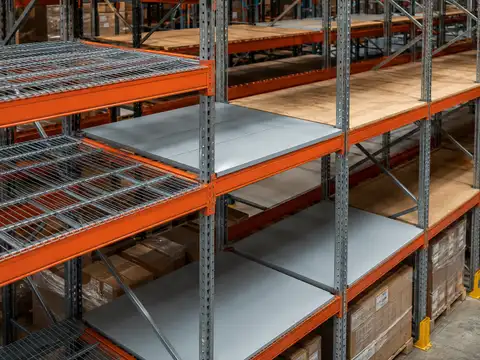
For ordinary palletized warehouse storage, start by evaluating wire mesh decking.
Use another deck only when the load gives you a reason.Small loose products may need a continuous surface. Heavy concentrated loads may justify grating or engineered steel. A sound pallet may need only pallet supports. The cheapest deck that safely performs the required job is normally better than specifying the heaviest surface everywhere.
Pallet-rack decking looks like a minor accessory until a project contains several hundred levels. At that scale, changing from a $45 wire deck to a $300-plus solid steel panel can move the equipment budget by tens of thousands of dollars without adding a single pallet position.
The decision is also more technical than “wire versus wood.” RMI's current ANSI MH26.2-2023 standard recognizes multiple industrial storage-rack decking materials, including welded-wire mesh, metal bar grating, composite engineered wood, corrugated metal and perforated sheet metal. The standard addresses uniformly distributed loads as well as concentrated and partially distributed loads commonly encountered on rack decks.
Decking decision
Start with the load, not the material
Pallet support, visibility, airflow and sprinkler-water passage.
Useful when the pallet only needs extra front-to-back support.
Useful for cartons, loose items and loads that cannot bridge mesh.
Flatter support surface while preserving designed openings.
For demanding concentrated loads and rugged environments.
Surface behavior, pallet footprint, fire-protection design, beam type, load concentration and handling method can matter as much as the stated pounds.
The five decking categories worth comparing
| Decking type | Strongest use | Main trade-off |
|---|---|---|
| Wire mesh | General pallet storage | Open surface does not support every small item |
| Pallet support bars | Extra pallet support without full deck | No continuous shelf surface |
| Solid steel / corrugated steel | Loose cartons, small items, smooth surface | Higher cost and fire-protection implications |
| Perforated / open-area steel | Flatter support with designed openings | More specialized and usually higher cost than wire |
| Bar grating | Heavy or concentrated industrial loads | Weight and cost |
Engineered wood and rated lumber can also be appropriate in particular applications, but they should be treated as specified rack-deck materials, not as miscellaneous plywood placed across beams.
Wire mesh decking is the general-purpose benchmark
Wire deck is popular because it solves several warehouse problems at once. It creates support between the front and rear beams, helps prevent loose product from falling through the rack, keeps upper storage levels visible and leaves a highly open surface for air, light and sprinkler-water passage.
Husky Rack & Wire's current deck uses 6-gauge pre-galvanized wire with 14-gauge channels and is designed for multiple rack applications and capacities. Global Industrial currently sells comparable 46-by-42-inch wire decks with published capacities around 2,200 to 3,000 pounds depending on the specific model.
Wire decking is also easy to retrofit because many standard designs simply drop into the beam step. That makes it attractive when an existing selective rack system needs more load support without a structural redesign of the rack itself.
A current wire-deck price snapshot
As of August 2026, Global Industrial lists a 46-by-42-inch wire deck with a stated 2,700-pound capacity at approximately $44.95 each before quantity discounts. Another 3,000-pound version of the same nominal dimensions is listed at approximately $49.95.
These are retail snapshots, not national project averages. Freight, quantity, rack manufacturer, channel configuration and capacity can materially change the delivered price.
100 standard wire decks at today's single-unit retail snapshot
100 × $44.95 = $4,495 before freight, tax or project quantity pricing. At 500 decks, the same single-unit reference becomes $22,475, which is why decking deserves its own procurement line rather than disappearing inside the rack total.
Waterfall wire deck vs flush deck
“Wire deck” still describes several geometries. A common waterfall deck extends over the top of the front and rear beams and turns down over their faces. Husky's current standard deck uses this familiar configuration, and many warehouse-rack systems are designed around step beams that accept channel-supported waterfall decks.
Waterfall geometry helps locate the deck on the beam and creates a continuous edge at the rack face. Flush or inside-waterfall configurations are used when the front beam needs to remain more exposed, for example where labels or a particular pick-face geometry matter.
The deck style should match the beam and application rather than being selected from appearance alone.
U-channel vs flared-channel wire deck
The channels underneath the mesh transfer deck load to the rack beams. Standard U-channel designs are commonly intended for step beams, where the support channel fits into the beam step.
Flared-channel decking widens the channel ends so they can sit on box or structural beams that do not provide the same recessed step. Global Industrial currently lists a 42-by-46-inch flared-channel deck with a stated 2,500-pound capacity at approximately $44.95.
Width and depth are not enough. Confirm whether the rack uses step beams, box beams or structural beams and identify where the support channels are intended to bear. The right mesh on the wrong channel geometry is still the wrong deck.
Wire deck does not increase the rack's rated capacity
A 3,000-pound deck placed on a beam level does not make a 2,000-pound beam pair capable of carrying 3,000 pounds. The rack structure, beams, decking and load all have their own design limits.
The usable load for the storage level is constrained by the weakest applicable part of the engineered system. The same principle applies in reverse: a beam pair with substantial capacity does not mean any inexpensive wire deck placed on top can carry the same load.
This sounds obvious, but it is a common purchasing error because retailers advertise deck capacity prominently while the existing beam capacity may not be visible to the buyer placing the order.
Load distribution matters as much as total pounds
ANSI MH26.2-2023 is valuable because it recognizes that rack decking sees more than ideal uniformly distributed loads. Real warehouses place pallet feet, runners, containers and concentrated products onto relatively small areas of the deck.
A deck rated for one uniform-load condition should not automatically be treated as suitable for a steel stillage that puts the same total weight onto four small feet. The local force path through mesh, channels and beams can be different.
2,000 pounds distributed is not the same as 2,000 pounds on four feet
Two loads can weigh exactly the same while imposing very different local stresses on a deck. When the product sits on legs, casters, narrow runners or unusual pallet feet, tell the decking supplier how the load actually contacts the surface.
When pallet support bars are enough
Not every pallet position needs a complete deck. Pallet support bars run front-to-back between the load beams and provide additional support beneath the pallet.
They can be a very efficient solution when the inventory always remains on structurally sound pallets and the only problem is preventing an undersized or poorly positioned pallet from dropping between the front and rear beams.
They do not create a shelf for cartons, loose product or small containers. That distinction is economically important because a warehouse can spend significantly less by installing support bars only where a full deck provides no additional operational value.
Pallet supports vs wire deck
| Question | Pallet supports | Wire mesh deck |
|---|---|---|
| Supports pallet runners | Yes | Yes |
| Creates broad shelf surface | No | Mostly |
| Helps contain loose cartons | No | Yes, depending on mesh size |
| Open area | Very high | High |
| Material quantity | Lower | Higher |
| Best use | Pallet support only | General-purpose decking |
Solid steel decking solves a very different problem
Corrugated or reinforced solid steel creates a continuous shelf surface. DACS describes its solid rack deck as flush with the top of the pallet-rack beam so products can slide on and off, and markets it for applications such as record storage, carpet and fabric storage.
This is useful when inventory cannot bridge an open mesh: small cartons, loose components, odd-shaped products or containers with narrow contact points can be more stable on a continuous surface.
Solid steel is also easier to sweep or wipe where debris control matters, although that same continuous surface changes airflow, light and sprinkler-water movement through the rack.
Solid steel can be dramatically more expensive than wire
Global Industrial currently lists a 46-by-42-inch solid 14-gauge steel deck with reinforced channels and a stated 3,000-pound capacity at approximately $315.95 for a single unit before quantity discounts.
Compare that with approximately $44.95 for one current 46-by-42-inch wire deck rated around 2,700 pounds. The two examples have relatively similar published capacity but radically different surface construction and retail price.
100 decks: wire vs solid steel retail snapshot
100 wire decks at $44.95 = $4,495.
100 solid steel decks at $315.95 = $31,595.
Difference = $27,100.
This is an illustration using current single-unit retail prices from one seller, not a project quotation. It shows why solid decking needs a specific operational reason rather than being specified as a generic “upgrade.”
Solid decking requires fire-protection coordination
Wire mesh is widely used in sprinklered warehouses because its open surface permits more water and air movement through rack levels. Husky specifically markets its wire deck for sprinklered facilities, and Global Industrial highlights sprinkler penetration as a benefit of its current wire products.
A solid deck behaves differently. It can obstruct vertical water movement and change how stored commodities interact with the fire-protection design. The consequence depends on rack arrangement, shelf area, commodity, storage height, sprinkler system and local code interpretation.
Do not assume that installing wire mesh automatically makes a rack configuration compliant, and do not assume solid steel is prohibited. Coordinate the final storage configuration with the fire-protection designer and authority having jurisdiction for the actual warehouse.
Perforated and open-area steel decks fill the middle ground
Some operations need a flatter surface than wire mesh but want more openness than a fully solid steel panel. Perforated or punched steel decking is intended for that middle ground.
ANSI MH26.2-2023 explicitly includes perforated sheet metal among the decking materials covered by the standard. DACS manufactures both solid and open-area rack-deck products for material-handling and fire-code applications.
The economic justification normally comes from one of two needs: smaller products require more continuous support, or the project is trying to preserve a particular designed open area while avoiding wire mesh.
Open-area steel is not automatically equivalent to wire mesh
A perforated panel can have very different opening size, opening percentage and structural behavior from a wire deck. The deck manufacturer should provide the specific performance data for the configuration.
For fire-protection purposes, the rack arrangement and stored load still matter. An open steel panel beneath a large solid carton or palletized commodity does not make the stored load disappear from the sprinkler calculation.
Bar grating is for demanding industrial loads
Metal bar grating uses load-bearing bars rather than welded wire mesh. ANSI MH26.2 includes metal bar grating within the recognized industrial decking category.
Grating becomes attractive when loads are unusually heavy, concentrated or punishing to ordinary mesh. Steel fabrications, tooling, dies and certain manufacturing loads can justify the additional material.
The trade-offs are predictable: grating is heavier, generally more expensive and can increase installation effort. It should be specified from the actual load condition rather than as a premium substitute for ordinary wire deck.
Engineered wood can be legitimate rack decking
Wood gets a poor reputation in pallet-rack discussions because improvised plywood is common. The category itself is not automatically wrong. ANSI MH26.2-2023 includes composite engineered wood as a recognized rack-decking material.
The standard also draws an important boundary: lumber that is not properly graded or stamped by a recognized grading agency is outside its stated scope. That is a useful reminder that “we had some plywood in maintenance” is not a decking specification.
Wood can be economical for hand-pick applications and cartons that benefit from a solid surface. Moisture, damage, replacement, cleanliness and fire-protection design all need to be considered before it is chosen for a warehouse-wide project.
Do not use rack decking as a walking surface
This is one of the most important distinctions in the current RMI standard. ANSI MH26.2-2023 is intended for decking that supports product loads. RMI explicitly excludes decking intended to support moving or live loads caused by walking or stepping.
A wire deck with a 2,500-pound product rating is therefore not a 2,500-pound work platform. A person's foot creates a different load condition, and ordinary pallet-rack decking is not a substitute for an engineered walkway, platform or mezzanine floor.
“It holds a pallet” does not mean “you can stand on it”
Product-load ratings should never be used to justify employees climbing, standing or walking on pallet-rack decking. If personnel access is required, design a structure intended for personnel loads.
Deck depth should match the rack and pallet geometry
A common U.S. selective-rack arrangement uses 42-inch-deep frames with 48-inch-deep pallets, leaving nominal pallet overhang at the front and rear. Many wire decks are therefore sold around a 42-inch deck depth.
But catalog conventions should not replace measurement. Confirm upright depth, beam type, beam spacing and the pallet's actual contact points before ordering hundreds of decks.
Oversized or undersized decking can interfere with beam seating, pallet placement, flue spaces or the intended load path.
Deck width follows the beam bay
Standard rack bays often use multiple deck panels across one beam pair rather than one very wide deck. For example, two 46-inch-wide panels can cover much of a common 96-inch beam level while allowing for the rack's actual clear geometry.
Multiple narrower panels are easier to manufacture, handle and replace. They also let the deck channels bear at intended locations rather than creating one long unsupported mesh sheet.
Mesh size matters for small products
Wire deck is only a “solid enough” shelf if the stored product is larger than the openings and stable on the mesh. Small hardware, narrow cartons, totes with small feet and irregular packaging can rock, snag or fall through a conventional mesh.
If small-item picking is frequent, the correct answer may be smaller mesh, a purpose-designed shelf insert, perforated steel or a different storage system entirely.
Do not solve a small-parts picking problem by specifying high-capacity pallet decking across the entire warehouse.
Decking can change picking ergonomics
A smooth solid surface makes cartons easier to slide toward the aisle. Wire mesh is lighter and more open but can create more friction and unevenness beneath small packages.
For reserve pallets, that difference may not matter at all because the forklift places the pallet directly onto the load level. For case picking, the surface can affect thousands of touches per day.
The right deck can depend on the bottom two levels
A warehouse may use wire decking on upper reserve pallet levels but a smoother steel or purpose-designed picking surface at the lower hand-pick levels. Specifying one deck type for every elevation can be simpler to buy and worse to operate.
Galvanized vs painted wire deck
Husky's current deck is made from pre-galvanized wire and channels. Other products use painted or powder-coated finishes. The right finish depends on corrosion exposure, appearance requirements and environment.
A dry indoor warehouse may not recover a meaningful premium from a more corrosion- resistant finish. A humid, cold or corrosive environment can make coating durability much more important to lifecycle cost.
Cold storage needs more than a “freezer-safe” label
Condensation, corrosion, sanitation requirements and fire protection can all influence decking selection in refrigerated facilities. Open wire often has practical advantages because it accumulates less debris and leaves visibility through rack levels.
Food and pharmaceutical operations may also have cleanliness and contamination requirements that affect surface material and finish. The storage commodity and sanitation program should therefore be part of the decking specification.
Used wire decking can be economical
Unlike proprietary dynamic-rack components, common wire decks can be relatively simple to reuse when dimensions, channel geometry, condition and capacity are known. That makes them a natural secondary-market item.
The same caution used for used rack still applies: verify that the deck is not bent, broken, heavily corroded or modified and that its support channels match the receiving beams.
A used deck that almost fits can be worse than no deck if it does not seat on the beams as designed.
Decking should not hide a bad pallet problem
Wire deck and pallet supports are often added because the operation receives weak, undersized or inconsistent pallets. That may be sensible as secondary support, but it can also conceal a supplier-quality issue.
If pallets regularly arrive with broken boards, missing runners or dimensions outside the storage standard, the warehouse should quantify those failures rather than automatically overbuilding every rack level around them.
Sometimes the cheapest rack-decking project is improving the pallet specification.
A simple decking selection process
- Define the load. Pallet, carton, tote, loose item, stillage, tooling or something else?
- Define the contact pattern. Full pallet runners, narrow feet, casters or distributed bottom?
- Confirm the beam type. Step, box or structural beam?
- Establish the required deck capacity. Use the actual load condition, not only total pounds.
- Check fire-protection implications. Open and solid surfaces can affect the storage arrangement differently.
- Decide whether a full deck is needed. Pallet supports may solve the problem at lower cost.
- Price lifecycle and quantity. Include freight, replacement and installation handling.
Decision table
| If this describes the load... | First option to investigate |
|---|---|
| Standard palletized inventory | Wire mesh decking |
| Sound pallets that only need extra runner support | Pallet support bars |
| Loose cartons or small items needing a continuous surface | Solid or perforated steel |
| Heavy concentrated industrial loads | Bar grating / engineered steel deck |
| Hand-pick cartons with moderate loads | Wire, engineered wood or purpose-built shelf surface |
| Box or structural beams | Confirm flared-channel or compatible deck geometry |
| Employees need to walk on the level | Not ordinary rack decking — engineer a personnel platform |
What to put in a decking RFQ
Before requesting prices, give suppliers:
- rack manufacturer and beam type;
- beam length;
- frame depth;
- number of deck panels per level;
- number of levels;
- pallet dimensions;
- maximum pallet or product weight;
- contact pattern beneath the load;
- whether cartons or loose items will be placed directly on the deck;
- required finish or environment;
- sprinkler / fire-protection coordination requirements;
- quantity and delivery location.
That information allows a supplier to price the correct deck rather than simply quoting the cheapest 42-by-46-inch panel in inventory.
Three mistakes that create expensive decking projects
1. Installing solid deck everywhere “for strength”
Solid steel can cost many times more than wire even at similar published load capacities. Use it where the continuous surface adds real value.
2. Using deck capacity as rack capacity
The deck rating does not override the beam, upright or overall rack design.
3. Treating the deck as a work platform
Product decking is not personnel flooring. If employees must walk on the structure, design for live loads and personnel access.
The practical recommendation
For a conventional selective-rack warehouse storing standard pallets, wire decking is the rational benchmark because it is widely available, relatively inexpensive and operationally versatile.
Move away from wire only when the load tells you to: solid surfaces for product that cannot bridge mesh, grating for demanding concentrated loads, pallet supports when a full shelf adds no value, or purpose-designed open steel when the project needs a specific combination of support and openness.
The goal is not to buy the strongest deck. It is to buy the least expensive surface that safely supports the actual load, works with the fire-protection design and fits the rack correctly.
Frequently asked questions
What is the best pallet rack decking?
Wire mesh is the best general-purpose starting point for many palletized warehouses because it combines load support with an open surface. Other materials can be better where small items, concentrated loads or specific operating conditions require them.
How much does wire decking cost?
Current August 2026 retail examples from Global Industrial place common 46-by-42-inch wire decks around $45–$50 each before bulk discounts and freight, depending on configuration and capacity.
How much does solid steel pallet rack decking cost?
One current 46-by-42-inch reinforced solid-steel deck with a stated 3,000-pound capacity is listed at approximately $315.95 before quantity discounts. Solid-steel pricing varies substantially by gauge and design.
Is wire decking required on pallet racks?
Not universally. The need depends on pallet support, storage configuration, product containment, fire protection and project requirements. Some locations may use pallet support bars or no secondary deck when the engineered storage configuration allows it.
Does wire decking increase pallet rack capacity?
No. A deck has its own rating but does not increase the rated capacity of the rack beams or frame. The storage level remains limited by the applicable capacities of the complete system.
Can employees walk on wire decking?
Ordinary industrial rack decking should not be treated as a walking surface. ANSI MH26.2-2023 covers product-load decking and expressly excludes moving/live loads due to walking or stepping.
What is the difference between U-channel and flared-channel decking?
U-channel decks are commonly configured to sit within the step of step beams. Flared-channel designs spread the channel ends so the deck can bear on box or structural beams. Match the deck to the exact beam geometry.
Is solid decking bad for sprinklers?
Solid surfaces can affect water movement and the fire-protection design differently from open mesh. That does not make solid deck universally prohibited. Coordinate solid shelving with the sprinkler designer and authority having jurisdiction for the actual rack, commodity and storage height.
Can plywood be used on pallet rack?
Engineered wood can be a legitimate rack-deck material when specified for the application. Improvised or ungraded lumber should not be treated as equivalent to tested industrial decking. ANSI MH26.2-2023 specifically excludes ungraded lumber from its scope.
The related-guides section below connects this decking decision with rack cost, installation, inspection and warehouse-layout planning before the external source list begins.
Sources and methodology
Warehouse Fieldbook reviewed the current RMI decking standard, manufacturer documentation and current August 2026 U.S. retailer listings. Retail prices are included only as market snapshots and are not represented as national project averages. Fire-protection discussion is intentionally framed as a coordination issue because rack arrangement, commodity, shelf construction and sprinkler design must be evaluated together.
- Rack Manufacturers Institute / MHI — ANSI MH26.2-2023, Industrial Storage Rack Decking
- Husky Rack & Wire — current wire-deck construction and application guidance
- DACS — solid corrugated-steel rack-deck applications
- DACS — current solid, open-area and fire-code decking product families
- Global Industrial — current 46 × 42 wire-deck retail example
- Global Industrial — current 3,000-lb wire-deck retail example
- Global Industrial — current solid-steel deck retail example
- Global Industrial — current flared-channel wire-deck example