
A defensible early U.S. range for new push-back rack is approximately:
$150–$400 per pallet positionStandard cart-on-rail configurations often fall toward the lower or middle part of that range. Tall structures, demanding loads, seismic requirements, installation complexity and unusual lane configurations can move a project higher.
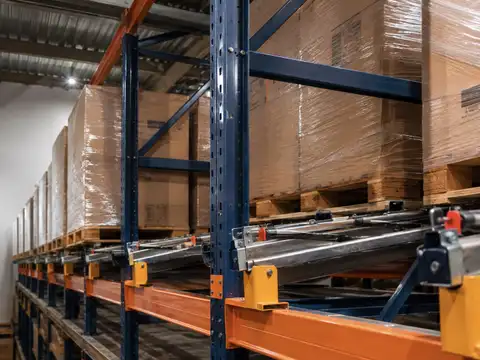
Push-back rack sits in an interesting middle ground. It stores pallets several positions deep like other high-density systems, but the forklift stays in the working aisle. Each pallet rests on a cart or rail arrangement that moves backward as another load is placed into the lane and rolls forward by gravity as the front pallet is removed.
That mechanism is exactly why push-back costs more than conventional selective rack—and why the comparison based only on steel price is incomplete. The buyer is paying for storage density without requiring the forklift to drive into the rack structure. For the right inventory profile, that can be worth considerably more than the additional hardware.
The useful 2026 price range is wider than it first appears
Source Equipment's current 2026 comparison puts push-back systems at roughly $151–$295 per pallet position in its dedicated push-back guide. Its broader U.S. pallet-rack market guide uses a wider $150–$400 per-position range, reflecting differences among manufacturers, configuration and project scope.
Another current supplier guide breaks the system out by depth and places two-deep rack around $151–$181 per position, rising progressively as more carts are added. Those detailed figures are useful because they expose the cost driver instead of pretending that a two-deep and a five-deep lane are the same product.
Depth changes the hardware
The extra positions are not free
Each additional pallet depth adds moving hardware and changes the economics of the lane. These bands reproduce one current 2026 supplier pricing guide and are best used as a directional example, not a universal quote.
The detailed bands above should not be treated as a national tariff. They come from one supplier guide and are included because they illustrate how the mechanics change with depth. The broader $150–$400 planning band is safer when the project has not yet been designed.
Why deeper push-back lanes cost more
Interlake Mecalux's current push-back design illustrates the hardware progression clearly. A two-deep lane uses one cart. At three deep there are two carts; at four deep, three carts; and at five deep, four carts, with the final pallet position supported directly on the rails. The system is not merely a deeper selective rack—it is adding a moving storage mechanism with every additional depth.
More depth can still improve the economics because each aisle face serves more pallet positions. But the benefit eventually runs into two limits: the operation needs enough pallets of the same SKU to fill the lane, and the vertical stack of nested carts consumes some clear space.
The five-deep system only wins if you can use five-deep inventory
Assume a four-deep design costs $235 per position and a five-deep design costs $260. The extra $25 looks modest. But if SKU quantities regularly leave the fifth position empty, that added hardware has created theoretical rather than usable capacity. Lane depth should follow inventory depth—not the other way around.
How much does a 500-position push-back system cost?
At the broad $150–$400 range, 500 pallet positions imply approximately $75,000–$200,000 for the rack-system planning figure before resolving exactly what installation, freight and project extras are included.
| Project size | At $150 / position | At $275 / position | At $400 / position |
|---|---|---|---|
| 250 positions | $37,500 | $68,750 | $100,000 |
| 500 positions | $75,000 | $137,500 | $200,000 |
| 1,000 positions | $150,000 | $275,000 | $400,000 |
| 2,000 positions | $300,000 | $550,000 | $800,000 |
That table is intentionally simple. It shows why push-back becomes a serious capital project very quickly. At 2,000 positions, a $40 change in effective cost per position moves the project by $80,000.
Installation and engineering still sit on top
Current 2026 U.S. supplier guidance for pallet-racking projects commonly uses roughly 15–35% of base equipment cost as an early allowance for installation and engineering. Push-back can be especially sensitive to labor because the lane hardware must move correctly: rails need the intended slope, carts need to track cleanly and the rack geometry cannot be treated casually.
A $140,000 equipment quote is not a $140,000 project
If rack equipment is $140,000, a 15–35% early installation/engineering allowance adds approximately $21,000–$49,000. Freight, tax, permits, guarding, demolition, slab issues and other building work can still sit outside that figure.
Once supplier proposals arrive, replace broad percentages with actual line items. A serious comparison should separate equipment, installation, freight and exclusions instead of allowing every bidder to define “installed price” differently.
Where push-back earns back its higher price
The most important benefit is not the cart mechanism itself. It is what those carts allow the warehouse to remove: aisles. Steel King states that its SK3600 push-back system can store pallets two to five deep and provide up to 90% more product storage than standard selective racking in appropriate layouts.
That does not mean every push-back project gains 90%. The actual improvement depends on building geometry, lane depth, SKU distribution, clear height and the selective layout used as the baseline. But the direction is clear: one aisle can serve several pallet positions deep rather than one position at each rack face.
Do not divide push-back cost only by total pallet positions. Also calculate the incremental cost per additional usable position compared with the best selective alternative. That tells you what you are actually paying for density.
A simple density-payback example
Assume a selective layout creates 900 usable positions for $110,000. A push-back redesign costs $165,000 and creates 1,250 positions. The premium is $55,000 for 350 additional positions:
$157 for each incremental pallet position
$55,000 ÷ 350 additional positions = about $157 of incremental rack investment per added position. Whether that is cheap or expensive depends on what one position is worth to the business—especially if the alternative is overflow storage, a larger lease or an earlier building expansion.
This is the point where rack purchasing becomes a real-estate decision. A system that costs more can be the cheaper business choice if it delays several years of additional occupancy cost.
Push-back keeps the forklift out of the rack
Unlike drive-in storage, the operator approaches every push-back lane from the aisle. The forklift places a pallet on the front cart, then uses the next load to push the previous pallet deeper into the lane. During retrieval, gravity returns the next pallet to the pick face.
That difference has operational value. Drive-in requires the truck to travel within structural lanes; push-back does not. Source Equipment specifically points to the lower rack-damage exposure that comes from keeping the forklift outside the structure. It also means every lane remains independently accessible from the aisle.
Independent lanes matter for SKU flexibility. Interlake Mecalux notes that a different SKU can be assigned to each lane and each level, whereas drive-in commonly dedicates a much larger lane block to the same product.
But push-back is still a LIFO system
Pallets are loaded and unloaded from the same aisle side. The last load placed into the lane is the first one available for removal, so the normal inventory logic is last in, first out (LIFO).
This makes push-back a strong fit for medium-turnover inventory where several pallets of the same SKU are held at once and strict FIFO rotation is not required. Interlake Mecalux specifically identifies medium-turnover palletized goods with two or more pallets per SKU as a typical use case.
If expiration dates or lot rotation require true FIFO, pallet flow is normally the more natural high-density comparison. It uses separate loading and unloading sides so the oldest pallet can exit first.
Push-back vs drive-in: where the money goes
| Factor | Push-back | Drive-in |
|---|---|---|
| Upfront hardware | Usually higher due to carts/rails | Often lower for comparable density |
| Forklift enters rack | No | Yes |
| Lane selectivity | Higher; each lane independently accessed | Lower |
| Typical depth | About 2–5 deep for many systems | Can run materially deeper |
| Inventory flow | LIFO | Usually LIFO in drive-in configuration |
| Best fit | Density plus faster aisle-face access | Bulk density with fewer SKUs |
Drive-in can therefore win on raw density economics, especially when very deep lanes of homogeneous inventory are practical. Push-back often wins when the warehouse is willing to pay more for density while keeping faster aisle access and more independent SKU lanes. The dedicated push-back vs drive-in comparison will model that trade-off in more detail.
Push-back vs pallet flow
Both systems use gravity-assisted movement, but the workflow is fundamentally different. Push-back loads and unloads from one side and is LIFO. Pallet flow normally loads from one side and picks from the other, creating FIFO.
Pallet-flow lanes also use a much more continuous bed of rollers and often include speed controllers and braking components. A current 2026 industry comparison estimates a push-back lane at roughly 65% of the cost of a comparable pallet-flow lane, although actual project pricing depends heavily on depth, load and hardware.
The cheaper system is therefore not automatically the correct one. A food or date-sensitive operation may recover a higher pallet-flow investment through better inventory rotation, while a LIFO-compatible warehouse can avoid paying for FIFO mechanics it does not need.
Cold storage is especially interesting
Push-back is common in refrigerated and frozen warehouses because conditioned volume is expensive. Interlake Mecalux specifically highlights cold stores as an application where reducing aisle volume can reduce the amount of space that must be cooled.
In that environment, the ROI has two components: added pallet capacity and the economics of the refrigerated envelope. A denser rack system may help delay physical expansion while also concentrating inventory inside the cooled space already being operated.
The inventory still has to suit LIFO. Cold storage does not override product rotation requirements, especially where dated food inventory is involved.
Used push-back rack: cheaper steel, harder matching
Used push-back systems do exist—Warehouse1 currently lists used, reconditioned and new push-back configurations in multiple position counts. But the used-market decision is more complicated than buying standard selective frames and beams.
The moving system matters. Carts, rails, stops and structural geometry need to correspond to the intended configuration. A cheap used lot is only a bargain if the component set is complete, compatible, documented and suitable for the pallet dimensions and loads being stored.
For that reason, I would be more conservative buying used dynamic rack than ordinary selective rack. The discount must compensate not only for age and condition but also for the risk that the exact system cannot be configured efficiently for the new facility.
Four quote details that deserve extra attention
1. Lane depth
The quotation should state exactly how many pallets deep each lane is. “Push-back rack” without depth is not enough information to compare price.
2. Pallet specification
Carts and rails are designed around the supported load. Mixed pallet footprints, weak pallets or unusual loads can require different support details and should be disclosed before the design is priced.
3. Cart and rail system
Ask who manufactures the moving hardware and whether replacement components are available. A dynamic rack system has more proprietary elements than standard selective racking.
4. What “installed” actually includes
Confirm freight, anchors, guards, demolition, permits, engineering, taxes and commissioning rather than assuming they are hidden inside the total.
Structural design is not part of an online price estimate
Push-back rack remains industrial steel storage rack. Interlake Mecalux states that its current U.S. push-back systems are engineered in accordance with the 2023 RMI design standards recognized by ANSI and referenced by the International Building Code. RMI separately publishes ANSI MH16.1-2023 for industrial steel storage racks within its scope.
Warehouse Fieldbook can help establish a capital budget and compare storage economics, but it cannot determine safe load capacity, anchorage or project-specific seismic design. Those are supplier and engineering decisions.
When push-back usually makes financial sense
Push-back deserves serious pricing when several of these conditions line up:
- the warehouse is short on pallet capacity;
- two to five pallets of many SKUs are commonly held at once;
- LIFO inventory flow is acceptable;
- the operation values aisle-face access and fast pallet handling;
- drive-in would sacrifice too much SKU selectivity;
- a building expansion or overflow lease is the alternative;
- pallet flow would add FIFO capability the operation does not need.
If most SKUs are only one pallet deep, selective rack normally preserves more useful access. If inventory blocks are very deep and homogeneous, drive-in or shuttle storage may produce better density. Push-back is strongest in the middle: a few pallets deep, many independent lanes and meaningful pressure on floor space.
Frequently asked questions
How much does push-back pallet rack cost per position?
For 2026 U.S. planning, a broad range of roughly $150–$400 per pallet position is defensible from current supplier guidance. More standardized systems often appear closer to approximately $150–$300 per position before all project-specific extras are known.
Does a five-deep push-back lane cost more per position?
Usually yes. Additional depth adds carts or other moving components. One current 2026 supplier guide moves from roughly $151–$181 per position at two deep to $243–$273 at five deep.
Is push-back cheaper than drive-in rack?
Not necessarily. Push-back typically carries more moving hardware and can cost more upfront. It may still be economically stronger when the warehouse values greater lane selectivity and keeping forklifts outside the rack structure.
Is push-back cheaper than pallet flow?
It is generally the simpler and lower-cost dynamic system, but pallet flow provides FIFO inventory movement that push-back does not. The correct choice depends on whether that inventory-rotation capability has operational value.
How deep can push-back rack go?
Major U.S. manufacturers commonly offer systems around two to five pallets deep, while some systems extend to six. Interlake Mecalux's cart-and-rail configuration supports up to five pallets deep; Ridg-U-Rak describes options up to six.
Sources and methodology
Warehouse Fieldbook reviewed current 2026 supplier pricing alongside current manufacturer specifications. Because published price ranges describe different systems and project scopes, this guide keeps a broad planning range rather than manufacturing one national average.
- Source Equipment — 2026 push-back cost and system comparison
- Source Equipment — broader 2026 U.S. pallet-rack cost ranges
- HEDA Shelving — push-back cost examples by lane depth
- Interlake Mecalux — push-back configurations, operation and components
- Steel King — SK3600 push-back specifications and capacity characteristics
- Ridg-U-Rak — push-back lane depth and cart-on-rail configuration
- ICON Material Handling — 2026 push-back vs pallet-flow cost comparison