
For early U.S. planning, public 2026 pricing guides support a broad drive-in rack range of roughly:
$115–$500 per pallet positionThe spread is real. Shallow, straightforward systems can sit much closer to the lower end, while deep lanes, tall structures, high capacities, difficult installations and more complete project scopes can push the effective cost toward the upper end.
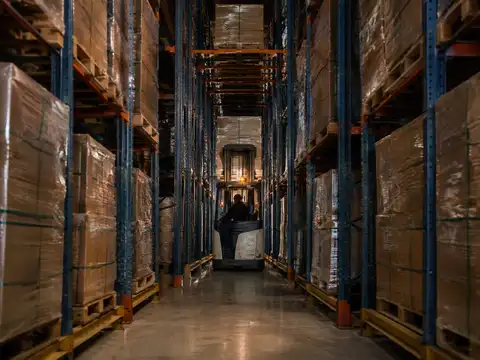
Drive-in pallet racking is bought for a very specific reason: it puts more pallets into the same floor area by removing many of the aisles required by selective rack. A forklift travels into the rack lane itself and places pallets on rails running along the depth of the structure. That creates density, but it also changes how inventory can be accessed and how the rack has to be designed.
That trade-off is the central economic question. Drive-in is not automatically attractive because it fits more pallets, and it is not automatically expensive because its price per position exceeds selective rack. The correct comparison is between the total cost of the storage system and the value of the additional usable warehouse capacity it creates.
Density economics
Drive-in rack trades access for floor efficiency
Only the front pallet in a lane is immediately accessible.
Forklift aisles are replaced by deep pallet lanes.
Best when each lane can hold several pallets of the same SKU.
The real question is not whether drive-in rack costs more than selective rack. It is whether the extra positions created by eliminating aisles are worth the loss of direct pallet access.
What drive-in pallet racking costs in 2026
Published prices vary more than they do for basic selective rack. One current 2026 U.S. supplier guide places drive-in rack around $115–$500 per pallet position depending on depth and configuration. Another 2026 market guide gives roughly $200–$500 per position, while older U.S. supplier guidance commonly cited around $100–$250 per position.
Those figures should not be forced into a false national average. A four-deep drive-in lane and a ten-deep system do not use the same amount of steel or create the same operational behavior. Some public figures also describe rack equipment only, while others blend more of the installed project into the estimate.
| Planning case | Useful early range | What usually drives it |
|---|---|---|
| Shallower / simpler drive-in | About $115–$200 / position | Fewer pallets deep, ordinary heights and loads |
| Typical high-density project | About $200–$300 / position | Deeper lanes, more structural components and installation complexity |
| Deep / complex system | About $300–$500+ / position | Deep lanes, tall rack, demanding loads or broader project scope |
These bands are appropriate for feasibility work. They are not a substitute for a layout and engineered proposal. Freight, tax, permits, guarding, slab conditions, seismic design, demolition and fire-protection changes can sit outside a published cost-per-position figure.
Lane depth is the number that changes the economics
A drive-in lane stores pallets one behind another. The deeper the lane, the more aisle area can potentially be eliminated. But a deeper lane also requires a larger quantity of the same SKU or product family to use the capacity efficiently.
This is where many simplistic comparisons fail. A ten-deep lane may create excellent storage density on paper, but if the warehouse rarely holds ten pallets of the same SKU at the same time, several positions can become stranded behind another product or simply sit empty. The rack has created theoretical capacity rather than usable capacity.
Four-deep vs eight-deep lanes
Suppose two layouts occupy roughly the same rack footprint. The eight-deep concept can reduce aisle count and create many more pallet positions, but it also needs larger inventory blocks per SKU. If the operation normally holds only two or three pallets of a SKU, the four-deep concept may produce fewer nominal positions but substantially better real utilization.
For that reason, a drive-in project should be modeled with actual inventory profiles rather than one average pallet count. Look at how many SKUs routinely have four, six, eight or more pallets on hand, and how often those quantities change.
Drive-in rack is usually LIFO
In a conventional single-entry drive-in system, the same aisle end is used for loading and retrieval. The last pallet placed into a lane is therefore the first one available to come back out: last in, first out (LIFO).
That can work very well for homogeneous products that turn as a block, reserve inventory or goods where strict rotation is not critical. It can be a poor fit for date-sensitive inventory if the lane cannot be emptied in a disciplined sequence.
Drive-through rack is a related configuration with access from both ends. It can support different inventory flows, but opening both sides changes the layout and should not be treated as identical to a conventional drive-in system.
How much does a 500-position drive-in project cost?
Using the broad $115–$500 planning range, 500 positions imply $57,500–$250,000 before deciding exactly what the published range includes. That is too wide for procurement but useful for deciding whether a concept deserves detailed engineering.
500 pallet positions
At $115 per position, the planning figure is roughly $57,500. At $250 it becomes $125,000. At $500 it reaches $250,000. The useful next question is not “which number is correct?” but which lane depth, rack height, load requirement and project scope describe the warehouse you are actually planning.
What about a 1,000-position system?
At 1,000 positions, the same broad range becomes approximately $115,000–$500,000. At this size, the difference between drive-in and selective rack should be evaluated against the building itself.
If drive-in creates several hundred additional pallet positions inside an existing facility, the premium may delay an expansion, avoid overflow storage or reduce the amount of leased square footage required. That can make a more expensive rack system financially stronger. If the building has abundant space and inventory requires high selectivity, paying for density can achieve the opposite.
Why drive-in costs more than selective rack
The structure extends through the storage lane
Selective rack keeps the forklift in an aisle and supports pallets at the rack face. Drive-in needs rails and structural components along the lane depth while maintaining a clear path for the lift truck to enter the structure.
There is more interaction between forklift and rack
In normal selective storage, a forklift approaches the rack from the aisle. In drive-in, the truck operates inside a relatively constrained structural lane. That changes protection, clearances, operating discipline and the consequences of impact damage.
Installation is less repetitive
Deep rack lanes create more structural connections and internal geometry than a simple line of selective bays. Installation cost therefore needs its own project allowance rather than assuming the same labor per position as ordinary selective rack.
Source Equipment's current 2026 U.S. guide estimates that installation and engineering across pallet-racking projects often add roughly 15–35% to base equipment cost, but drive-in projects can differ substantially depending on height, lane depth and jobsite conditions.
Where drive-in can save money
The savings do not come from buying cheaper steel. They come from using the building more intensely. Selective rack requires an access aisle in front of every storage face. Drive-in replaces many of those aisles with pallet lanes.
Mecalux describes drive-in as one of the simplest and most affordable high-density storage methods. The phrase high-density matters more thanaffordable: it is the ability to concentrate pallets that can improve the economics of expensive or capacity-constrained warehouse space.
When a $75,000 premium can make sense
Assume a selective layout costs $150,000 and provides 1,000 pallet positions. A drive-in option costs $225,000 but provides 1,450 usable positions for the actual SKU profile. The extra $75,000 has created 450 positions, or about $167 of incremental rack investment per added position. If those positions avoid leased overflow space or an expansion, the premium may be easy to justify.
Where drive-in becomes expensive
A high-density layout can look excellent on a drawing and perform badly once inventory starts moving. The main risks are operational rather than purely structural.
Too many SKUs
Drive-in works best when a lane can be dedicated to several pallets of the same SKU. A warehouse with hundreds of low-volume SKUs may spend much of its capacity on partially empty lanes.
Frequent access to individual pallets
Because pallets behind the front position are not independently accessible, retrieval flexibility is lower than with selective rack. If operators constantly need a pallet buried deep in a lane, the apparent storage-density advantage starts generating extra moves.
Poor inventory rotation
LIFO is not inherently bad, but it must match the inventory. Date-sensitive goods or strict lot rotation can require a different storage method or a carefully designed drive-through or pallet-flow strategy.
Forklift damage
The truck enters the rack itself. Uprights and rails therefore operate closer to vehicle traffic than in conventional selective layouts. Training, clearances and inspection discipline matter because one damaged component can affect the economics of the system through repair cost and downtime.
Drive-in vs selective: the financial decision
| Decision factor | Selective rack | Drive-in rack |
|---|---|---|
| Equipment cost / position | Usually lower | Usually higher |
| Direct access | Every pallet | Front pallet in each lane |
| Storage density | Lower | Higher |
| SKU variety | Strong fit | Better with fewer, deeper inventory blocks |
| Layout flexibility | High | More specialized |
| Best economic case | Access is valuable | Space is valuable |
This comparison is developed further in Selective vs Drive-In Pallet Racking. For budgeting alone, the key point is that drive-in should not be rejected merely because its rack cost per position is higher. Nor should it be chosen merely because the layout contains more positions.
Cold storage is one of the strongest use cases
Refrigerated and frozen warehouse space is expensive to build and operate, so every square foot has unusually high economic value. That makes dense storage particularly attractive when the inventory profile is compatible with deep lanes.
A cold-storage operator can sometimes justify a substantial premium for drive-in rack because reducing aisle area allows more product to sit inside the same conditioned envelope. The rack decision then affects not just real-estate capacity but refrigeration economics as well.
That does not make drive-in universally correct for cold storage. SKU mix, expiration dates, throughput and pallet rotation still control whether the density is genuinely usable.
How to compare drive-in rack quotes
A drive-in quotation should make the lane geometry obvious. Before comparing totals, normalize at least these items:
- usable pallet positions;
- number of lanes;
- pallets deep per lane;
- number of storage levels;
- upright/frame height;
- pallet dimensions and design loads;
- rail and support configuration;
- entry guides and rack protection;
- anchors and hardware;
- installation labor;
- freight;
- engineering and permit scope;
- demolition or relocation;
- explicit exclusions.
Then calculate both installed cost per pallet position and the number of usable positions for the real inventory profile. A quote can be technically cheaper per nominal position and economically worse if the lanes are too deep for the SKU quantities the warehouse actually holds.
Safety and structural design are part of the project
Drive-in rack is industrial steel storage rack, so structural design belongs in professional project scope rather than an online cost calculation. RMI lists ANSI MH16.1-2023 as the current standard covering minimum requirements for structural design, testing and utilization of industrial steel storage racks within its scope.
The 2023 revision includes updated seismic and stability methodology. That matters because lane depth, rack geometry, load distribution and site seismic conditions can all affect structural design. Warehouse Fieldbook's price ranges are for capital planning; they are not load-capacity or anchorage instructions.
When drive-in is likely to be worth pricing
A drive-in concept deserves serious consideration when most of the following are true:
- warehouse floor space is constrained or expensive;
- many SKUs are held in several pallets at a time;
- inventory can operate with lane-level LIFO logic;
- direct access to every pallet is not necessary;
- capacity expansion would otherwise require more building space;
- operators can work safely and consistently inside rack lanes.
If those conditions are absent, selective or another high-density method may deliver better economics even when drive-in creates the highest theoretical pallet count.
Before requesting a drive-in quote
Give vendors more than a building drawing. The useful inputs are pallet size and weight, SKU count, pallets on hand by SKU, inventory-turn behavior, desired storage levels, clear height, forklift dimensions and any known building or seismic constraints.
That information allows a supplier to test whether the operation actually benefits from four-deep, six-deep or even deeper lanes. Without it, a quote can optimize the rack rather than the warehouse.
Sources and methodology
Pricing in this guide is intentionally expressed as a broad range because current public sources disagree materially on drive-in cost per position. Warehouse Fieldbook reviewed 2026 supplier pricing, additional U.S. rack-industry guidance and current RMI structural-standard information. Where sources define scope differently, the article preserves that uncertainty rather than presenting a false average.
- Source Equipment — 2026 U.S. rack pricing by system type
- T-Racking — 2026 warehouse-racking cost guide
- Stein Service & Supply — cost-per-position comparison by rack type
- Mecalux — drive-in / drive-through system characteristics
- Rack Manufacturers Institute / MHI — ANSI MH16.1-2023
- RMI Rack Safety — seismic and stability methodology