
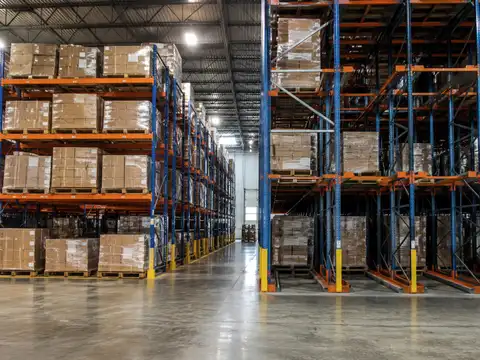
Choose selective pallet rack when you have many SKUs, relatively few pallets of each SKU and frequent need for direct pallet access.
Choose drive-in when space matters more than selectivity.Drive-in becomes compelling when inventory is deep enough to fill multi-pallet lanes and the added capacity can prevent overflow storage, reduce freezer volume or delay a building expansion.
The usual comparison between selective and drive-in racking is too shallow. Selective is described as “flexible,” drive-in as “dense,” and the buyer is left to guess which benefit matters more. A warehouse manager needs a more practical test: how many usable pallet positions does each layout create for the actual SKU profile, and what does that capacity cost?
Current manufacturer guidance makes the structural difference clear. Mecalux describes selective pallet rack as the most widespread pallet-storage system because it is versatile, relatively simple and provides direct access to every pallet. Its drive-in system does the opposite: forklifts enter deep storage lanes, allowing the building to replace multiple access aisles with pallet positions.
The trade-off
Selective protects access. Drive-in buys density.
Selective usually wins.
Drive-in deserves a serious layout.
The first decision is inventory depth, not rack price
Before comparing equipment, count how many pallets you normally hold per SKU. Selective rack works exceptionally well when SKU variety is high because each pallet position is independently accessible from an aisle.
Drive-in works best when several pallets of the same SKU can be dedicated to one lane. If a five-deep lane contains only two pallets most of the time, three nominal positions are not useful capacity. The warehouse may show a high theoretical pallet count while operating with poor utilization.
400 SKUs with two pallets each
An operation holding roughly two pallets per SKU usually gains little from eight-deep drive-in lanes. Selective rack preserves direct access and allows each location to be assigned independently. The “less dense” layout can therefore provide more usable capacity for the inventory that actually exists.
40 SKUs with 25 pallets each
The same building now has deep inventory blocks. Multi-pallet lanes can remain well utilized because each SKU has enough inventory to fill them. This is the type of profile where removing selective aisles can create a substantial capacity advantage.
Selective rack usually costs less per pallet position
Current 2026 U.S. pricing guides continue to place selective rack below drive-in on equipment cost. East Coast Storage Equipment publishes approximately $55–$200 per position for single-deep selective rack. Other current market guides use roughly $50–$200.
Drive-in pricing is more dispersed. Current 2026 public guides show figures from roughly $115–$135 per position for simpler configurations to approximately $200–$500 per position for deeper or more complex systems.
| Cost factor | Selective | Drive-in |
|---|---|---|
| Typical rack cost / position | Lower | Higher |
| Internal lane hardware | Minimal | Support rails through deep lanes |
| Installation complexity | Usually lower | Usually higher |
| Aisle requirement | Higher | Lower |
| Potential building capacity | Lower | Higher when SKU depth fits |
That is why the less expensive rack can create the more expensive warehouse. Selective saves on steel but consumes more floor area in access aisles. Drive-in spends more on the storage structure but can turn some of those aisles into inventory.
The right metric is incremental cost per added position
Suppose a selective layout creates 1,000 usable positions for $130,000 and a drive-in design creates 1,500 usable positions for $230,000. The drive-in system costs $100,000 more but creates 500 additional positions.
$200 of extra rack investment for each added position
$100,000 premium ÷ 500 incremental positions =$200 per additional pallet position. The next question is whether one extra storage position is worth more or less than $200 to the business over the life of the system.
If the alternative is leasing overflow space for years, $200 can be inexpensive. If the building has abundant unused floor area, the same premium can be unnecessary. The rack cannot be evaluated separately from occupancy economics.
Drive-in can add a lot of capacity—but “up to” needs context
Steel King's cold-storage guidance states that drive-in systems can accommodate up to 75% more pallets than selective rack in suitable layouts. That is a manufacturer-published maximum-style figure, not a promise that every warehouse will gain 75%.
Actual improvement depends on aisle width, building dimensions, columns, clear height, lane depth and SKU distribution. A rectangular freezer holding a few high-volume products can approach the ideal conditions for deep storage. An irregular distribution center with hundreds of SKUs may gain much less.
“Drive-in stores 75% more” is not a budget formula. Use it as evidence that the upside can be large, then compare two actual layouts inside the real building.
Selective gives direct access to every pallet
This is the defining operational advantage. Mecalux describes selective rack as the only conventional pallet-rack configuration in its comparison that offers direct access to every stored pallet. Operators do not need to move one pallet to reach another.
Direct access is valuable when orders are unpredictable, SKU counts are high, partial quantities are common or stock locations change frequently. It simplifies slotting and makes the rack tolerant of inventory volatility.
That flexibility can also reduce administrative complexity. A position can change from one SKU to another without first clearing a deep lane of the previous product.
Drive-in gives direct access to lanes, not every pallet
In drive-in, pallets are stored behind one another on rails. The forklift can access the lane entrance, but a pallet deep inside the channel is physically blocked by pallets in front of it.
That limitation is acceptable when the lane contains one homogeneous product and inventory turns as a block. It becomes costly when operators repeatedly need a pallet that is buried behind another lot or SKU.
The operational question is therefore not “do we need access?” Every warehouse needs access. The question is at what level do we need independent access: pallet, lane or product block?
Drive-in is normally LIFO
A conventional drive-in lane is loaded and unloaded from the same aisle side. The last pallet placed into the lane is therefore the first one removed. This is last-in, first-out inventory logic.
LIFO is not inherently a problem. Reserve stock, nonperishable products and homogeneous lots can operate perfectly well that way. It becomes a problem when expiration dates, batch control or quality rotation require older stock to leave first.
Drive-through is the related alternative when access is provided from both ends. Steel King and Mecalux both describe drive-through configurations that allow loading from one side and retrieval from the other, making FIFO-style flow possible.
FIFO changes the density comparison
A drive-through system needs access to both ends of the rack block. That can mean an additional working aisle or at least a different building layout. Some of the maximum density advantage of single-entry drive-in is therefore exchanged for inventory-flow capability.
This is an important nuance for food and beverage warehouses. It is easy to say “drive-in is dense” and “FIFO is required” without noticing that the drive-through version may not achieve the same pallet count as the single-entry concept.
Forklift travel is fundamentally different
With selective rack, the forklift remains in the aisle. It approaches a position, deposits or retrieves the load and continues to the next location.
With drive-in, the forklift enters the rack lane. Mecalux explicitly notes that this requires more maneuvering time for storage and retrieval than other high-density systems where the truck remains at the face.
The effect gets larger as lanes become deeper. A truck serving a pallet ten positions deep has to travel inside the structure, handle the load and reverse out of the channel. That time should be included in the operating comparison.
Density can save space while costing handling time
If drive-in adds 400 positions but increases average handling time enough to require another forklift and operator during peak periods, part of the space saving has been exchanged for labor and equipment cost. The correct decision uses both CAPEX and operating data.
Rack impact exposure is different too
Selective uprights sit beside forklift aisles, so they are still exposed to vehicle impacts. Drive-in adds a different exposure: the truck intentionally operates inside the rack structure.
That makes operator training, clearances and rack inspection particularly important. Damage does not automatically make drive-in a poor choice, but maintenance risk belongs in total cost of ownership rather than being ignored because it is not part of the initial quotation.
Cold storage often shifts the answer toward density
Freezer and cooler space is expensive because the building must continuously condition the stored volume. Removing aisles can therefore create value beyond ordinary rent per square foot.
Steel King specifically identifies drive-in as a common cold-storage solution and reports that it can hold up to 75% more pallets than selective in suitable applications. Its guidance frames facility density as potentially large enough to influence whether an expansion is necessary.
Selective still wins when the cold-store SKU profile requires independent access or strict rotation that deep LIFO lanes cannot support efficiently. Temperature does not override inventory behavior.
Selective is usually stronger for e-commerce and broad SKU catalogs
E-commerce, spare-parts and mixed retail distribution often involve many SKUs with relatively shallow pallet depth. Inventory can also change quickly as demand moves between products.
Selective rack fits that volatility because each pallet can be reassigned without changing the physical storage lane. Drive-in is much less forgiving when each lane needs several pallets of one SKU to use capacity efficiently.
High SKU count does not make drive-in impossible. It simply raises the probability that theoretical deep-lane capacity will be lost to partially filled channels.
Drive-in is usually stronger for bulk reserve storage
Manufacturers, beverage operations and other businesses can carry many pallets of the same item or production lot. In those conditions, several deep positions can be filled without sacrificing meaningful SKU flexibility.
The best use case is often reserve stock: large inventory blocks where direct access to every pallet is not necessary. A separate selective area can then handle forward picking or lower-volume products.
The answer can be both systems
Warehouses do not have to choose one rack philosophy for the entire building. Mecalux documents installations that combine selective and drive-in storage so inventory can be assigned according to product size, volume and turnover.
That hybrid approach is often more rational than forcing all SKUs into the same storage rule. High-volume reserve products can use dense lanes while low-volume, fast-changing or highly selective inventory remains directly accessible.
Segment inventory before selecting rack. The warehouse may discover that the most profitable “system” is 70% selective and 30% drive-in rather than 100% of either.
How to compare two real layouts
Build the selective and drive-in concepts using the same building and inventory assumptions. For each design, record:
- total nominal pallet positions;
- estimated usable positions after SKU fragmentation;
- number and width of forklift aisles;
- number of storage levels;
- rack equipment cost;
- installation cost;
- required forklift type;
- estimated pallet moves per hour;
- additional handling caused by deep lanes;
- inventory-rotation compatibility;
- expected rack protection and maintenance requirements;
- building expansion or overflow space avoided.
Once those numbers are visible, the decision usually becomes clearer. A dense layout that only looks attractive because nominal positions were counted while SKU fragmentation was ignored should fail the test.
Four numbers I would calculate before approving drive-in
1. Usable density gain
Compare usable—not nominal—positions between the two layouts after assigning real SKU quantities to lanes.
2. Incremental rack cost per added position
Divide the additional installed drive-in cost by the number of usable positions it adds over selective.
3. Annual space cost avoided
Estimate overflow rent, expansion cost or refrigerated space that the added positions prevent or delay.
4. Handling-cost change
Estimate whether deeper forklift travel changes labor hours, truck requirements or peak throughput.
These four figures turn the comparison from an equipment preference into a capital-allocation decision.
Structural design should not be reduced to the comparison table
Both systems remain industrial steel storage rack. RMI currently lists ANSI MH16.1-2023 as the standard specifying minimum requirements for structural design, testing and utilization of industrial steel storage racks within its scope.
Drive-in geometry can be materially different from selective rack because the system contains deep lanes and the forklift works inside the structure. Actual capacities, bracing, anchoring and seismic requirements belong in the engineered project—not in a generic online rule.
Decision table
| If this describes your warehouse... | Usually investigate first |
|---|---|
| Many SKUs, few pallets per SKU | Selective |
| Every pallet needs immediate access | Selective |
| Inventory changes frequently | Selective |
| Large homogeneous product blocks | Drive-in |
| Warehouse is at capacity | Model drive-in against selective |
| Cold storage / freezer | Strong case to model drive-in |
| Strict FIFO required | Selective or drive-through / flow alternatives |
| High turnover with many deep SKUs | Compare drive-in with push-back or shuttle too |
The practical recommendation
Selective should be the baseline because it is simple, flexible and inexpensive relative to high-density alternatives. Drive-in should have to prove its value with a layout and inventory model.
If drive-in adds little usable capacity after SKU fragmentation, keep the flexibility of selective. If it creates hundreds of genuinely usable positions and those positions prevent expensive additional space, then a higher rack price can be economically trivial compared with the building cost it avoids.
The key is to make drive-in compete against the best selective layout, not against a deliberately inefficient baseline. That produces a decision that will still make sense after the racks are full.
Frequently asked questions
Is drive-in pallet racking cheaper than selective?
Usually not on rack equipment cost per position. Current 2026 public guides generally place selective below drive-in. Drive-in can still be cheaper at the warehouse level if its density avoids enough additional building or overflow space.
How much more storage does drive-in provide?
It depends on the building and inventory. Steel King states that drive-in can accommodate up to 75% more pallets than selective in suitable cold-storage layouts. Treat that as an upper-end manufacturer example, not a universal gain.
Which system is better for many SKUs?
Selective rack is normally stronger because every pallet is directly accessible and storage locations can be reassigned easily. Drive-in works best when several pallets of the same SKU can occupy a lane.
Is drive-in rack FIFO or LIFO?
Conventional single-entry drive-in is normally LIFO because loading and retrieval happen from the same side. Drive-through configurations can provide access from opposite sides and support FIFO-style inventory flow.
Which is better for cold storage?
Drive-in often deserves serious consideration because reducing aisle volume can increase capacity inside expensive refrigerated space. Selective remains preferable where high SKU variety or direct pallet access matters more than maximum density.
Can a warehouse use both systems?
Yes. A hybrid layout can use selective rack for low-volume or high-selectivity SKUs and drive-in for deep reserve inventory. For many mixed warehouses, that is more efficient than forcing every product into one storage method.
The detailed standalone cost articles are linked below in the related-guides section. Keeping them separate avoids repeating the full price methodology here.
Sources and methodology
Warehouse Fieldbook reviewed current manufacturer documentation for system characteristics and current 2026 public rack-pricing references. Manufacturer maximum-density claims are described as such rather than treated as universal results. All financial examples in this article are illustrative calculations designed to show the decision method; they are not project quotations.
- Mecalux — selective pallet rack access, flexibility and system characteristics
- Interlake Mecalux — drive-in / drive-through operation and density characteristics
- Steel King — drive-in and drive-through high-density system characteristics
- Steel King / Food Logistics — cold-storage rack comparison and up-to-75% density example
- East Coast Storage Equipment — current selective rack cost per position
- Source Equipment — February 2026 selective vs drive-in application comparison
- Rack Manufacturers Institute / MHI — ANSI MH16.1-2023