
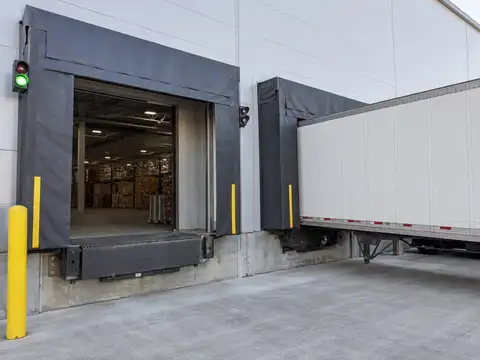
A loading dock equipment budget should be built component by component.
Current online product prices show why “loading dock equipment cost” is not one number. A simple dock plate can cost hundreds of dollars. Edge-of-dock levelers are already in the low thousands. Pit levelers, powered restraints and full shelters can each add several thousand dollars before professional installation, electrical work, concrete work, freight or control integration.
| Equipment | Current example price | Example / scope | Planning caution |
|---|---|---|---|
| Aluminum dock plate | $615 | Vestil 72" × 24" usable, 6,500-lb product example. | Product listing says for foot traffic, hand trucks and pallet trucks—not fork trucks. |
| Mechanical edge-of-dock leveler | $1,499–$2,152 | Current 20,000-lb Global Industrial / Vestil examples. | Different widths, mounting conditions and service ranges affect application. |
| Hydraulic pit leveler | $6,719 | Current 6-ft-wide, 20,000-lb pit-mounted example. | Listing states professional installation is required; concrete/pit condition matters. |
| Larger mechanical pit leveler | $10,079 | Current Vestil 84-in-wide, 35,000-lb example. | Shows how size/capacity/configuration can move product price materially. |
| Vehicle restraint | $3,199–$4,749 | Current DLM manual-to-automatic restraint examples with light/sign packages. | Integration, trailer compatibility and controls can add project scope. |
| Dock seal | $889–$1,575 | Current Wesco and Blue Giant seal examples. | Door size, projection, dock geometry and trailer mix matter. |
| Rigid dock shelter | $2,519–$3,299 | Current Global Industrial / Blue Giant shelter examples. | Shelters and seals solve different trailer/access/weather needs. |
| LED dock light | about $130–$220 | Current Global Industrial dock-light examples. | Hard-wiring, mounting and controls are separate where required. |
| Heavy-duty dock bumper | about $64–$260 each | Current laminated / steel-faced bumper examples. | Projection and compatibility with leveler/restraint geometry matter. |
The table is intentionally a product-price snapshot.
It should not be interpreted as:
- average installed U.S. pricing;
- a low/high contractor bid;
- a guarantee that one product fits your dock;
- a substitute for a site survey.
What is usually included in a loading dock equipment package?
Select the device around vehicle/equipment type, trailer height range, capacity, dock geometry and duty cycle.
Trailer movement control and inside/outside communication belong in the operating system, not as afterthoughts.
Trailer mix, door dimensions, access needs and environmental control influence which interface is appropriate.
Small components can be inexpensive relative to the leveler but still affect safety, visibility and equipment life.
Dock plate, edge-of-dock leveler and pit leveler are different cost classes
Bluff Manufacturing describes aluminum dock plates as a light, cost-effective solution for hand-truck and pallet-jack traffic.
Its current edge-of-dock product line is available in capacities from:
20,000 to 30,000 lb.
A current Global Industrial dock-plate listing specifically states that its 6,500-lb aluminum example is not for use with fork trucks.
This matters commercially:
the cheapest bridging product is not a cheaper substitute if it is the wrong equipment for the vehicle/load application.
Current edge-of-dock price examples
Global Industrial currently lists:
- 66-in usable width, 20,000-lb mechanical edge-of-dock leveler: $1,499;
- 72-in usable width, 30,000-lb mechanical example: $1,949;
- 72-in usable width, 20,000-lb Vestil example: $2,152.
These examples illustrate two points:
- product price can vary even within one equipment class;
- capacity alone does not determine price.
Current pit-leveler price examples
Global Industrial currently lists:
- one hydraulic 6-ft-wide pit leveler at $6,719;
- one 84-in-wide, 35,000-lb mechanical pit leveler at $10,079.
The hydraulic product page also states:
professional installation is required.
That is why the equipment purchase should remain separate from installed project cost in the budget.
Editable budget estimator
Loading Dock Equipment Budget Calculator
Multiply a dock-position count by your chosen equipment package, then keep installation/site work and contingency visible instead of hiding them inside an assumed installed price.
Selected product categories only; installation/site work remains separate.
Equipment per dock × number of modeled dock positions.
Uses your entered project quotes/allowances, not a generic installation factor.
Equipment + entered site/other costs + selected contingency.
Replace them with vendor and contractor quotes before procurement. Product selection must also fit trailer mix, loads, dock geometry and safety requirements.
How to use the calculator
The defaults intentionally model one possible equipment package:
- hydraulic pit leveler: $6,719;
- manual restraint kit: $3,199;
- dock seal: $1,575;
- dock light: $220 rounded allowance;
- bumpers/small dock hardware: $250 editable allowance.
This produces an equipment-only example of:
$11,963 per dock position before site and project costs.
That is a calculator example—not an installed-price claim.
Replace every component with:
- the equipment actually specified;
- the supplier's current quote;
- contractor/site-work pricing;
- freight and controls scope;
- your project contingency policy.
Vehicle restraints can be a major line item
Global Industrial currently lists DLM PowerStop restraint examples at:
- manual restraint with lights/signs: $3,199;
- manual restraint with automatic lights/signs: $3,249;
- automatic restraint with automatic lights/signs: $4,749.
These are product prices.
Installed scope can also include:
- mounting;
- power;
- control panels;
- interlocks;
- signage/lights;
- commissioning;
- building/approach repairs where needed.
OSHA requires control against vehicle movement while a dockboard is in place
OSHA 29 CFR 1910.26(d) requires measures such as:
- wheel chocks;
- sand shoes;
- other means
to prevent a transport vehicle from moving while employees are on the dockboard.
OSHA's standard does not mean every dock must buy the same powered restraint.
It does mean vehicle-movement control belongs in the dock operating and safety design.
Do not select a restraint solely by lowest purchase price. The actual system must fit the trailer population, dock equipment, operating procedure and applicable safety requirements. A product-price comparison is not a safety engineering decision.
Dock seals and shelters have different price and application profiles
Current Global Industrial product examples include:
- Wesco dock seal: $889;
- Vestil seal/shelter combination: $1,444;
- Blue Giant adjustable-head dock seal: $1,575;
- rigid dock shelter: $2,519;
- Blue Giant rigid dock shelter: $3,299.
A higher-priced shelter is not automatically “better.”
Selection depends on:
- door opening;
- trailer height/width range;
- dock projection;
- whether full trailer-rear access is needed;
- environmental-control requirement;
- wear/contact conditions.
Survey the door and dock before ordering a seal
Global Industrial's current seal listings and Vestil survey materials request dimensional information such as:
- door size;
- dock bumper projection;
- dock ledge/building projection;
- dock height;
- approach incline/decline;
- highest/special trailer dimensions.
This is one reason seal/shelter cost can change after the site survey.
Dock lights are small relative to levelers—but should still be scoped correctly
Current Global Industrial dock-light examples are approximately:
- $129.95 for a 60-in-reach dock light;
- $219.95 for a 90-in-arm LED dock light.
The product is only one part of installed cost if the project requires:
- hard-wiring;
- new circuits;
- mounting modifications;
- control integration.
Bumpers can range from small replacement items to heavy steel-faced protection
Current Global Industrial examples include:
- heavy-duty laminated bumper: about $63.95;
- larger heavy-duty bumper: about $119.95;
- steel-faced bumper: about $259.95.
Global Industrial's dock-bumper technical material also warns that bumper projection interacts with:
- vehicle-restraint capture;
- dock-leveler lip purchase.
So bumper selection is not merely a cheap accessory purchase.
Price the dock as a system
What arrives from the manufacturer/distributor?
Leveler, restraint, seal/shelter, bumpers, lights, controls and other specified hardware.
Who unloads, mounts, aligns and commissions the equipment?
Complexity depends on equipment type, access, phasing and whether the dock remains operational during work.
Does the existing pit and dock face fit?
Pit repair, new pits, embeds, curb/face repair and structural changes can materially change project cost.
Powered equipment needs more than a purchase order.
Power feeds, disconnects, control stations, interlocks and communication lights may require electrical/controls scope.
Heavy equipment has logistics cost.
Freight, unloading, crane/forklift support, temporary storage and constrained installation access can affect project cost.
What does a closed dock position cost operations?
Replacement projects may require staged closures, temporary traffic plans or work outside normal operating hours.
New construction and replacement have different cost structures
New construction can coordinate:
- pit dimensions;
- power;
- door opening;
- embed steel;
- restraint mounting;
- seal projection;
- controls/interlocks
before concrete and wall systems are complete.
Retrofit/replacement can add:
- demolition;
- unknown pit condition;
- field modification;
- downtime;
- temporary dock closures;
- compatibility work with existing doors/controls.
Therefore the same equipment model can produce different installed project costs.
Mechanical vs hydraulic leveler: compare lifecycle, not purchase price only
A lower purchase price can be attractive for:
- lower-volume docks;
- simpler applications;
- sites prioritizing lower initial equipment cost.
Powered/hydraulic operation can be attractive where:
- dock cycles are frequent;
- push-button operation is preferred;
- controls/interlocks are part of the dock sequence;
- maintenance/ergonomic considerations justify the configuration.
The dock-leveler cost guide covers dock-leveler pricing and selection in detail.
Edge-of-dock can avoid a pit—but has a different operating envelope
Bluff states that edge-of-dock levelers are an inexpensive alternative to pit-mounted levelers.
Its model data shows typical capacities in the:
20,000–30,000-lb range.
Global Industrial's Vestil edge-of-dock listing describes a 5-in-above / 5-in-below service range for one 20,000-lb model.
An edge-of-dock unit therefore should not be chosen solely because product price is lower.
Confirm:
- dock height;
- trailer bed-height variation;
- vehicle type;
- load/equipment capacity;
- required transition angle.
Dockboards have explicit OSHA requirements
OSHA 1910.26 requires dockboards to be capable of supporting their maximum intended load.
The rule also addresses:
- run-off protection for applicable dockboards;
- portable dockboard securing/overlap;
- measures preventing transport-vehicle movement;
- portable-board handholds or other safe-handling means.
A cheap board that does not match the intended load/equipment is not a legitimate budget saving.
Fall protection can add dock-edge scope
OSHA 1910.28(b)(4) contains fall-protection rules for employees on dockboards exposed to falls of 4 ft or more, including specific exceptions for certain motorized material-handling operations.
The dock-opening risk and operating mode should therefore be reviewed when planning:
- barriers;
- guarding;
- procedures;
- training;
- dock equipment.
Do not assume the equipment package is complete because the leveler and door are installed.
Forklift operation at elevated docks is another design boundary
OSHA 1910.178(m)(6) requires a safe distance to be maintained from the edge of ramps or platforms while a powered industrial truck is on an elevated dock, platform or freight car.
The dock layout should therefore coordinate:
- door opening;
- leveler;
- truck path;
- edge protection/control;
- pedestrian movement.
The Warehouse Aisle Width Guide and Pallet Rack Layout Guide provide the interior material-handling context.
Current retail product price is most useful as a quote-checking anchor
Online product prices can help answer:
- Is a quote dominated by equipment or installation?
- Is the specified product in the expected equipment class?
- Has the project accidentally omitted restraints, seals or lights?
- Does one dock position have materially different equipment from the others?
They are less useful for answering:
- What should my contractor charge?
- How much concrete repair will my existing pit require?
- What electrical work exists behind the wall?
- What will freight and downtime cost at my location?
Build a dock-position equipment schedule before requesting quotes
Track equipment and exceptions by physical dock position.
Define the vehicle population the dock must actually serve.
Match material-handling equipment and load profile.
Document how trailer movement is controlled and communicated.
Specify projection and compatibility rather than buying by door width alone.
Keep installed-cost drivers visible next to the equipment schedule.
Ask bidders to separate alternates
Useful alternates include:
- mechanical versus hydraulic leveler;
- manual versus automatic restraint;
- seal versus shelter;
- standard versus upgraded bumper;
- standalone controls versus interlocked dock controls;
- normal-hours versus off-hours installation.
This makes value engineering transparent.
Otherwise, two bids can look different because they are buying different dock systems.
Use total cost per operational dock—not equipment subtotal alone
Then compare:
This is stronger than comparing:
leveler price alone.
Do not buy every dock position identically by default
A facility may have:
- high-cycle shipping docks;
- low-cycle receiving docks;
- refrigerated positions;
- parcel/small vehicle positions;
- special-height trailers;
- yard/overflow docks.
The correct equipment package can differ by position.
Standardization has value for:
- maintenance;
- spares;
- training;
- controls;
- operator familiarity.
But standardization should follow the operating envelope, not override it.
Estimate multi-dock equipment purchases with the calculator—but survey each exception
If 12 dock positions use the same package:
the calculator quickly scales equipment cost.
Then break out positions that require:
- different leveler size/capacity;
- different restraint;
- special seal/shelter;
- extra controls;
- significant pit/dock-face work.
Model these as a second package rather than forcing one average cost across all docks.
Replacement projects should include condition assessment
Inspect:
- pit walls/floor;
- embedded steel;
- dock face;
- bumpers;
- door tracks/opening;
- electrical supply;
- existing controls;
- restraint mounting area;
- seal/shelter mounting surface.
A product-only replacement quote can miss the expensive part of a deteriorated dock.
Maintenance history should influence replacement specification
Review:
- service calls by dock;
- downtime;
- hydraulic/mechanical failures;
- bumper damage;
- restraint faults;
- seal tears;
- door impacts.
A lower-capital replacement that repeats the same failure mechanism can be more expensive over its life.
The loading-dock maintenance cost guide covers maintenance budgeting separately.
Budget audit before procurement
- Dock-position count and IDs.
- Trailer types and bed-height range.
- Material-handling equipment using each position.
- Maximum intended load / capacity basis.
- Dock height and approach condition.
- Leveler/board type, size and operating range.
- Vehicle-movement control strategy.
- Restraint type and trailer compatibility.
- Inside/outside communication lights and signs.
- Door size and condition.
- Seal/shelter survey dimensions.
- Bumper type and projection.
- Dock lighting.
- Fall/edge control requirements.
- Concrete/pit/dock-face condition.
- Electrical power and controls.
- Interlock requirements.
- Freight/unloading/access plan.
- Installation labor.
- Commissioning/training.
- Downtime/phasing.
- Maintenance/service plan.
- Quoted equipment subtotal.
- Quoted installed project total.
What this article intentionally does not include
It does not fold commercial overhead-door replacement into the base dock-equipment package because door replacement has:
- its own product types;
- dimensions;
- operators;
- tracks;
- controls;
- installation scope.
The loading-dock door replacement guide covers commercial door replacement cost separately.
It also does not invent a universal labor percentage.
Installation and site work are left as editable project inputs in the calculator.
The decision rule
Budget the loading dock as a system. Use current product prices to understand equipment class and to check quotes, but separate them from installation, concrete, electrical, controls, freight and downtime. Specify the trailer, material-handling and operating envelope first; then compare vendors on the same equipment schedule. The cheapest component is not the cheapest dock if it creates retrofit work, does not serve the vehicle mix or omits required safety/operating scope.
Frequently asked questions
How much does loading dock equipment cost?
Current U.S. online product examples range from hundreds of dollars for dock plates, lights and bumpers to several thousand dollars for edge-of-dock/pit levelers, vehicle restraints and dock shelters. Installation and site work are separate.
How much does a dock leveler cost?
Current Global Industrial examples include mechanical edge-of-dock units around $1,499–$2,152, a hydraulic pit leveler at $6,719 and a larger 35,000-lb mechanical pit leveler at $10,079. These are product-price examples, not installed averages.
How much does a loading dock vehicle restraint cost?
Current DLM examples listed by Global Industrial run from about $3,199 for a manual restraint/light package to $4,749 for an automatic restraint with automatic lights/signs, before site-specific installation.
How much does a dock seal cost?
Current product examples include roughly $889 for one Wesco seal and $1,575 for one Blue Giant adjustable-head seal. Size and dock/trailer geometry can change the specification.
How much does a dock shelter cost?
Current rigid-shelter examples are about $2,519 to $3,299 before installation.
How much does a dock light cost?
Current Global Industrial examples are roughly $130–$220 for the product. Wiring, mounting and electrical modifications can add installed cost.
How much does a dock bumper cost?
Current product examples range from roughly $64 for a heavy-duty laminated bumper to about $260 for a steel-faced model. A dock typically uses bumper protection as part of the full dock interface.
Is an edge-of-dock leveler cheaper than a pit leveler?
Current retail examples show lower equipment prices for edge-of-dock units, but they have a different working envelope and application. Confirm dock/trailer height range and handling requirements before using price as the deciding factor.
Does the loading dock equipment price include installation?
Retail product pages usually show equipment price. Professional installation, concrete/steel repair, electrical work, controls, freight and commissioning may be additional. One current hydraulic pit-leveler listing explicitly states that professional installation is required.
What equipment is needed at a warehouse loading dock?
Depending on the application, scope can include a dockboard or leveler, vehicle movement control/restraint, bumpers, seal/shelter, dock light, communication lights/signs, controls/interlocks and edge/fall-control measures.
Does OSHA require vehicle restraints?
OSHA 1910.26(d) requires measures such as wheel chocks, sand shoes or other means to prevent transport-vehicle movement while employees are on a dockboard. The standard does not mandate one universal powered-restraint product for every dock.
What does OSHA require for dockboards?
OSHA 1910.26 includes requirements for maximum intended load, run-off protection where applicable, securing portable dockboards, preventing vehicle movement and safe handling of portable boards.
A dock equipment budget should distinguish productivity hardware from safety-critical controls. The loading dock safety equipment guide maps restraints, chocks, trailer support, barriers, lights and interlocks to the failure modes they control.
Sources and methodology
Warehouse Fieldbook separates current product pricing from installed project cost. Product-price anchors were taken from public U.S. Global Industrial listings observed in August 2026 for dock plates, edge-of-dock and pit levelers, DLM vehicle restraints, Wesco/Blue Giant seals, rigid shelters, dock lights and bumpers. Bluff Manufacturing is used for current edge-of-dock capacity/application context. OSHA 29 CFR 1910.26 supplies the U.S. dockboard safety requirements; OSHA 1910.28 supplies relevant dockboard fall-protection provisions; and OSHA 1910.178 supplies powered-industrial-truck rules at elevated docks. Retail prices are examples at a point in time, not averages, bids or guarantees.
- OSHA — 29 CFR 1910.26 Dockboards
- OSHA — 29 CFR 1910.28 fall-protection duties
- OSHA — 29 CFR 1910.178 Powered industrial trucks
- Bluff Manufacturing — edge-of-dock leveler capacities and application
- Global Industrial — current aluminum dock plate product-price example
- Global Industrial — current 20,000-lb edge-of-dock leveler price example
- Global Industrial — current hydraulic pit-leveler price example
- Global Industrial — current larger mechanical pit-leveler price example
- Global Industrial — current DLM vehicle-restraint price examples
- Global Industrial — current Wesco dock-seal price example
- Global Industrial — current Blue Giant dock-seal price example
- Global Industrial — current rigid dock-shelter price example
- Global Industrial — current Blue Giant rigid-shelter price example
- Global Industrial — current dock-light product-price examples
- Global Industrial — current heavy-duty dock-bumper price example
- Global Industrial — current steel-faced dock-bumper price example