
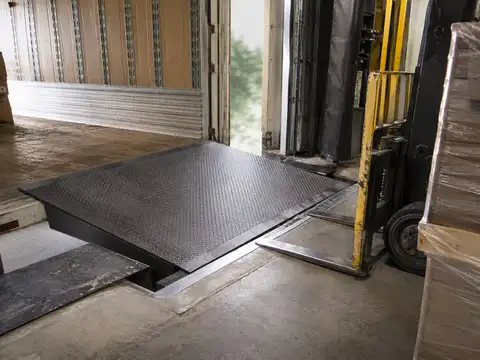
Current dock leveler equipment examples run from about $1,500 for a basic mechanical edge-of-dock unit to $6,700+ for a hydraulic pit leveler—before installed project costs.
Public pricing is useful for understanding equipment class, but it does not tell you the final project cost. A replacement leveler can require removal, rigging, pit repair, structural steel, electrical work, controls, freight, commissioning and dock closures. Price the leveler and the site separately.
Dock leveler cost stack
The purchase price is only the first layer.
A leveler project can move from a simple edge-mounted replacement to a pit-reconstruction and controls project. Separate each cost layer before comparing bids.
Type, width, length, capacity, lip, operation and options.
Public product price can help benchmark this layer.Removal, rigging, setting, welding/bolting, adjustment and commissioning.
Labor and access are project-specific.Existing pit size/condition, curb angle, embeds and dock-face repair.
Often the hidden retrofit variable.Power feed, disconnect, push-button station, interlocks and communications.
Powered equipment adds scope beyond the leveler itself.Delivery, unloading, temporary closure, off-hours work and operational disruption.
Real project cost extends beyond contractor labor.What a dock leveler does
OSHA defines a dockboard as a portable or fixed device that spans a gap or compensates for an elevation difference between:
- a loading platform;
- a transport vehicle.
OSHA's 2016 final walking-working-surface rule also explains that dockboards are commonly referred to as:
- bridge plates;
- dock levelers.
The selection question is therefore:
what equipment safely bridges the actual gap and height variation for the intended loads and transfer vehicles?
Dock leveler cost by equipment class
Current examples: $1,499–$2,049
Global Industrial currently lists 20,000-lb mechanical edge-of-dock examples at these prices for 66-in and 72-in usable widths.
Current example: $4,449
A current DLM powered edge-of-dock product listing uses push-button control and a 115V motor, adding powered operation without a conventional pit-mounted deck.
Current example: $6,719
A current hydraulic pit-mounted listing provides a 12-in-above / 12-in-below service range and states professional installation is required.
Price depends heavily on size and capacity
Vestil's current mechanical pit-leveler family includes 6-ft and 7-ft widths, standard 20,000-lb gross rolling load capacity and higher capacities available by configuration.
Edge-of-dock leveler cost
Bluff Manufacturing's current edge-of-dock line is available in:
- 20,000–30,000-lb capacities;
- 66-in, 72-in, 78-in and 84-in widths;
- a published working range of 5 in above and 5 in below dock.
Global Industrial's current 66-in-wide, 20,000-lb mechanical example is:
$1,499.
Its current 72-in-wide, 20,000-lb example is:
$2,049.
This makes edge-of-dock equipment attractive on purchase price in suitable applications.
But the published working envelope is also the reason it is not a universal replacement for a pit leveler.
When edge-of-dock can be the wrong “cheap” option
Check:
- dock height;
- lowest trailer bed;
- highest trailer bed;
- approach grade;
- forklift/transfer vehicle;
- load weight;
- required lip engagement;
- frequency of use.
If the trailer fleet falls outside the available working range, buying a cheaper EOD unit does not solve the actual dock geometry.
Powered edge-of-dock cost
A current DLM HED-series powered edge-of-dock product is listed at:
$4,449.
The current listing describes:
- push-button control;
- 115V 1/2-HP motor;
- independent hydraulic cylinders for lip and center plate.
Compared with a mechanical EOD, powered operation can add:
- equipment purchase cost;
- electrical scope;
- control/commissioning scope;
- additional maintenance components.
The value depends on cycle volume, operator workflow and the site's maintenance strategy.
Hydraulic pit leveler cost
Global Industrial currently lists one hydraulic pit-mounted leveler at:
$6,719.
The listing describes:
- 8-ft-4-in overall length;
- 6-ft width;
- 20,000-lb capacity;
- 16-in lip;
- 12-in-above / 12-in-below-dock service range;
- professional installation required.
That public price is a strong example of why:
equipment price ≠ installed leveler project cost.
Mechanical pit leveler cost
Mechanical pit equipment is available across multiple:
- widths;
- lengths;
- capacities;
- pit configurations;
- lip/options packages.
Vestil's current mechanical family lists:
- 6-ft and 7-ft widths;
- multiple lengths;
- 20,000-lb standard gross rolling load;
- higher capacities by contacting the factory;
- options including weather stripping, shallow-pit configurations, longer lips and installation hardware.
Because the configured product can vary materially, obtain an actual model quote instead of forcing a generic mechanical-pit price into the budget.
Dock leveler installation cost: why there is no universal labor percentage
Installation can range from relatively straightforward replacement work to a construction project.
A percentage such as:
“installation = 25% of equipment”
has no reliable universal basis.
The cost drivers are physical.
Cracked concrete, damaged curb angle, corrosion, wrong dimensions or drainage problems can add repair/reconstruction.
Width, length, lip, rear hinge and pit dimensions should be surveyed before ordering replacement equipment.
Power, disconnect, conduit, control stations and interlocks can be separate electrical/controls scope.
Cutting, lifting, disposal and installation access can materially change labor.
Live facilities may need off-hours work, temporary traffic changes or phased replacement to preserve shipping/receiving capacity.
Restraints, doors, lights and levelers may be interlocked; replacement can therefore involve controls integration and commissioning.
New-construction leveler cost vs replacement cost
New construction can coordinate:
- pit dimensions;
- curb angle;
- conduit/power;
- dock face;
- leveler controls;
- door;
- restraint;
- seal/shelter.
Replacement work inherits whatever already exists.
That can make retrofit cost more uncertain because the contractor may discover:
- hidden pit deterioration;
- nonstandard dimensions;
- obsolete controls;
- corroded embeds;
- damaged dock face;
- existing equipment that is difficult to remove.
Survey the existing pit before requesting a firm quote
Vestil's loading-dock documentation includes an existing-pit survey process with capacity and pit specification inputs.
A replacement survey should capture at least:
- pit width;
- pit length;
- pit depth;
- rear structure/curb angle;
- front curb/dock face;
- existing electrical supply;
- existing leveler make/model;
- bumper projection;
- adjacent restraint/door equipment.
Photographing the pit and dock face before bid pricing can reduce scope ambiguity.
Capacity rating should reflect gross rolling load—not pallet weight alone
A leveler supports more than the product on the forks.
The moving load includes:
- powered industrial truck or other transfer equipment;
- operator where applicable;
- load;
- dynamic movement.
Vestil describes its standard mechanical pit capacity in terms of:
gross rolling load.
Use the manufacturer's application/capacity methodology rather than comparing the rating only with product weight.
OSHA 1910.26(a) requires dockboards to be capable of supporting the maximum intended load. Do not value-engineer a dock leveler by reducing capacity without confirming the complete intended transfer load and the manufacturer's rating basis.
OSHA dockboard rules apply to the operating system, not the purchase price
OSHA 1910.26 requires:
- support for the maximum intended load;
- run-off protection for applicable dockboards placed in service on or after January 17, 2017, subject to the stated exception;
- portable dockboards to be secured or have sufficient overlap to prevent movement;
- vehicle-movement control while employees are on the dockboard;
- safe handling provisions for portable dockboards.
Buying a more expensive leveler does not automatically create compliance.
The dock operating procedure, vehicle control, training and surrounding layout also matter.
Fall-protection scope can affect the dock project
OSHA 1910.28(b)(4) generally requires dockboard fall protection at 4 ft or more, with a specific exception when:
- the dockboard is used solely for materials-handling operations using motorized equipment;
- employees are not exposed to falls greater than 10 ft;
- employees have the required training.
Depending on the operation, dock-edge control can therefore be separate scope from the leveler itself.
Working range can be more important than purchase price
Bluff publishes a ±5-in working range for its current edge-of-dock line.
The current hydraulic pit example above publishes:
12 in above and below dock.
If the actual trailer bed-height spread exceeds the edge-of-dock envelope, the lower equipment cost does not make the EOD a valid substitute.
Measure the trailer population
Before choosing the leveler, collect:
- trailer type;
- loaded bed height;
- unloaded bed height;
- air-suspension behavior where relevant;
- smallest/largest vehicles served;
- frequency by vehicle type.
Design around the operating fleet rather than the one trailer sitting at the dock during the site survey.
Approach grade changes effective dock geometry
A sloped approach can change:
- trailer position relative to the dock;
- effective bed height;
- bumper contact;
- seal/shelter interface;
- leveler slope.
Survey the apron/approach when replacing equipment at a dock with persistent transition-angle or trailer-fit issues.
Longer lips and special configurations can add cost
Vestil lists options such as:
- longer lips;
- shallow-pit configuration;
- weather stripping;
- emergency stop;
- under-deck insulation;
- installation hardware/shells.
These options can be justified by:
- trailer geometry;
- environmental control;
- existing pit condition;
- operating requirements.
Include them explicitly in bid comparisons.
Mechanical vs hydraulic: compare operating context, not stereotypes
Mechanical systems can reduce powered components and initial equipment cost in some applications.
Hydraulic systems can provide push-button operation and powered control.
Vestil describes hydraulic operation as:
- press/hold raise button;
- hydraulic pump raises the deck;
- lip extends;
- deck descends onto the trailer;
- leveler returns after the truck departs.
Evaluate:
- cycles/day;
- operator interaction;
- maintenance resources;
- electrical availability;
- controls/interlock strategy;
- expected service life and downtime sensitivity.
Leveler width is not just a price option
Width affects:
- transfer path;
- vehicle tire/forklift alignment;
- pit compatibility;
- equipment fit;
- cost.
Bluff currently offers EOD widths of:
66, 72, 78 and 84 inches.
Vestil's mechanical pit family includes 6-ft and 7-ft widths.
Use the width required by the transfer equipment and dock design rather than assuming the cheapest available width.
Do not forget bumper geometry
Bumpers protect the dock and also set part of the trailer-to-dock relationship.
The current Global Industrial EOD examples include twin impact-absorbing bumpers that project from the dock face.
Bumper:
- condition;
- projection;
- mounting;
- compatibility with restraint and leveler
should be surveyed with the leveler replacement.
Replacement quote: good scope vs incomplete scope
Removal, disposal and rigging responsibilities are explicit.
Creates a hidden project cost.
Defines what happens if deterioration is found.
Likely change-order risk.
Clarifies powered-equipment scope.
The leveler may arrive without a complete operating system.
Defines the completed operational state.
Leaves interface and performance issues unresolved.
Use the loading-dock equipment calculator for the complete dock position
The Loading Dock Equipment Cost article already includes an editable calculator that separates:
- leveler;
- vehicle restraint;
- seal/shelter;
- dock light;
- bumpers/hardware;
- site work;
- other project cost;
- contingency.
Use it after choosing the leveler class here.
This avoids duplicating the same project-budget calculator across adjacent articles.
How to compare dock leveler quotes
Put the following on one normalized comparison sheet:
- manufacturer/model;
- operation type;
- width/length;
- capacity/rating basis;
- lip length;
- published service/working range;
- controls and voltage;
- bumper package;
- installation;
- demo/removal;
- pit repair assumptions;
- electrical work;
- freight;
- commissioning;
- warranty;
- maintenance/service plan;
- lead time;
- dock downtime.
Only then compare total installed scope.
Low bid can be expensive if the leveler does not match the trailer fleet
A mismatched leveler can create:
- excessive slope;
- insufficient working range;
- poor lip engagement;
- vehicle compatibility problems;
- additional manual handling;
- premature wear.
The equipment selection should solve the observed operating envelope.
Low bid can also be expensive if it increases dock downtime
A loading dock is production infrastructure.
If a position is closed, the facility can lose:
- receiving capacity;
- shipping capacity;
- yard flexibility;
- staging flow.
The warehouse-space planning guide explains why docks and staging are functional capacity, not merely building edge.
Multi-dock replacement should be phased around throughput
For multiple levelers:
- identify peak dock demand;
- define how many positions can be offline simultaneously;
- sequence work by door/traffic pattern;
- protect emergency capacity;
- coordinate inventory/carrier schedules.
A lower per-unit installation price may not be worth simultaneous dock closures that disrupt operations.
Dock leveler cost and warehouse expansion decisions are connected
A facility expansion or relocation can create the opportunity to standardize:
- pit geometry;
- leveler model;
- controls;
- restraints;
- seals/shelters;
- dock heights.
The Warehouse Expansion vs Space Optimization framework treats building-level changes as part of the future operating system, not just additional square footage.
Dock layout mistakes can make leveler upgrades underperform
The Warehouse Layout Mistakes That Reduce Capacity article explains how staging and circulation shortages can make a warehouse appear full even when rack capacity exists.
Similarly, a premium leveler cannot solve:
- blocked dock approaches;
- undersized staging;
- poor trailer routing;
- bad internal forklift geometry.
Equipment and layout should be reviewed together.
Dock leveler procurement audit
- Dock ID and traffic role.
- Existing dock height.
- Approach grade.
- Trailer bed-height range.
- Trailer frequency by type.
- Transfer vehicle / forklift model.
- Gross rolling load / maximum intended load basis.
- Required usable width.
- Required working/service range.
- Lip length / trailer engagement requirement.
- Existing pit width, length and depth.
- Pit concrete and embedded-steel condition.
- Existing bumper projection/condition.
- Vehicle restraint compatibility.
- Door and seal/shelter interface.
- Electrical voltage / available power.
- Control/interlock requirements.
- Fall/edge-protection operating requirements.
- Removal and disposal scope.
- Freight / unloading / rigging.
- Installation labor.
- Commissioning and training.
- Warranty / maintenance plan.
- Allowed dock downtime.
- Total installed project price.
Why a separate leveler calculator would duplicate the model
The prior loading dock equipment article already contains the calculator needed to model:
- per-dock equipment cost;
- site work;
- other project scope;
- contingency.
A second dock-leveler calculator would duplicate the same arithmetic.
This article adds value by helping the user select the correct leveler category and identify the project costs that must be inserted into that existing calculator.
The decision rule
Use public product prices to understand equipment class, not to predict final installed cost. First define trailer height range, transfer equipment, gross rolling load, dock geometry and duty cycle. Then compare mechanical edge, powered edge and pit-mounted options that actually fit that envelope. Finally, normalize bids across removal, pit/steel work, electrical, controls, installation, commissioning and downtime. The cheapest leveler is only cheaper if it solves the same operating problem.
Frequently asked questions
How much does a dock leveler cost?
Current U.S. public product examples range from about $1,499 for one 20,000-lb mechanical edge-of-dock unit to $6,719 for one 20,000-lb hydraulic pit-mounted leveler. Installed project cost can be higher because of labor, pit work, electrical, controls and freight.
How much does an edge-of-dock leveler cost?
Current Global Industrial 20,000-lb mechanical examples are listed at $1,499 for a 66-in usable width and $2,049 for a 72-in usable width.
How much does a powered edge-of-dock leveler cost?
A current DLM HED-series powered edge-of-dock example is listed at $4,449 before project-specific installation/electrical work.
How much does a hydraulic dock leveler cost?
One current hydraulic pit-mounted 20,000-lb product example is listed at $6,719. The listing states professional installation is required.
Does dock leveler price include installation?
Public retail listings generally represent the product. Removal, installation, concrete/steel repairs, electrical, controls, freight and commissioning may be separate project costs.
Is an edge-of-dock leveler cheaper than a pit leveler?
Current public examples show lower product prices for mechanical edge-of-dock units, but they also have a more limited working envelope. Use trailer/dock geometry to decide whether they are a valid application.
What capacity dock leveler do I need?
Determine the maximum intended transfer load using the manufacturer's rating method and the complete rolling equipment/load combination. OSHA requires dockboards to support their maximum intended load.
What size dock leveler do I need?
Width, length and lip should be selected from the dock/pit geometry, trailer population and transfer equipment. Do not choose width solely from product price.
Can I replace a pit leveler with an edge-of-dock leveler?
Sometimes, but only if the edge-mounted unit's working range, capacity and operating geometry support the trailer fleet and material-handling process.
Why is dock leveler replacement expensive?
Existing pits can require demolition, rigging, concrete or steel repair, electrical modification, control integration and operational phasing in addition to the new equipment.
Does OSHA regulate dock levelers?
OSHA 1910.26 regulates dockboards, a category that includes devices used to bridge the gap/elevation difference between loading platforms and transport vehicles. The rule addresses maximum intended load, run-off protection, securing, vehicle-movement control and portable-board handling.
Sources and methodology
Warehouse Fieldbook separates public equipment pricing from installed project cost. Current price examples were taken from public U.S. Global Industrial listings observed in August 2026: 20,000-lb mechanical edge-of-dock examples at $1,499 and $2,049, a DLM powered edge-of-dock example at $4,449 and a hydraulic pit-mounted example at $6,719. Bluff Manufacturing supplies current EOD capacities, widths and ±5-in working range. Vestil supplies current pit-leveler family/configuration information and hydraulic operating details. OSHA 29 CFR 1910.26 and 1910.28 provide the dockboard load, movement and fall-protection safety boundaries. Prices are point-in-time product examples, not national averages, installed-cost estimates or guaranteed future prices.
- OSHA — 29 CFR 1910.26 Dockboards
- OSHA — 29 CFR 1910.28 fall-protection duties
- OSHA — 2016 walking-working-surfaces final rule and dockboard context
- Bluff Manufacturing — current edge-of-dock capacities, widths and working range
- Vestil — current mechanical pit-leveler sizes, capacities and options
- Vestil — current hydraulic pit-leveler operating details
- Vestil — current Edge-O-Dock mechanical/hydraulic/powered family
- Global Industrial — current $1,499 mechanical EOD example
- Global Industrial — current $2,049 mechanical EOD example
- Global Industrial — current $4,449 powered EOD example
- Global Industrial — current $6,719 hydraulic pit-leveler example