
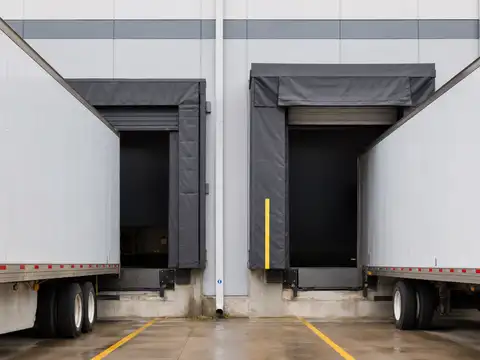
Foam compression around the trailer.
Rite-Hite describes dock seals as foam pads that a trailer compresses when it backs against the dock bumpers. They can provide a tight seal at relatively low initial product cost when the trailer population has only minor variation.
Best question: can the trailer repeatedly compress this enclosure without sacrificing required access?Flexible curtains around the trailer perimeter.
Shelters use side/head curtains to contact the perimeter of the trailer rather than relying on large foam pads compressed into the opening. They typically accommodate larger openings and a wider variety of trailer heights/styles.
Best question: do we need broader trailer compatibility and full rear access?Dock enclosure decision map
Choose from the trailer envelope inward.
The correct enclosure depends on the trailers actually served and how people and material-handling equipment need to enter them. A seal or shelter that does not match that envelope can leak, wear quickly or restrict access.
Minor variation favors compression-seal applications; wider variation generally favors shelter-type flexibility.
Shelters are designed around the perimeter and preserve full rear access; compressed foam seal pads can intrude into the opening.
Opening dimensions, dock projection, neighboring doors and wall conditions can rule products in or out.
Temperature, rain, dust, insects, food/pharma controls and visible light gaps all affect the enclosure specification.
Compression seals take repeated trailer pressure; shelters reduce direct compression but can still be damaged by off-center impacts.
Dock seal vs shelter: direct comparison
| Decision factor | Dock seal | Dock shelter |
|---|---|---|
| How sealing is created | Trailer compresses foam pads at top/sides. | Flexible curtains apply pressure around the trailer perimeter. |
| Trailer-size variation | Best when variation is relatively small. | Better suited to wider variety of trailer heights/styles. |
| Rear trailer access | Compressed side pads can intrude into the opening. | Designed to preserve full unobstructed rear access. |
| Door opening | Often used on smaller/controlled openings. | Commonly supports larger openings; product-specific limits still apply. |
| Wear mode | Direct repeated compression/friction from trailers. | Less direct compression, but curtains/frame can still be damaged by off-center docking. |
| Initial product cost | Often lower in basic configurations. | Often higher in basic rigid-shelter configurations. |
| Sealing performance | Compression seals can be very tight in the right application. | Depends strongly on shelter design; premium designs address hinge/top/corner gaps. |
| Outside projection | Rite-Hite notes seals typically take less exterior space. | Rigid shelters can project farther from the dock wall. |
Current product-price examples
Current public U.S. retail pricing illustrates the commercial difference between a basic compression seal and rigid shelter examples.
Current 8×8-door, 10-in-projection product example. Global Industrial states it is recommended when full rear-trailer access is not required.
Current 10×10-door rigid-shelter product example with 18-in projection.
Current 10×10-door rigid-shelter example with 24-in projection.
Current 10×10-door rigid-shelter example with 36-in projection.
The lowest product price can be the wrong lifecycle choice
Rite-Hite notes that compression seals:
- can provide a tight seal;
- are relatively low-priced as a category;
- can wear more easily under heavy dock traffic.
Shelters:
- can cost more initially;
- are less subjected to daily compression;
- allow full rear-trailer access;
- can accommodate a wider trailer mix.
Therefore compare:
Do not compare purchase price only.
Choose a dock seal when trailer variation is small
Rite-Hite specifically describes dock seals as best used when there is:
minor variation in the size and style of trailers served.
This makes sense mechanically.
A compression seal depends on predictable contact between:
- trailer rear;
- side pads;
- head pad/curtain;
- dock bumpers;
- building face.
Large trailer variation can create:
- excess compression;
- too little contact;
- head gaps;
- side gaps;
- inconsistent access.
Choose a shelter when trailer variety is broader
Rite-Hite states that shelters:
- fit larger dock door openings;
- serve a wide variety of trailer heights and styles;
- allow full unobstructed access to the trailer load.
Blue Giant's current stationary shelter similarly says it:
- accommodates larger doorways;
- serves a variety of trailer types and sizes;
- uses flexible fabric curtains;
- allows full interior access.
Full trailer access can decide the comparison immediately
A foam compression seal can push side pads into the rear opening when compressed.
Rite-Hite explicitly notes this can restrict forklift access.
This matters when:
- pallets are loaded close to trailer walls;
- wide loads need full opening width;
- forklifts require maximum maneuvering room;
- trailer swing doors/hinges affect the side interface.
Global Industrial's current Blue Giant fixed-head seal description likewise says the product is recommended when:
full access to the back of the trailer is not required.
Shelter does not automatically mean poor sealing
Older/basic shelters can leave:
- trailer hinge gaps;
- top gaps;
- corner gaps.
Rite-Hite explains that newer premium shelter designs can use:
- side-curtain hooks around hinge gaps;
- weighted head curtains;
- engineered corner-gap sealing.
Therefore:
compare the actual enclosure design, not only the category name.
Seal does not automatically mean superior durability
Compression seals repeatedly experience:
- trailer compression;
- vertical trailer movement during loading;
- fabric friction;
- marker-light heat/contact;
- head-pad stress.
Rite-Hite's replacement guidance lists common seal deterioration such as:
- tears;
- punctures;
- exposed foam;
- sagging materials.
Premium seal construction can include features designed around these wear modes.
Shelters also fail when the trailer approaches badly
Shelters are not immune to damage.
Rite-Hite specifically notes they can be damaged when:
trailers back into the dock off-center.
Blue Giant's retractable shelter uses a collapsible frame designed to retract on impact to:
- reduce stress;
- extend unit life.
Product geometry should therefore reflect:
- driver alignment;
- yard/approach geometry;
- dock guides;
- wall projection;
- expected impact exposure.
Opening size is only one survey dimension
Rite-Hite's enclosure audit factors include:
- door size;
- dock approach grade;
- distance between doors;
- wall obstructions;
- trailers served;
- trailer access needs;
- budget.
This is the correct survey mindset.
A 10×10 door can require a different enclosure at two sites because:
- dock projection differs;
- trailer population differs;
- approach grade differs;
- door spacing differs;
- wall features differ.
Projection is a real fit constraint
Global Industrial's current Vestil rigid-shelter family includes examples with:
- 18-in projection;
- 24-in projection;
- 30-in projection;
- 36-in projection.
The 24-in example also recommends at least:
10 in of trailer penetration for a good seal.
The enclosure must therefore be coordinated with:
- dock face;
- bumper projection;
- trailer stopping position;
- restraint geometry;
- leveler lip engagement.
Do not change bumper projection casually to “make the shelter fit”
Bumpers establish part of the trailer position relative to:
- dock face;
- leveler;
- restraint;
- seal/shelter.
The Dock Leveler Cost guide explains why bumper and leveler geometry should be reviewed together.
The Loading Dock Equipment Cost guide provides the broader dock-position equipment budget.
Trailer doors and hinge gaps matter
Swing-open trailer doors create hinges and rear hardware along the side of the trailer opening.
Some basic shelters do not fully close those hinge gaps.
Premium shelter designs can use:
- J-hooks;
- wraparound curtains;
- special head curtains
to improve perimeter sealing while preserving trailer access.
Blue Giant's HingeMaster shelter is specifically described as:
sealing swing-open trailer door hinge gaps while maintaining unrestricted access.
Cold storage and food environments can justify a different enclosure class
In temperature-sensitive or contamination-sensitive facilities, evaluate:
- visible daylight gaps;
- air infiltration;
- rain/water penetration;
- dust;
- insects;
- exhaust fumes;
- cleanability;
- condensation.
Rite-Hite and Blue Giant both frame seals/shelters as environmental-control equipment intended to reduce outdoor elements entering around docked trailers.
In these applications, a basic lowest-price enclosure may not be the correct comparison point.
Inflatable enclosures are a third option
Blue Giant currently offers inflatable seal systems that:
- inflate after docking;
- deflate before departure;
- can preserve trailer access;
- reduce direct wear on the air bags when not engaged.
This can be relevant when:
- high sealing performance matters;
- trailer variation is significant;
- compression wear should be reduced;
- powered controls are acceptable.
Do not force every application into only foam seal versus rigid shelter if a hybrid/inflatable design better matches the requirement.
Dock seal vs shelter cost is not just the equipment price
Replacement can add:
- old enclosure removal;
- damaged mounting surface repair;
- new backing/anchors;
- bumper adjustment;
- custom sizing;
- off-hours work.
Public retail pricing should be used as:
a product benchmark, not a turnkey installed quote.
Choose by total trailer population, not the average trailer
Build a trailer-envelope table with:
- trailer type;
- rear width;
- loaded/unloaded height as relevant;
- door type / hinge arrangement;
- rear projections/obstructions;
- frequency at the dock.
Then identify:
- minimum envelope;
- maximum envelope;
- high-frequency envelope;
- exception vehicles.
The enclosure should be evaluated against:
the vehicles the facility actually has to serve.
Do not let rare exception vehicles oversize every dock position
If 95% of trailers are consistent and 5% are unusual:
it can be better to designate:
- a small number of flexible shelter positions;
- standard seal positions for the stable fleet
rather than buying the most flexible enclosure at every door.
The correct strategy depends on:
- dock assignment flexibility;
- traffic peaks;
- carrier scheduling;
- exception frequency.
Full rear access matters most where wide loads and wall-side pallets occur
Test a compressed seal with:
- the widest forklift/load path;
- pallets positioned close to trailer side walls;
- hand unloading along both sides;
- trailer door hardware;
- forklift turning/entry alignment.
OSHA's forklift guidance says entry-door height must be adequate for the vehicle and load/operating context.
OSHA 1910.176(a) also requires sufficient safe clearances:
- at loading docks;
- through doorways;
- where mechanical equipment turns or passes.
An enclosure must not create an unrecognized handling-equipment clearance problem.
A dock seal or shelter is environmental-control equipment, not a substitute for dock-edge protection, vehicle-movement control, dockboard/leveler requirements or safe forklift clearances. Review the complete dock operating system.
Inspect light gaps with a trailer docked
Rite-Hite recommends visually checking for:
light shining around the trailer.
Visible daylight can quickly reveal:
- head gaps;
- side gaps;
- hinge gaps;
- corner gaps;
- misapplied enclosure geometry.
Record the gap by trailer type.
If only one trailer class leaks, the problem may be:
compatibility rather than enclosure wear.
Common failure signals
Indicates repeated compression/friction, age or a misapplied trailer/enclosure geometry.
Review approach alignment, guides, frame type and driver behavior rather than only replacing fabric.
Check trailer size, header fit, hinge gaps, corners, projection and product condition.
Reassess compression, trailer variation and whether a full-access shelter is better suited.
Do not replace wear without finding the cause
Repeated enclosure damage can originate from:
- trailers stopping too close/far;
- worn or wrong bumper projection;
- off-center approach;
- wrong enclosure for trailer variation;
- incorrect wall mounting;
- trailer vertical movement;
- forklift/load contact.
Fixing only the cover or pad can reproduce the failure.
Door replacement can change the seal/shelter fit
If the facility changes:
- door opening size;
- track arrangement;
- door projection;
- dock opening hardware;
- wall surface
recheck the enclosure.
The Commercial Loading Dock Door Replacement Cost guide explains the full opening-replacement scope.
A leveler or bumper project can also change enclosure geometry
The trailer stopping position relative to the wall affects:
- seal compression;
- shelter penetration;
- leveler lip engagement;
- restraint capture;
- door/trailer interface.
This is why seal/shelter selection should not be isolated from the dock face.
How to decide between a seal and shelter
Small variation → start by evaluating a seal.
Stable trailer dimensions make predictable foam compression easier to achieve.
Wide variation → start by evaluating a shelter.
Flexible perimeter curtains can accommodate a broader range of heights and styles.
Need full rear opening → shelter has a strong advantage.
Compression-seal side pads can intrude into the loading opening; shelters preserve access.
Limited outside projection → seal can deserve analysis.
Rite-Hite notes that seals typically occupy less space outside the dock than shelters.
Heavy compression wear → compare shelter/inflatable alternatives.
High dock traffic can accelerate seal wear; alternative enclosure mechanics may improve lifecycle performance.
High sealing requirement → compare premium designs, not generic categories.
Hinge, top and corner details can determine leakage more than the word “seal” or “shelter” on the quote.
Dock seal/shelter survey checklist
- Dock / door ID.
- Door opening width and height.
- Dock height.
- Dock-face / wall construction.
- Existing enclosure make/type.
- Existing enclosure projection.
- Bumper size, condition and projection.
- Approach grade.
- Distance to adjacent dock doors.
- Wall obstructions / pipes / controls / lights.
- Trailer types served.
- Trailer height/width envelope.
- Trailer rear-door type / hinge arrangement.
- Frequency by trailer type.
- Required rear-trailer access width.
- Forklift/load clearance requirement.
- Environmental-control requirement.
- Cold-storage / food / clean-process requirement.
- Observed daylight gaps by trailer type.
- Rain/water entry history.
- Dust/insect/exhaust complaints.
- Current wear/damage pattern.
- Off-center trailer impact history.
- Leveler / restraint interaction.
- Custom-size requirement.
- Removal / wall-repair scope.
- Installation quote.
- Wear-part / replacement-part availability.
- Warranty.
- Total installed price.
Why seal-versus-shelter selection needs field measurements
Seal-versus-shelter selection cannot be reduced to:
door width × trailer height × price.
Several variables are categorical constraints:
- need for full rear access;
- trailer variation;
- wall obstructions;
- wear pattern;
- environmental-control requirement.
A weighted calculator would require arbitrary scores.
Use the decision map and survey instead.
For actual dock-package budgeting, use the calculator in:
The decision rule
Use a dock seal when the trailer population is consistent enough for predictable foam compression, full rear opening access is not critical and the product fits the wall/dock geometry. Use a shelter when trailer variation is broader, the opening is larger or full trailer-rear access matters. For demanding environmental control, compare the actual hinge, head and corner sealing design. In every case, survey the trailer fleet, door, wall, approach, bumpers and dock equipment before buying.
Frequently asked questions
What is the difference between a dock seal and a dock shelter?
A dock seal uses foam pads that are compressed by the backed-in trailer. A dock shelter uses flexible curtains around the trailer perimeter, generally allowing more trailer variation and full rear access.
Is a dock seal or dock shelter better?
Neither is universally better. Seals are strong candidates for relatively consistent trailers and tight compression sealing; shelters are strong candidates for mixed trailer fleets, larger openings and full rear access.
Which is cheaper: a dock seal or shelter?
Basic dock seals are often lower-priced as a category. One current Blue Giant seal example is $1,449, while current Vestil rigid-shelter examples are roughly $2,204–$2,750 before installation. Product fit matters more than price alone.
How much does a dock seal cost?
Current public retail examples vary by size and configuration. One Blue Giant fixed-head 8×8-door seal is currently listed at $1,449 before installation.
How much does a dock shelter cost?
Current Vestil rigid-shelter examples for 10×10 doors are listed around $2,204 for 18-in projection, $2,519 for 24 in and $2,750 for 36 in before installation.
Do dock seals restrict forklift access?
They can. Rite-Hite notes that compressed foam/fabric side pads can enter the trailer opening and restrict forklift access in some applications.
Do dock shelters allow full trailer access?
Yes, full rear access is one of the primary shelter advantages described by Rite-Hite and Blue Giant, though the exact usable opening depends on the product.
Which works better with different trailer sizes?
Shelters generally accommodate a wider variety of trailer heights/styles. Compression seals are generally better suited to smaller variation.
Can a dock shelter seal as tightly as a dock seal?
Some premium shelter designs are engineered to close hinge, top and corner gaps and can provide much stronger sealing than older/basic shelter designs. Compare the actual product construction.
How do I know if my dock seal or shelter needs replacement?
Signs include torn fabric, exposed foam, sagging material, damaged shelter frames, visible daylight gaps, persistent weather entry or a changed trailer population that the existing enclosure no longer fits.
What dimensions are needed to order a dock seal or shelter?
Survey door size, dock height, wall/dock projection, bumper projection, approach grade, adjacent-door spacing, wall obstructions and the trailer size/style envelope.
Does OSHA require a dock seal or shelter?
OSHA rules cited here address loading-dock and mechanical-handling safety, not a universal requirement to install one particular environmental enclosure. OSHA 1910.176(a) does require sufficient safe clearances at loading docks and through doorways where mechanical handling equipment is used.
Sources and methodology
Warehouse Fieldbook treats dock seals and shelters as application-specific environmental-control equipment. Rite-Hite's current guidance supplies the core distinction: seals are compressed foam pads best suited to smaller trailer variation, while shelters use perimeter curtains, serve a wider trailer mix and preserve full rear access. Rite-Hite's replacement guidance supplies current wear, daylight-gap and survey factors. Blue Giant's current shelter and inflatable product pages provide independent manufacturer confirmation of full-access, larger-opening and flexible-trailer applications. Current Global Industrial listings provide point-in-time U.S. product-price anchors: a Blue Giant fixed-head seal at $1,449 and Vestil rigid shelters at $2,204–$2,750 depending on projection. OSHA 1910.176 and powered-industrial-truck guidance provide the U.S. loading-dock, doorway-clearance and dock-edge safety boundaries. Product prices are examples, not installed averages or future guarantees.
- Rite-Hite — Dock Seals vs Dock Shelters
- Rite-Hite — replacement, wear, trailer variation and dock-enclosure survey factors
- Rite-Hite — Loading Dock Shelter Buyer's Guide
- Blue Giant — current loading dock shelter families
- Blue Giant — stationary shelter, larger openings and varied trailer applications
- Blue Giant — retractable shelter and impact-retracting frame
- Blue Giant — current inflatable dock enclosure options
- Global Industrial — current $1,449 Blue Giant dock-seal product example
- Global Industrial — current $2,204 rigid-shelter product example
- Global Industrial — current $2,519 rigid-shelter product example
- Global Industrial — current $2,750 rigid-shelter product example
- OSHA — 29 CFR 1910.176 safe clearances at loading docks and through doorways
- OSHA — loading dock hazards and powered-industrial-truck practices
- OSHA — forklift entry-door clearance and trailer-entry practices