
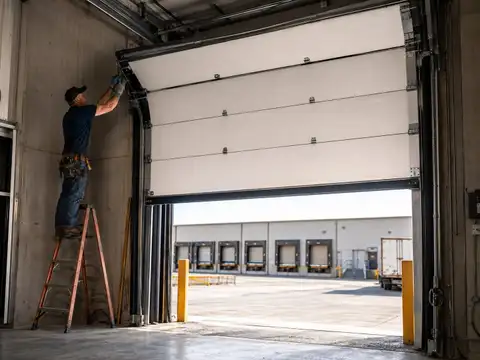
A 10×10 commercial sectional door product can start around $1,500–$1,800 in current supplier pricing—but a complete dock-door replacement can cost materially more once the rest of the opening is included.
The replacement decision should specify exactly what is being replaced: panels/sections only, complete door, tracks and springs, operator, controls, jamb/header structure or the entire opening system. Different bids can look far apart simply because they contain different scopes.
First ask: what does “replace the dock door” mean?
Appropriate when localized panel damage exists but tracks, counterbalance, hardware and operator remain serviceable and compatible.
New sections/curtain plus the door hardware package specified by the manufacturer.
More complete replacement where old track, counterbalance or hardware should not be carried forward.
Adds powered operation, electrical supply, safety/control devices and commissioning.
Includes damaged jamb/header/track attachment, structural repair, impact protection and other site work around the door.
Current commercial sectional-door product prices
Michiana Building Supplies currently publishes commercial Overhead Door Model 250/270 and 251/271 product pricing.
Its page identifies:
- Models 250/270 as non-insulated;
- Models 251/271 as insulated, R-6, with white vinyl backer.
| Door family | Size | Published base price | Use in planning |
|---|---|---|---|
| 250/270 non-insulated | 8×10 | $1,279 | Small commercial opening product anchor. |
| 250/270 non-insulated | 10×10 | $1,494 | Useful dock-door-size product anchor. |
| 250/270 non-insulated | 12×10 | $1,797 | Shows size effect within the same family. |
| 251/271 insulated R-6 | 8×10 | $1,529 | Insulated commercial product anchor. |
| 251/271 insulated R-6 | 10×10 | $1,825 | Default product anchor used in the calculator. |
| 251/271 insulated R-6 | 12×10 | $2,210 | Larger insulated opening example. |
A higher-performance commercial door can be a different product class
Overhead Door's current Thermacore Model 591 is a heavier insulated commercial sectional system with:
- 1 5/8-in steel-polyurethane-steel construction;
- R-value 14.86;
- U-factor 0.13;
- standard maximum width 35 ft 2 in;
- standard maximum height 24 ft 1 in.
That is materially different from a basic R-6 commercial door.
Therefore:
do not compare commercial door quotes on opening size alone.
Commercial door replacement budget
Loading Dock Door Replacement Calculator
Build a replacement budget from the door assembly outward. Product, operator, hardware, removal, installation, electrical and opening repair remain separate so the result can be reconciled with contractor bids.
Door + entered operator + non-duplicated hardware allowance.
Product package × modeled door count.
Removal, installation, electrical, opening repair and other entered scope.
Product + project/site scope + user-selected contingency.
Commercial door quotes vary in what is included. Confirm the bid scope before using separate hardware allowances. The default door price is a product anchor, not an installed-cost average.
How to use the replacement calculator
The default $1,825 door assembly input is simply the current published base price for one 10×10 insulated R-6 commercial sectional door example.
The calculator deliberately sets these default values to zero:
- operator;
- separate track/spring/hardware allowance;
- removal;
- installation;
- electrical;
- opening repair;
- other project costs;
- contingency.
Those values should come from:
- the selected product scope;
- the existing-condition survey;
- actual contractor and electrical quotes.
This prevents the tool from presenting a fictional installed-price average.
Do not double-count tracks, springs and hardware
Some commercial door packages include:
- sections;
- tracks;
- rollers;
- counterbalance hardware;
- weather seal.
Others may quote:
- door sections separately;
- operator separately;
- high-cycle spring upgrades separately;
- installation hardware separately.
Read the scope before adding a standalone hardware allowance in the calculator.
Commercial dock door replacement cost drivers
Width and height affect sections/curtain, track, spring/counterbalance and operator sizing.
Insulated steel-polyurethane-steel, non-insulated steel and specialty doors have different performance and cost.
Spring-cycle rating, operator duty and hardware durability should match actual traffic.
Bent tracks, jamb damage, broken attachments and structural deformation can turn a door swap into a larger repair.
Standard spring cycles matter in a busy loading dock
Overhead Door's Thermacore Model 591 currently lists:
10,000 cycles as standard springs.
It also offers high-usage components with torsion springs rated:
- 25,000 cycles;
- 50,000 cycles;
- 75,000 cycles;
- 100,000 cycles.
This is commercially important.
A dock door opening:
- 2 cycles/day;
- 20 cycles/day;
- 80 cycles/day
has a very different spring-life demand.
Convert cycles into a planning life
Example:
- 10,000-cycle spring;
- 20 full cycles/day;
- 250 operating days/year.
10,000 ÷ 20 ÷ 250 = approximately:
2 years of theoretical cycle count.
This is not a warranty or actual-life prediction.
It demonstrates why door-cycle data should be included when specifying spring packages.
Do not count a partial open/close event incorrectly
For procurement comparison, define how your operator/door system counts cycles.
Use:
- manufacturer/controller cycle count;
- WMS/facility monitoring;
- manual sample observation
rather than guessing from trailer count.
Commercial operator replacement can be its own project
Overhead Door's current Model 591 guidance says a:
chain hoist or electric operator is recommended for doors above 10 ft tall or more than 400 lb.
It also offers electric-operator configurations in:
- side;
- center;
- trolley mounting.
LiftMaster's current commercial-operator line separates:
- light-duty;
- medium-duty;
- industrial-duty;
- specialty commercial operators.
Operator cost should therefore be based on:
- door weight/size;
- cycles;
- mounting geometry;
- controls;
- facility requirements.
Do not automatically replace a serviceable operator
If replacing the door but retaining the existing operator, verify:
- compatibility with the new door;
- capacity/duty;
- mounting;
- control/safety interfaces;
- remaining condition/life;
- warranty implications.
The cheapest apparent bid can become expensive if an old operator fails shortly after the new door is commissioned.
Repair vs replace: inspect the complete moving system
Overhead Door's current commercial repair page explicitly lists repairs for:
- replacement sections;
- bent tracks;
- broken cables;
- broken springs;
- rollers;
- malfunctioning operators.
This is useful because it frames:
door failure as a system condition—not automatically a full replacement.
Repair may be economical.
One damaged section can sometimes be replaced while retaining a healthy track, spring/counterbalance and operator system.
Do not diagnose from the panel condition alone.
A visually intact door can still have a significant lifting or guidance-system defect.
Replacement becomes more attractive as repair frequency rises.
Overhead Door's repair-vs-replace guidance advises considering frequent repairs and the overall condition of springs, cables, rollers and tracks.
The opening may need repair before a new door can be installed.
Forklift/truck impact can affect track attachment, jambs, header and nearby dock equipment.
Springs, cables, counterbalance and powered operators can store or apply significant energy. Warehouse personnel should not improvise repairs to these components. Use qualified service procedures and the door/operator manufacturer's instructions.
Track replacement can change the project more than the door price suggests
Track configuration depends on available building space and the desired door path.
Commercial applications can use:
- standard lift;
- high lift;
- vertical lift;
- other configured arrangements.
Changing track can affect:
- wall/ceiling clearances;
- sprinklers/lights/ducts;
- operator location;
- seal/shelter mounting;
- maintenance access.
Survey the full door path, not only the wall opening.
Door opening dimensions are not the only dimensions that matter
Record:
- clear opening width;
- clear opening height;
- headroom;
- sideroom;
- backroom;
- jamb/header construction;
- dock seal/shelter projection;
- leveler/restraint relationships;
- sprinkler/MEP conflicts.
A 10×10 replacement door can have very different installation scope in two buildings.
Insulation changes more than purchase price
A loading dock opening can be a major thermal boundary.
Higher-performance insulated doors can reduce heat transfer while closed.
But the economic value depends on:
- indoor setpoint;
- outdoor climate;
- hours door remains open;
- door-opening frequency;
- seal condition;
- adjacent dock seal/shelter;
- air infiltration.
A high R-value door cannot recover energy while it is held open for long periods.
Air infiltration belongs in the specification
Overhead Door publishes for Model 591 an air-infiltration value of:
0.08 cfm/ft² at 25 mph.
This shows why an energy-conscious door comparison should include:
- thermal resistance;
- air infiltration;
- perimeter seals;
- actual operating time open.
Door panel R-value alone does not describe the entire dock-opening energy performance.
High-cycle usage can justify different hardware before the old door fails
If one dock has:
- far more trailer turns;
- frequent opening/closing between every load;
- automatic close controls;
- cold-storage cycling
then it may deserve:
- higher-cycle spring package;
- higher-duty operator;
- more robust track/hardware;
- planned maintenance based on cycles.
Do not standardize all dock doors to the lowest-cycle position by default.
Impact protection can be cheaper than repeated door replacement
Vestil sells overhead-door warning barriers specifically to warn:
- fork trucks;
- pallet trucks;
- other traffic
before contact with overhead doors and openings.
It also offers steel track protectors for overhead-door tracks.
These products do not eliminate all collision risk, but they highlight an important replacement question:
what caused the old door to fail?
If impact caused the damage, replacing the door without changing:
- clearance marking;
- traffic route;
- door position/control;
- track protection;
- operator behavior
can reproduce the same loss.
OSHA requires sufficient safe clearance through doorways used by mechanical handling equipment
OSHA 1910.176(a) states that sufficient safe clearances must be allowed:
- in aisles;
- at loading docks;
- through doorways;
- where turns or passage are made.
OSHA 1910.176(e) also requires clearance signs to warn of clearance limits.
This matters after door replacement if:
- track or hardware reduces usable clearance;
- a high-lift arrangement changes overhead clearance;
- forklift/load traffic passes through the opening.
Use the Warehouse Aisle Width Guide for the broader equipment-clearance logic.
The loading-dock edge remains a separate hazard
OSHA's powered-industrial-truck loading-dock guidance identifies:
- falling off the dock edge;
- skidding/slipping
as loading-dock hazards and recommends maintaining a safe distance from the edge.
A new door should not create a false assumption that the opening is safe whenever the door is raised.
Door operation, dock barriers/procedures and trailer/dock controls remain separate parts of the safety system.
Coordinate door replacement with the leveler, restraint and seal
The door exists inside a dock system.
Check:
- leveler control sequence;
- vehicle restraint interlock;
- dock-door position switch;
- communication lights;
- seal/shelter fit;
- bumper projection.
The Dock Leveler Cost article explains the leveler side.
The Loading Dock Equipment Cost article provides the broader per-dock equipment budget.
Controls integration can add hidden replacement cost
Modern docks may sequence:
- restraint engaged;
- door open;
- leveler enabled;
- interior/exterior lights;
- automatic door closing.
LiftMaster currently markets commercial operator/facility systems that can provide:
- door monitoring;
- door activity data;
- automatic closure;
- facility connectivity.
If the existing dock has these functions, include:
- inputs/outputs;
- control panel changes;
- programming;
- commissioning
in the replacement scope.
Replacement can affect dock downtime
For one door, downtime may be manageable.
For 20 doors, simultaneous work can reduce:
- receiving capacity;
- shipping capacity;
- yard flexibility;
- staging flow.
Plan:
- maximum doors offline at once;
- sequence by dock priority;
- temporary protection/weather control;
- off-hours work if justified;
- carrier/operations communication.
The warehouse-space planning guide treats docks as operational capacity, which is the right lens for replacement phasing.
When repair is usually worth pricing
Get a repair option when:
- damage is localized;
- replacement sections remain available;
- tracks are straight/secure;
- springs/cables/counterbalance are serviceable;
- operator remains suitable;
- the door's thermal/security performance still meets the need.
When full replacement deserves serious consideration
Compare full replacement when:
- multiple sections are damaged;
- tracks/jamb attachments are significantly damaged;
- springs/cables/hardware require extensive work;
- operator is obsolete or mismatched;
- repairs have become frequent;
- replacement parts are difficult to source;
- current insulation/security/wind performance no longer meets the facility need;
- the project is already changing the full dock system.
Overhead Door's own repair-vs-replace guidance recommends considering the overall condition of springs, cables, rollers and tracks and whether repair frequency is increasing.
Compare repair and replacement over a common horizon
Avoid:
comparing this year's repair bill with a full replacement quote and stopping there.
Do not use residential replacement averages for a warehouse dock
Commercial loading-dock doors can differ through:
- size;
- cycles;
- operator duty;
- track arrangement;
- impact exposure;
- dock controls;
- insulation/air infiltration requirement;
- installation access.
Residential national “garage door replacement cost” figures do not describe this scope.
Commercial dock door replacement audit
- Dock / door ID.
- Clear opening width and height.
- Headroom, sideroom and backroom.
- Door make/model if known.
- Door construction / insulation.
- Panel/curtain damage.
- Track condition and configuration.
- Rollers/hinges/hardware condition.
- Spring/counterbalance condition.
- Cable condition.
- Observed full cycles/day.
- Operator make/model/duty.
- Electrical supply.
- Safety/control devices.
- Restraint / leveler interlocks.
- Seal/shelter interface.
- Jamb/header/track attachment condition.
- Impact history / root cause.
- Required thermal performance.
- Required wind/load options.
- Removal/disposal scope.
- Installation/rigging access.
- Allowed door downtime.
- Warranty requirements.
- Repair option price.
- Full installed replacement price.
Why this calculator is separate from the loading dock equipment calculator
The loading-dock equipment cost guide excludes commercial overhead-door replacement from its base loading-dock equipment package.
A door replacement project has its own scope:
- sections/curtain;
- tracks;
- springs/counterbalance;
- operator;
- door-specific controls/safety devices;
- jamb/header attachment;
- opening damage.
The replacement calculator therefore models a distinct project rather than duplicating the leveler/restraint/seal calculator.
The decision rule
Start with the opening condition, not an online door price. Determine whether the project needs sections, a complete door, tracks/springs, an operator or full opening rehabilitation. Match the new door to opening size, cycles, thermal performance, duty and controls. Then normalize every bid across product, removal, installation, electrical, opening repair, commissioning and downtime. A $1,500–$2,000 door product can become a very different capital project once the condition of the complete dock opening is known.
Frequently asked questions
How much does a commercial loading dock door cost?
Current supplier product examples for commercial sectional doors include about $1,494 for a 10×10 non-insulated unit and $1,825 for a 10×10 insulated R-6 unit. Installation and project-specific components are additional.
How much does a 10×10 commercial overhead door cost?
Current Michiana Building Supplies pricing lists a 10×10 non-insulated Model 250/270 base price of $1,494 and a 10×10 insulated R-6 Model 251/271 base price of $1,825.
Does commercial dock door price include installation?
Do not assume it does. Supplier door prices may not include removal, professional installation, structural/opening repair, electrical work, controls, operator, commissioning or downtime.
How much does commercial dock door replacement cost installed?
Installed cost is project-specific. Build it from the selected door/operator package plus removal, installation, electrical/controls, opening repair, freight and any other identified scope.
Should I repair or replace a damaged warehouse overhead door?
Localized panel, track, roller, cable or spring issues can sometimes be repaired. Full replacement becomes more attractive when multiple systems are deteriorated, repair frequency is rising or the existing door no longer fits the operating need.
How many cycles do commercial door springs last?
It depends on the specified spring package. Overhead Door's current Thermacore 591 lists 10,000-cycle standard springs and optional high-usage packages at 25,000, 50,000, 75,000 and 100,000 cycles.
Do commercial loading dock doors need an electric operator?
Not every door does. Overhead Door currently recommends a chain hoist or electric operator for its Model 591 when the door is above 10 ft tall or more than 400 lb. Application and duty still determine the appropriate operator.
What is a good R-value for a loading dock door?
There is no universal value. Current commercial products range across different thermal-performance classes; select insulation based on indoor conditions, climate, opening frequency and the rest of the dock environmental-control system.
What causes commercial dock doors to need replacement?
Common causes include impact damage, panel deterioration, bent tracks, broken springs/cables, operator problems, repeated repairs, corrosion and changing thermal or operational requirements.
Can I replace only one damaged door section?
Sometimes. Overhead Door lists replacement sections as a commercial repair service. Compatibility, section availability and the condition of tracks, springs, cables and other components should be checked.
Does OSHA regulate warehouse doorway clearance?
OSHA 1910.176(a) requires sufficient safe clearances through doorways where mechanical handling equipment is used, and 1910.176(e) requires clearance signs warning of clearance limits.
Should I replace the operator when replacing the commercial door?
Not automatically. Verify that the existing operator is compatible, correctly sized for duty, properly mounted and in suitable condition. If it is obsolete or near end of life, replacing it during the door project may reduce future disruption.
Sources and methodology
Warehouse Fieldbook separates current door-product prices from installed replacement cost. Current commercial sectional-door price anchors were taken from Michiana Building Supplies' published Overhead Door Model 250/270 non-insulated and 251/271 insulated R-6 pricing observed in August 2026. Overhead Door's current Thermacore 591 data is used for thermal performance, standard/high-cycle spring options, size limits and operator guidance, while its commercial repair resources support the distinction between section, track, cable, spring, roller and operator repair. LiftMaster's current commercial operator line is used only to show that operator duty/application varies. OSHA 29 CFR 1910.176 supplies the U.S. mechanical-handling clearance boundary through loading docks and doorways, and OSHA's powered-industrial-truck dock guidance supplies the dock-edge hazard context. Prices are point-in-time product examples, not national installed averages or guaranteed future prices.
- Michiana Building Supplies — current commercial Overhead Door 250/270 and 251/271 pricing
- Overhead Door — Thermacore Model 591 commercial sectional door specifications
- Overhead Door — commercial door repair scope: sections, tracks, cables, springs, rollers and operators
- Overhead Door — repair vs replacement decision factors
- LiftMaster — current commercial door operator families and warehouse applications
- Vestil — overhead door warning barriers for warehouse and dock traffic
- Vestil — overhead door track protectors
- OSHA — 29 CFR 1910.176 safe clearances at loading docks and through doorways
- OSHA — powered industrial truck loading-dock hazards and recommended practices