
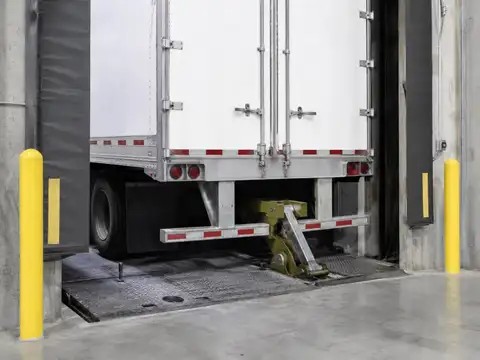
Basic wheel chocks cost tens of dollars; current manual and automatic dock restraint packages cost roughly $3,200–$4,750 before site-specific installation and integration.
The expensive part of a vehicle-restraint project is not only the steel device. A complete system can include mounting, power, interior/exterior lights, controls, interlocks, alarms, commissioning, trailer-compatibility review and a documented procedure for trailers the restraint cannot capture.
Trailer-control ladder
Price rises as the control system becomes more active, integrated and trailer-tolerant.
Start with the vehicle types and operating procedure. Then decide how trailer movement will be prevented, how engagement is confirmed and what happens when the primary restraint cannot capture the trailer.
Manual placement/removal. No automatic dock interlock unless a monitored system is added.
Current basic product examples: tens of dollars each.Operator engages/releases the restraint. Compatibility depends on rear impact guard geometry.
Current example: $3,199 equipment package.Can support interior control, communication lights and interlocked dock sequences.
Current example: $4,749 equipment package.Useful where rear impact guards are missing or incompatible; requires its own application review.
Manufacturer-specific quote rather than a universal price.Current vehicle-restraint product prices
Current Global Industrial rubber wheel-chock example.
Current Ideal Warehouse example; listing recommends two per loading-dock position.
Current manual PowerStop MML kit with lights and signs.
Current automatic PowerStop AAL-SC package with automatic lights/signs.
Wheel chocks are cheap equipment—but the system depends heavily on procedure
A current Global Industrial laminated rubber wheel chock is listed at:
$35.95.
A current Ideal Warehouse laminated chock is listed at:
$46.95.
That product page recommends:
two wheel chocks per loading dock position.
Equipment purchase is therefore inexpensive compared with a powered restraint.
But the operating system must reliably answer:
- Who places the chocks?
- Who confirms they are present?
- Who removes them?
- What prevents premature trailer departure?
- How is dock staff told that the trailer is ready?
- What happens in snow, ice, rain or poor pavement conditions?
OSHA explicitly addresses vehicle movement
OSHA 1910.26(d) requires measures such as:
- wheel chocks;
- sand shoes;
- other means
to prevent a transport vehicle from moving while employees are on a dockboard.
OSHA 1910.178(k)(1) separately states that brakes must be set and wheel blocks placed under the rear wheels to prevent highway trucks from rolling while they are boarded with powered industrial trucks.
Do not assume that purchasing a powered vehicle restraint automatically replaces every OSHA requirement that may apply to your operation. The exact standard, vehicle, dockboard/leveler use and operating procedure matter. Build the safety procedure from the applicable OSHA requirements and the restraint manufacturer's instructions.
Manual RIG restraint cost
Global Industrial currently lists the DLM Manual PowerStop MML restraint kit with lights and signs at:
$3,199.
The related current PowerStop product description identifies:
- low-profile design;
- non-impact/self-aligning operation;
- compatibility with multiple dock-leveler types;
- up to 30,000 lb of pull-out force;
- horizontal and vertical service envelopes.
A manual restraint can reduce reliance on workers walking to the trailer wheels, but it still depends on:
- operator engagement;
- confirmation;
- communication;
- trailer RIG compatibility.
Automatic vehicle restraint cost
Global Industrial currently lists the DLM Auto PowerStop AAL-SC restraint with automatic lights and signs at:
$4,749.
Powered restraint systems can add:
- interior controls;
- automatic engagement/release logic;
- inside/outside communication lights;
- audible alarms;
- leveler/door interlocks;
- diagnostics.
These features can reduce dependence on a manual process but increase:
- equipment cost;
- electrical work;
- controls scope;
- commissioning;
- maintenance complexity.
Blue Giant's current powered-restraint approach shows why controls matter
Blue Giant's StrongArm HVR303 uses:
- electro-mechanical hook restraint;
- interior/exterior LED communication;
- audible alarm capability;
- touch controls.
The current product page publishes:
- 9–26 in vertical restraining range;
- 16 in of instant float;
- 32,000 lb restraining force;
- design intended to comply with ANSI MH30.3.
That illustrates the real comparison:
not manual steel versus powered steel, but:
device + detection + communication + sequence of operation.
ANSI MH30.3-2022 is the current U.S. industry standard for vehicle restraining devices
MHI/LODEM currently lists:
ANSI MH30.3-2022 — Design, Testing, and Utilization of Vehicle Restraining Devices.
MHI states that the standard defines performance and testing requirements for:
- design;
- use;
- maintenance
of vehicle restraining devices.
When comparing restraint products, ask vendors:
- whether the model is designed/tested to ANSI MH30.3;
- what rating/test claims are manufacturer-declared;
- what installation/application requirements support those claims.
Vehicle restraint types
Lowest equipment cost; procedure-intensive.
Physically blocks wheel movement. Requires reliable placement/removal and a communication process.
Mechanical restraint mounted at the dock face.
Engages a compatible rear impact guard and can be paired with communication lights/signs.
Automatic/powered engagement with feedback and controls.
Supports interior operation, communication and more sophisticated interlocking with dock equipment.
Controls trailers through the wheel rather than relying on a RIG.
Blue Giant recommends wheel-based alternatives such as its Interlock Chock or WVR303 when a trailer lacks a usable ICC/RIG bar.
Trailer compatibility can matter more than restraint price
A rear-impact-guard restraint cannot safely control a trailer it cannot capture.
Survey:
- RIG/ICC bar presence;
- bar height;
- bar condition;
- bar setback from dock face;
- obstructions;
- air-ride suspension movement;
- liftgate or special-trailer hardware;
- straight trucks / vans / containers;
- dropped trailers.
Blue Giant's current FAQ specifically notes:
when the ICC bar is missing, evaluate wheel-based restraints.
Build a trailer-compatibility matrix
| Trailer condition | RIG-hook restraint | Wheel-based / fallback consideration |
|---|---|---|
| Standard compatible rear impact guard | Primary application for many dock-mounted hook restraints. | May not be necessary as primary method. |
| Bent/damaged but capturable RIG | Some modern restraints publish tolerance for damaged/bent bars; verify model envelope. | Keep a documented fallback if engagement fails. |
| Missing / non-capturable RIG | Cannot assume engagement. | Wheel-based restraint/chocking or another approved procedure may be needed. |
| Special vehicle / liftgate / straight truck | Application review required. | Alternative vehicle-control method may be the real design basis. |
| Dropped trailer | Horizontal restraint does not solve every trailer-stability hazard. | Review support/stabilization requirements separately. |
The restraint is only one cost line
Manual, powered, hydraulic, electric or wheel-based equipment selected for the trailer envelope.
Anchors, welds, steel/concrete condition and mounting geometry can affect the installed cost.
Powered restraints may require conduit, disconnects, transformer or other electrical work.
Integration with leveler, door, seal/inflatable and dock lights can create a larger control project.
Confirm engagement logic, communication states, overrides, fault handling and operator procedure.
Wheel-based equipment, chocking, alternate dock assignment or another documented control method may require additional cost.
Installed vehicle restraint system cost
For a multi-dock project, also include:
- freight;
- dock closures;
- off-hours installation;
- central control panels;
- network/monitoring where selected;
- spares/maintenance setup.
Do not use a universal installation percentage
Installation varies with:
- dock-face condition;
- concrete/steel mounting;
- existing electrical service;
- distance to panel;
- control architecture;
- existing leveler/door;
- working hours;
- number of dock positions.
Use actual installation/electrical quotes.
Integrated controls can add value beyond the restraint itself
Blue Giant's current Gold Series III control platform can control:
- dock leveler;
- vehicle restraint;
- optional overhead door;
- inflatable seal;
- dock light.
Blue Giant states that the leveler can be prevented from operating unless the vehicle restraint is:
secured or under supervisory override.
This type of sequence can reduce:
- manual step skipping;
- ambiguous communication;
- unsafe equipment sequencing.
But it must be included in:
- electrical design;
- control programming;
- commissioning;
- maintenance.
Overrides need governance
Rite-Hite's 2025 dock-safety guidance warns about unsafe use of equipment overrides.
A restraint system should define:
- who may override;
- why override is permitted;
- what alternative vehicle-control method is required;
- how the status is communicated;
- whether the event is logged.
An override should not become the normal way to serve incompatible trailers.
“Boots off the ground” changes the restraint economics
Rite-Hite describes powered restraints as supporting facilities that want dock personnel to operate the vehicle control from inside rather than walking onto the drive approach.
This can affect the business case through:
- less outdoor manual chock placement;
- faster engagement/release;
- better status visibility;
- more standardized process.
It also creates:
- higher capital cost;
- controls maintenance;
- compatibility/fallback requirements.
Pull-out force is not the only selection metric
Current manufacturer examples publish values such as:
- 30,000 lb pull-out force for DLM PowerStop;
- 32,000 lb restraining force for Blue Giant HVR303;
- 35,000 lb for Blue Giant SVR303.
But also compare:
- vertical engagement range;
- horizontal reach;
- trailer float;
- RIG condition tolerance;
- mounting method;
- controls;
- maintenance access;
- ANSI MH30.3 claim/certification basis.
Survey every dock position before quoting a retrofit
Rite-Hite's current rotating-hook product documentation states that a completed dock survey is required for each dock position to help ensure proper application.
That is a useful procurement rule regardless of brand.
Record:
- dock height;
- dock-face condition;
- bumper projection;
- leveler type;
- door/seal/shelter;
- approach grade;
- vehicle envelope;
- available power;
- control equipment;
- mounting obstructions.
The Dock Leveler Cost guide explains the adjacent leveler/pit survey.
The Dock Seal vs Dock Shelter guide covers the trailer-to-building enclosure geometry.
Wheel-based restraints are especially important in mixed fleets
Blue Giant's current FAQ recommends wheel-based restraints when a usable ICC/RIG bar is missing.
Rite-Hite's current GWC-1000 wheel restraint is marketed as:
- a wheel-based vehicle restraint;
- certified to exceed ANSI MH30.3 performance testing standards;
- compliant by design with OSHA 29 CFR 1910.178 according to the manufacturer.
Wheel-based systems can be useful for:
- trailers without capturable rear impact guards;
- mixed international/special trailer fleets;
- docks where RIG compatibility has historically been poor.
They still require:
- vehicle/tire envelope review;
- drive-approach suitability;
- controls/communication;
- operator training.
Dropped trailers create a separate stability question
Vehicle restraint addresses horizontal trailer separation.
A dropped semitrailer can also have:
- landing-gear loading;
- upending;
- vertical movement;
- support/stability concerns.
OSHA 1910.178(k)(3) states that fixed jacks may be necessary to support a semitrailer during loading/unloading when it is not coupled to a tractor.
Do not assume a dock-mounted horizontal restraint solves every dropped-trailer hazard.
Vehicle restraint and door/leveler interlock should be decided together
A possible controlled sequence is:
- Trailer arrives.
- Restraint engages / vehicle-control status confirmed.
- Interior safe status is displayed.
- Door is permitted to open.
- Leveler is permitted to deploy.
- Loading/unloading occurs.
- Leveler stores.
- Door closes.
- Restraint releases.
- Exterior driver signal changes.
The exact sequence should match the selected manufacturer's controls and the facility procedure.
The Commercial Loading Dock Door Replacement Cost guide covers the door/control side of this interface.
Use the loading-dock equipment calculator for the complete dock package
The Loading Dock Equipment Cost calculator already includes an editable vehicle-restraint line item together with:
- leveler;
- seal/shelter;
- dock light;
- bumpers/hardware;
- site/installation work;
- other project costs;
- contingency.
Use this article to select the correct restraint architecture, then place the actual restraint and controls quotes into that calculator.
Why a restraint-only calculator would duplicate the cost model
A restraint-specific calculator would largely repeat:
quantity × equipment price + installation + electrical + controls.
That arithmetic already exists in the loading-dock equipment cost guide.
The higher-value question here is:
which trailers can the selected restraint actually control and what fallback is required for the rest?
Vehicle restraint procurement audit
- Dock IDs and dock-position count.
- Trailer types/frequencies.
- RIG/ICC bar presence and condition.
- RIG height/setback envelope.
- Air-ride suspension / trailer float.
- Special trailers, liftgates, straight trucks and vans.
- Dropped-trailer frequency.
- Applicable OSHA vehicle-control procedure.
- Wheel-chock / alternative-control procedure.
- Restraint type by trailer class.
- ANSI MH30.3-2022 conformity/test documentation requested.
- Published pull-out/restraining force.
- Published engagement range.
- Dock-face / pavement mounting condition.
- Power requirement.
- Interior/exterior communication lights.
- Audible alarms.
- Door interlock.
- Leveler interlock.
- Override authority/procedure.
- Fallback for failed/non-compatible engagement.
- Installation labor.
- Electrical / controls work.
- Commissioning.
- Operator / maintenance training.
- Planned maintenance program.
- Spare parts / service response.
- Dock downtime during retrofit.
- Equipment price.
- Total installed system price.
How to compare restraint quotes
A lower quote is not comparable if:
- it omits lights;
- it omits controls;
- it excludes electrical installation;
- it cannot serve a material share of the trailer fleet;
- it has no defined fallback procedure;
- commissioning/training is excluded.
The decision rule
Build the vehicle-restraint system around the trailers and the operating procedure. Wheel chocks have low equipment cost but depend heavily on manual execution. Dock-mounted manual restraints add positive mechanical capture and communication. Powered restraints add interior operation, feedback and interlocks. Wheel-based restraints can address trailers that cannot be captured reliably by a rear-impact-guard hook. Compare total installed system cost only after compatibility, OSHA obligations, controls, fallback and commissioning are defined.
Frequently asked questions
How much does a loading dock vehicle restraint cost?
Current public product examples include $3,199 for a DLM manual PowerStop restraint kit with lights/signs and $4,749 for a DLM automatic restraint with automatic lights/signs. Installation, electrical and controls may be additional.
How much do loading dock wheel chocks cost?
Current commercial product examples range from about $35.95 to $46.95 each for heavy rubber/laminated chocks, with other designs costing more.
Are wheel chocks required by OSHA?
OSHA 1910.178(k)(1) explicitly requires brakes to be set and wheel blocks placed under the rear wheels of highway trucks to prevent rolling while they are boarded with powered industrial trucks. OSHA 1910.26(d) separately requires measures such as chocks, sand shoes or other means to prevent transport-vehicle movement while employees are on a dockboard.
Can a vehicle restraint replace wheel chocks?
Do not make that assumption generically. The answer depends on which OSHA standards apply to the operation and the approved vehicle-control procedure. Review the specific standards and manufacturer instructions.
What is a RIG restraint?
It is a dock-mounted restraint designed to engage a trailer's rear impact guard, also commonly referred to as an ICC/RIG bar in industry materials.
What if a trailer has no usable ICC/RIG bar?
A RIG-hook restraint may not be able to capture it. Blue Giant recommends evaluating wheel-based restraints such as its Interlock Chock or WVR303 when the ICC bar is missing.
Do vehicle restraints integrate with dock levelers and doors?
Yes. Current Blue Giant controls can integrate vehicle restraints with levelers, communication lights and optional overhead doors and other dock equipment.
What causes vehicle-restraint installation cost to increase?
Dock-face/pavement repair, difficult mounting, electrical supply, control integration, interlocks, multiple communication devices, off-hours installation and special trailer requirements can increase cost.
How much restraining force should a trailer restraint have?
Do not choose from one force number alone. Current manufacturer examples publish 30,000–35,000-lb force values, but engagement range, trailer compatibility, installation and ANSI MH30.3 testing/conformity also matter.
Do I need a powered restraint?
Not necessarily. Powered restraint value increases where interior operation, automatic status, integrated communication and interlocks are important. Trailer compatibility and fallback still need to be addressed.
Does a vehicle restraint support a dropped trailer?
Not necessarily. Horizontal trailer restraint does not automatically solve landing-gear or vertical-stability hazards. OSHA 1910.178(k)(3) notes that fixed jacks may be necessary for an uncoupled semitrailer during loading/unloading.
A vehicle restraint addresses trailer movement, but it is not the complete dock-safety system. See the loading dock safety equipment guide for the surrounding controls that still need to be evaluated.
Sources and methodology
Warehouse Fieldbook separates current equipment pricing from installed restraint system cost. Current public U.S. price anchors observed in August 2026 come from Global Industrial listings for wheel chocks and DLM PowerStop manual/automatic restraint packages. OSHA 29 CFR 1910.26(d) and 1910.178(k) provide the U.S. vehicle-movement and powered-industrial-truck safety requirements used here. The current MHI/LODEM listing for ANSI MH30.3-2022 supplies the industry-standard design/testing/utilization reference. Blue Giant and Rite-Hite current product materials are used for restraint types, trailer compatibility, controls, interlocks, engagement ranges and survey practices. Manufacturer performance claims are identified as manufacturer claims rather than universal regulatory requirements. Product prices are point-in-time examples, not national installed averages.
- OSHA — 29 CFR 1910.26 Dockboards
- OSHA — 29 CFR 1910.178 Powered industrial trucks
- MHI / LODEM — ANSI MH30.3-2022 vehicle restraining devices standard listing
- Global Industrial — current commercial wheel-chock product-price examples
- Global Industrial — current $46.95 Ideal Warehouse chock example
- Global Industrial — current DLM vehicle-restraint price examples
- Global Industrial — current DLM PowerStop product/application example
- Blue Giant — current vehicle-restraint types, compatibility, interlock and maintenance FAQ
- Blue Giant — HVR303 engagement range, restraining force and control features
- Blue Giant — SVR303 hydraulic restraint and ANSI MH30.3 manufacturer declaration
- Blue Giant — integrated dock leveler/restraint/door/light control
- Rite-Hite — current Dok-Lok vehicle restraint systems
- Rite-Hite — vehicle restraint selection and inside-operated restraint context
- Rite-Hite — GWC-1000 wheel-based restraint
- Rite-Hite — rotating-hook restraint survey, installation and ANSI MH30.3 claims
- Rite-Hite — 2025 dock override / interlock safety guidance