
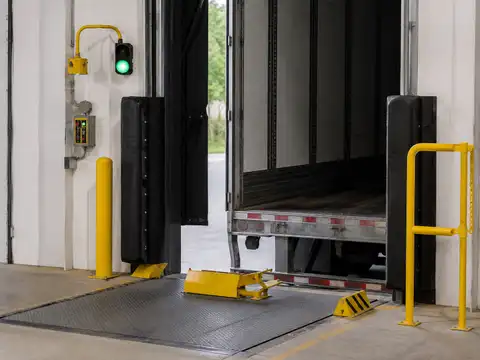
Build the dock around failure modes, not around a shopping list.
Start with the event that can hurt someone: trailer moves while a forklift is inside, a bridge shifts, an uncoupled trailer upends, a forklift runs off an open dock, a worker steps into the drive approach, or equipment operates in the wrong sequence. Then select equipment and procedures that control that event.
The restraint, leveler, barrier, lights and controls should operate as one transfer system.Buying “dock safety equipment” without defining the trailer fleet and operating sequence.
RIG geometry, intermodal chassis, liftgate trailers, trailer height, uncoupled loading, forklift axle loads, dock approach, door geometry and existing controls can all change what equipment will work.
Application survey first; product selection second.Dock-bay safety map
Match the Equipment to the Failure Mode
A safe dock is a sequence of controls around one transfer event. No single device covers trailer movement, bridge failure, open-edge falls, trailer support, pedestrian conflict and miscommunication at the same time.
Control early departure, trailer creep or other movement before a forklift crosses into the trailer.
Address landing-gear/upending exposure when a semitrailer is loaded or unloaded without a tractor attached.
Bridge the height/gap safely without movement, run-off exposure or capacity mismatch.
Protect the dock opening when no trailer or bridge condition removes the open-edge hazard.
Communicate trailer/restraint status and reduce the chance that the door, leveler or restraint operates out of sequence.
Do not drive a powered industrial truck into a trailer with damaged/weak flooring or without a clear operating view.
Keep employees out of the truck approach and forklift transfer path unless their task requires access.
A damaged restraint, leveler, barrier, door or control system cannot protect the dock simply because it is installed.
OSHA 1910.26 sets the current federal dockboard baseline
Under 29 CFR 1910.26, an employer must ensure each dockboard meets the section's requirements.
The current rule includes:
- capacity for the maximum intended load;
- run-off protection for dockboards put into initial service on or after January 17, 2017, subject to the stated exception;
- securement of portable dockboards against movement, with a limited feasibility exception;
- measures such as wheel chocks or sand shoes to prevent the transport vehicle from moving while employees are on the dockboard;
- handholds or another safe-handling means for portable dockboards.
OSHA also regulates how forklifts cross the dockboard
OSHA 1910.178(n)(11) requires dockboards or bridgeplates to be properly secured before they are driven over, driven over carefully and slowly, with rated capacity never exceeded.
OSHA 1910.178(m)(6) also requires a safe distance from the edge of elevated docks and platforms.
ANSI MH30.1-2022 is the current LODEM dock-leveling standard listed by MHI
MHI's current LODEM specifications page lists ANSI MH30.1-2022 — Performance and Testing Requirements for Dock Leveling Devices.
Treat this industry standard separately from OSHA requirements.
It is useful for product specification and testing, but Warehouse Fieldbook does not present it as if it were itself an OSHA regulation.
Match each safety device to the hazard it actually controls
| Equipment | Primary safety function | Critical diligence before buying |
|---|---|---|
| Wheel chocks / wheel-based chock system | Prevent trailer movement by blocking the wheels when correctly selected/placed. | Tire geometry, surface/grade, chock material, inspection, placement/removal process and communication. |
| RIG-engaging vehicle restraint | Mechanically secure compatible trailer rear-impact guard to the dock. | RIG presence/condition/height, obstructions, intermodal/liftgate trailer mix, engagement verification and bypass procedure. |
| Rear-wheel vehicle restraint | Secure trailers where RIG engagement is not the preferred/available method. | Wheel position range, approach geometry, snow/debris, trailer configurations and operating sequence. |
| Trailer stand / fixed jack | Support an uncoupled semitrailer against upending/landing-gear instability where necessary. | Trailer loading pattern, placement, support capacity, surface and whether tractor is attached. |
| Dock leveler / dockboard | Create the structural bridge from dock to trailer. | Capacity/application, trailer height range, lip engagement, run-off protection, maintenance and forklift traffic. |
| Dock-edge gate / barrier | Protect people/equipment from an open dock drop-off when the opening is not safely occupied by a trailer/bridge condition. | Guardrail compliance where used as fall protection, impact rating if vehicle containment is claimed, width, anchorage and operation. |
| Inside/outside communication lights | Tell dock workers and drivers whether the current dock state permits loading or departure. | Color logic, line of sight, driver instructions, failure indication and whether the light reflects actual restraint state. |
| Interlocked controls | Prevent selected equipment from operating until prerequisite dock conditions are satisfied. | Defined safe sequence, bypass authorization, fault mode, compatibility and training. |
| Dock lights / trailer lights | Improve visibility inside trailers and around transfer zones. | Glare, mounting vulnerability, trailer geometry, electrical/environmental rating and shadowing from loads. |
| Pedestrian barrier / protected route | Keep people away from vehicle approach, trailer path and forklift transfer zone. | Actual pedestrian destinations, egress, barrier capability, crossings and delivery-driver access. |
Vehicle securement is the first transfer gate
OSHA 1910.178(k)(1) says highway-truck brakes shall be set and wheel chocks placed under rear wheels to prevent rolling while the truck is boarded by powered industrial trucks.
OSHA 1910.178(m)(7) similarly addresses brakes and wheel blocks during loading/ unloading.
OSHA also maintains an agency-wide directive for positive mechanical dock restraints
OSHA Directive STD 01-11-007 currently posted by OSHA allows a positive mechanical means to secure trucks or trailers to a loading dock under specified conditions when it effectively prevents movement during loading, unloading and boarding.
The directive also says the equipment must be installed, maintained and used according to manufacturer recommendations, and damaged mechanical equipment is removed from service immediately.
Commercial-motor-vehicle preemption has generated OSHA interpretation history. The 2011 OSHA clarification explains that FMCSA parking-brake regulation preempts OSHA's chocking requirements for certain CMV-driver working conditions, while PIT operators still must not board a trailer unless it is properly secured or restricted from movement. Do not turn this guide into a site-specific legal conclusion: verify the employer, vehicle and operating context.
Three trailer-securement architectures
Strong procedure and placement discipline are essential. Surface, grade and chock condition matter; the process also requires access near the trailer wheels.
Survey the trailer fleet. Obstructed, missing or incompatible RIGs, intermodal chassis and liftgates can change the suitable restraint architecture.
Confirm the manufacturer's wheel-position range and facility geometry rather than assuming every wheel-based restraint fits every trailer.
For purchase scope and budget structure, see Vehicle Restraint System Cost.
Uncoupled trailers add an upending/support problem
OSHA 1910.178(k)(3) says fixed jacks may be necessary to support a semitrailer and prevent upending during loading or unloading when the trailer is not coupled to a tractor.
The similar language appears in 1910.178(m)(7).
A vehicle restraint that prevents trailer separation should not automatically be assumed to replace whatever support the uncoupled trailer needs.
Check the trailer floor before the forklift enters
OSHA 1910.178(m)(7) also requires the flooring of trucks, trailers and railroad cars to be checked for breaks and weakness before they are driven onto.
This is not an accessory purchase problem. It is an operating gate that belongs in the dock procedure.
Open dock edges create a separate fall hazard
OSHA 1910.28(b)(1) generally requires protection where an employee is on a walking-working surface with an unprotected side/ edge 4 feet or more above a lower level, subject to the section's specific provisions and exceptions.
For the working side of a loading dock, 1910.28(b)(1)(iii) contains a specific infeasibility provision while the work operation is in process, with access limited to authorized trained employees.
Dockboards have their own fall-protection provision
OSHA 1910.28(b)(4) generally requires employees on dockboards exposed to falls of 4 feet or more to be protected by guardrails or handrails.
The rule has an exception where dockboards are used solely for materials-handling operations using motorized equipment, employees are not exposed to fall hazards greater than 10 feet and the employees have the required training.
Dock edges and dockboards are covered by specific provisions and exceptions. Whether a gate, rail, barrier or another fall-protection method is required depends on the work configuration. A product marketed for dock-edge protection still has to satisfy the applicable OSHA criteria for the way it is being used.
Guardrail compliance is not the same as forklift impact containment
OSHA 1910.29(b) sets criteria for guardrail systems, including a top-edge height around 42 inches, plus a 200-pound top-rail strength criterion and associated requirements.
Those guardrail criteria should not be interpreted as an impact rating for stopping a powered forklift.
Confirm the product and installation satisfy the OSHA criteria applicable to the opening and work.
Ask for the manufacturer's weight/speed/impact chart and anchorage requirements if the barrier is claimed to stop material-handling equipment.
Manual devices rely on behavior; powered/interlocked systems can reduce certain sequence errors when designed correctly.
Current Rite-Hite products illustrate why product ratings must remain product-specific
Rite-Hite's current Dok-Guardian LD and LDXL page says those lighter-duty barriers are designed to stop up to 5,500 lb and directs buyers to the product's impact rating charts for complete weight/ speed ratings.
Rite-Hite separately offers heavier dock barrier products. Therefore do not transfer one model's impact number to another barrier or to a homemade gate.
Communication lights are valuable only if their meaning is unambiguous
A dock light system should answer two separate questions:
- Can the forklift operator enter the trailer?
- Can the driver depart the dock?
Define red/ green meaning on both sides of the wall, train employees and drivers, and define what happens during fault/ bypass conditions.
Interlocks can turn the safe sequence into equipment logic
Rite-Hite currently publishes control sequences that can integrate vehicle restraints, dock levelers, overhead doors, dock lights and other hazard controls.
Its current “Closed Door” example follows a sequence that verifies a trailer, engages the restraint, communicates safe status, opens the door, raises the leveler, then reverses that sequence after loading.
Verify trailer present, securement and support status.
Confirm the trailer is correctly positioned, restrained/chocked as required, supported where necessary and safe to board.
Open the door, deploy the leveler/bridge and verify lip/bridge engagement.
Confirm rated equipment, proper position and no visible fault before forklift crossing begins.
Control forklift travel, trailer floor condition and pedestrian access.
Keep the dock face clear, use safe forklift speed and maintain the defined inside/outside communication state.
Clear trailer, store leveler, close access and then release vehicle.
Interlocks can prevent selected out-of-sequence actions; bypass should be controlled and documented.
Maintenance is part of the safety function
OSHA's mechanical-restraint directive specifically requires damaged mechanical equipment to be removed from service immediately.
The same principle should drive site inspection of:
- restraint hooks/barriers/wheel mechanisms;
- chocks and chains/handles;
- leveler deck, lip, hinges and maintenance supports;
- hydraulic/pneumatic/electrical faults;
- dock bumpers and structural attachment;
- barrier/gate anchors and impact damage;
- inside/outside signal lights;
- interlock sensors and bypass state;
- door tracks and controls;
- trailer stands/jacks.
Use Loading Dock Maintenance Cost to build the recurring maintenance budget around the actual installed equipment.
Leveler selection and safety are tied to application
A leveler selected only by nominal capacity can still be wrong for the application.
Confirm:
- forklift type and gross loaded weight;
- axle/load concentration and traffic frequency;
- trailer bed-height range;
- pit dimensions;
- lip length and required overlap;
- below-dock/end-load requirements;
- environment/corrosion/washdown;
- stored/cross-traffic position;
- restraint/control interlock compatibility.
For acquisition economics see Dock Leveler Cost.
Safety equipment should be budgeted as a system
A vehicle restraint quote may not include:
- inside/outside lights;
- combined control panel;
- door interlock;
- leveler interlock;
- concrete/face repair;
- power/control wiring;
- traffic signs;
- dock-edge barrier;
- trailer stand;
- commissioning/training.
Build the complete scope with Loading Dock Equipment Cost instead of comparing isolated hardware quotes.
Loading dock safety equipment audit
- Trailer fleet types documented.
- RIG presence/geometry/condition range documented.
- Intermodal chassis/liftgate/obstructed-RIG trailers identified.
- Trailer height range documented.
- Tractor-coupled vs uncoupled loading documented.
- Drive approach/grade documented.
- Wheel-chock method/procedure defined where used.
- Positive mechanical restraint suitability evaluated.
- Restraint engagement verification defined.
- Restraint bypass procedure authorized and documented.
- Inside/outside light meaning defined.
- Driver instructions defined.
- Trailer stand/fixed-jack need evaluated for uncoupled trailers.
- Dockboard/leveler maximum intended load confirmed.
- Forklift + load + operator/application effects considered.
- Dockboard run-off protection requirement reviewed.
- Portable dockboard securement reviewed if applicable.
- Portable dockboard safe handling means reviewed if applicable.
- Leveler/dockboard rated capacity visible.
- Leveler lip/bridge engagement verified.
- Trailer floor inspection included before forklift entry.
- Open dock-edge fall exposure assessed.
- 1910.28 dock/dockboard provisions reviewed for actual work.
- Guardrail criteria distinguished from forklift-impact rating.
- Barrier product impact chart reviewed where containment is claimed.
- Barrier/gate anchorage reviewed.
- Pedestrian route through dock area mapped.
- Driver/pedestrian drive-approach access controlled.
- Door/leveler/restraint sequence documented.
- Interlock logic documented.
- Fault/bypass state documented.
- Inside light visible from forklift approach.
- Outside light visible to driver.
- Dock/trailer interior lighting adequate.
- Leveler maintenance support/energy-control procedure documented.
- Restraint inspection procedure documented.
- Chock inspection procedure documented.
- Barrier/gate inspection procedure documented.
- Signal/interlock functional test documented.
- Damaged equipment out-of-service criteria documented.
- Manufacturer manuals available.
- Operator/dock-attendant training completed.
- Maintenance ownership assigned.
- PM frequency based on manufacturer/application.
- Incident/near-miss reporting tied to dock location.
- Trailer-separation events tracked.
- Barrier/restraint impacts tracked.
- Bypass events tracked.
- System revalidated after trailer-fleet/process/equipment changes.
- Complete installed scope—not hardware price alone—approved.
Why safety-package selection should not be reduced to one score
A calculator that turns trailer weight, dock height and forklift weight into one “required safety package” would create false precision.
Restraint compatibility, dockboard/ leveler application, trailer support, fall protection, barrier impact capability, controls and CMV legal context all require product- and site-specific evaluation.
The useful tool is the layer map plus equipment-selection and audit matrices.
The decision rule
Start with trailer movement and support, then verify the structural transfer device, open-edge protection, communication/interlocks, trailer floor, people and maintenance. Use wheel chocks or an appropriate positive mechanical restraint in the legal/operating context that applies; support uncoupled trailers where necessary; never cross an unsecured or overloaded dockboard; and do not confuse guardrail compliance with powered-vehicle impact containment. Interlock equipment only after the site's safe sequence is defined. Then inspect and maintain every device that the sequence depends on.
Frequently asked questions
What loading dock safety equipment is most important?
There is no single most important device. Trailer securement, correct dockboard or leveler, trailer support where needed, dock-edge fall protection, communication, interlocks, lighting and pedestrian controls address different failure modes.
Does OSHA require wheel chocks at loading docks?
OSHA 1910.178(k)(1) and (m)(7) contain wheel-chock/block requirements, while OSHA also maintains an agency-wide directive recognizing positive mechanical means under specified conditions. CMV preemption can affect enforcement in particular working conditions, so apply the rule to the actual employer/vehicle context.
Can a vehicle restraint replace wheel chocks?
OSHA Directive STD 01-11-007 recognizes a positive mechanical means that effectively prevents trailer movement, when installed, maintained and used according to the stated conditions. Do not assume every restraint/product/site automatically satisfies every applicable requirement.
What does OSHA require for dockboards?
Current 1910.26 addresses maximum intended load, run-off protection for newer dockboards, portable-dockboard securement, vehicle movement prevention and safe handling of portable dockboards. Additional fall-protection provisions appear in 1910.28.
Do forklift operators have to check trailer floors?
OSHA 1910.178(m)(7) requires truck/trailer/railcar flooring to be checked for breaks and weakness before powered industrial trucks drive onto it.
Does OSHA require a barrier at every open loading dock?
OSHA's walking-working-surface rules include general open-edge requirements plus loading-dock and dockboard-specific provisions and exceptions. Evaluate the actual work configuration rather than applying one slogan to every dock opening.
Is an OSHA-compliant guardrail automatically strong enough to stop a forklift?
No. OSHA guardrail criteria protect against fall hazards; powered-vehicle impact containment is a separate product/design claim that needs an appropriate tested or engineered rating and anchorage.
Should the vehicle restraint, door and leveler be interlocked?
Interlocks can reduce out-of-sequence operation when configured around a defined safe process. They are not universally mandatory, and bypass/fault procedures still require training and control.
What is ANSI MH30.1-2022?
MHI/LODEM currently lists ANSI MH30.1-2022 as the performance and testing standard for dock leveling devices. It is an industry consensus standard, not the same thing as an OSHA regulation.
How often should loading dock safety equipment be inspected?
Use the equipment manufacturer's inspection/maintenance instructions and the site's duty/environment. Increase attention after impacts, faults, bypasses or changes in trailer/process conditions. Do not invent one universal inspection interval for all devices.
What should be included in a complete loading dock safety package quote?
Price the restraint/chock method, trailer support where needed, leveler/dockboard, dock-edge protection, communication lights, controls/interlocks, electrical and structural installation, commissioning, training and maintenance—not hardware alone.
Sources and methodology
OSHA 1910.26 supplies the current dockboard load, run-off, securement, vehicle- movement and portable-handling requirements. OSHA 1910.28 and 1910.29 supply current walking-working-surface fall-protection and guardrail-system requirements relevant to loading-dock openings and dockboards. OSHA 1910.178 supplies powered-industrial- truck rules for trailer braking/chocking, uncoupled trailer support, trailer-floor inspection, dockboard crossing and safe distance from elevated dock edges. OSHA Directive STD 01-11-007 supplies the agency-wide positive-mechanical-restraint guidance and its manufacturer-use/maintenance/out-of-service conditions; OSHA's 2011 interpretation supplies CMV-preemption nuance and confirms PIT operators must not board a trailer that is not properly secured/restricted from movement. MHI/LODEM currently lists ANSI MH30.1-2022 for dock leveling devices. Current Rite-Hite product/control pages are used only as product-specific examples of impact-rated dock barriers and interlocked safe-sequence controls, not as universal OSHA requirements. Warehouse Fieldbook adds no universal “safety package” calculator.
- OSHA — 29 CFR 1910.26 Dockboards
- OSHA — 29 CFR 1910.28 Duty to Have Fall Protection and Falling Object Protection
- OSHA — 29 CFR 1910.29 Fall Protection Systems Criteria
- OSHA — 29 CFR 1910.178 Powered Industrial Trucks
- OSHA — STD 01-11-007 Mechanical Means to Secure Trucks or Trailers to a Loading Dock
- OSHA — 2011 clarification of wheel-chocking enforcement and CMV preemption
- MHI / LODEM — current loading-dock equipment standards and specifications
- Rite-Hite — current interlocked sequence-of-operations controls
- Rite-Hite — current Dok-Guardian LD / LDXL product-specific dock-edge barrier ratings