
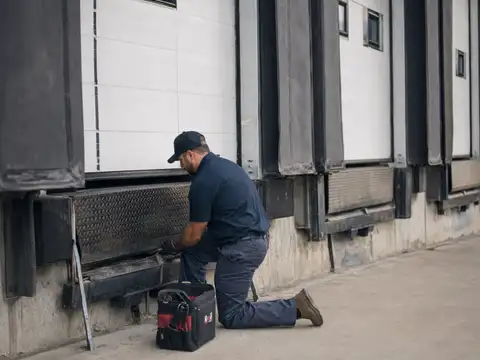
Budget loading dock maintenance as an operating-cost ledger—not a flat annual price per door.
The real annual cost combines scheduled service, emergency repairs, parts, internal labor, dock downtime and the capital reserve needed for aging levelers, restraints, doors and enclosures. The maintenance interval also changes with equipment and use: current Blue Giant manuals, for example, recommend substantially more frequent planned service for multi-shift operation than for single-shift operation on certain dock equipment.
The six maintenance costs that matter
Dealer/service-contract invoices plus internal coordination and planned dock closure.
Emergency dispatch, diagnostics, labor and potentially premium/off-hours response.
Hoses, seals, bumpers, switches, springs, rollers, lights, controls, fluids and hardware.
Use loaded labor cost if the goal is total facility cost rather than invoice spend only.
A small repair invoice can still be expensive when a critical shipping position is unavailable.
Annual dock maintenance budget
Loading Dock Maintenance Cost Calculator
Build the budget from actual service assumptions. Planned maintenance, reactive calls, parts, internal labor, downtime and replacement reserve remain separate so one hidden number cannot distort the annual cost.
Dock positions × PM visits/year × entered PM cost per dock/visit.
Emergency calls + parts + loaded in-house maintenance labor.
Entered downtime hours × your measured business cost per hour.
All entered maintenance costs + reserve/other scope + selected contingency.
Total annual maintenance budget ÷ modeled dock positions.
Equipment mix, age, cycles, shifts, service geography, contract scope and downtime economics differ by facility. Use your own quotes and maintenance history.
Why the calculator does not preload a “normal” annual maintenance price
Public manufacturer/service pages usually quote maintenance after:
- equipment survey;
- asset count;
- equipment type;
- operating shifts;
- service location;
- contract scope.
That is appropriate.
A universal cost per dock would conceal variables such as:
- manual vs hydraulic leveler;
- manual vs powered restraint;
- commercial door cycles;
- seal/shelter wear;
- dock-lift hydraulics;
- controls/interlocks;
- distance to service technicians;
- single-shift vs multi-shift operation.
Enter:
your actual quotes and maintenance history.
Current manufacturer schedules show why shifts matter
| Current source / equipment | Single-shift example | Multi-shift example | Daily operator layer |
|---|---|---|---|
| Blue Giant mechanical dock leveler manual · July 13, 2026 | planned maintenance every 3 months | monthly | current manual contains a daily maintenance procedures checklist |
| Blue Giant StrongArm SVR303 restraint manual · March 13, 2026 | planned maintenance every 3 months | monthly | operator inspection prior to use / daily checklist |
A 20-dock facility does not necessarily have 20 identical maintenance schedules
One facility can include:
- mechanical levelers;
- hydraulic levelers;
- edge-of-dock units;
- powered vehicle restraints;
- manual restraints;
- high-cycle doors;
- foam seals;
- rigid shelters;
- dock lifts.
Build an asset register by:
- dock position;
- asset type;
- manufacturer;
- model;
- serial number;
- date in service;
- operating shift/cycle profile;
- required PM interval.
Rite-Hite's five-step planned-maintenance framework is a useful scope check
Rite-Hite's current dock-leveler planned-maintenance page organizes service into:
- cleaning;
- lubricating;
- adjusting;
- inspecting;
- documentation.
Its checklist covers components such as:
- work area;
- controls/power supply;
- switches and latches;
- rollers;
- pit and pit drain;
- pivot/wear points;
- rear hinge pins;
- hydraulic reservoir/pistons;
- cylinders, hoses and fittings;
- wire harnesses;
- toe guards;
- weather seals;
- communication horn/lights;
- bumpers;
- seals/shelters.
This makes a strong quote-comparison question:
what exactly does the PM visit include?
Cheap PM can be expensive if the service scope is shallow
Compare:
- inspection points;
- cleaning included;
- lubrication included;
- adjustment included;
- minor parts included/excluded;
- controls test;
- restraint test;
- door inspection;
- seal/shelter inspection;
- written report;
- photos;
- repair recommendations;
- response-time commitment.
A cheaper visit that only looks at the leveler may not be comparable with a full dock-position PM inspection.
Maintenance cost per dock
This KPI is useful:
only after the cost ledger has been built correctly.
Track it by:
- facility;
- dock position;
- asset class;
- equipment age.
A rising cost per dock can indicate:
- aging equipment;
- impact damage;
- higher throughput;
- poor preventive maintenance;
- obsolete parts;
- bad operating practices.
Track planned vs reactive spend separately
If total spend looks stable but the reactive share rises:
the maintenance program may be becoming less predictable.
Also track:
- emergency calls per 100 dock positions;
- repeat failures by asset;
- hours out of service;
- parts spend by asset;
- mean time between unplanned failures;
- repair-to-replacement decisions.
Downtime belongs in maintenance cost
Rite-Hite's current service materials emphasize that dock downtime affects:
- productivity;
- shipping schedules;
- profitability.
A 2-hour repair at:
a low-volume spare dock
is not economically equivalent to:
a 2-hour repair at the facility's primary outbound position during peak shipping.
Use the calculator's downtime field only if:
you have a defensible business cost per unavailable dock hour.
How to estimate your own downtime cost
Possible measurable components include:
- idle labor;
- overtime;
- trailer detention;
- redirected internal travel;
- temporary staging congestion;
- missed carrier cutoffs;
- expedited freight;
- lost production dependent on inbound material.
Avoid:
copying another company's “$ per hour” estimate.
Rite-Hite publishes an emergency-call benchmark—but it should not become your default
A September 2025 Rite-Hite ONE marketing article states:
- emergency service calls average $437 per visit before parts;
- one customer case was losing roughly $500 per hour during dock-leveler downtime.
These are:
vendor-published benchmark/case statements.
They are not:
- national averages established by an independent dataset;
- a rate card for every service company;
- a valid downtime value for every warehouse.
This is why the calculator leaves:
- reactive service cost;
- downtime cost/hour
at zero until the user enters facility-specific data.
Manufacturer ROI claims should not be used as universal savings assumptions
Rite-Hite currently publishes different maintenance-savings claims in different marketing materials:
- its Planned Maintenance video says service-repair costs can be reduced 12–18% over the equipment lifetime;
- its September 2025 reactive-maintenance article says proactive programs can cut maintenance costs 30–40%.
These are:
manufacturer marketing claims.
The fact that the percentages differ is another reason not to hard-code:
“preventive maintenance saves X%”
into a financial calculator.
Measure your own:
- reactive calls before/after;
- parts spend;
- downtime;
- equipment life;
- total annual cost.
Cost by equipment type
Failure can immediately remove the dock from forklift/trailer transfer service.
Verify engagement, warnings, override/fallback function and dock bumpers.
Cycle intensity and impact history can dominate long-term door maintenance.
Damage can increase air/water leakage even while the dock remains physically usable.
Use the previous cost guides to set replacement reserves
If a facility has aging dock equipment, create a separate capital/major-repair reserve using real replacement evidence from:
- Dock Leveler Cost
- Commercial Loading Dock Door Replacement Cost
- Vehicle Restraint System Cost
- Loading Dock Lift Cost
Do not bury replacement reserve inside the preventive-maintenance contract.
Leveler maintenance: current OEM evidence
Blue Giant's current mechanical dock-leveler manual dated July 13, 2026 describes:
- daily maintenance procedures;
- planned maintenance;
- quarterly service for single-shift operation;
- monthly service for multi-shift operation.
Rite-Hite separately says dock-leveler service is typically needed:
semi-annually or quarterly
in its general service-safety guidance.
These are not contradictory if viewed correctly:
maintenance frequency depends on:
- manufacturer/model;
- usage;
- shift intensity;
- service program.
Vehicle-restraint maintenance: daily inspection plus periodic technician service
Blue Giant's current StrongArm SVR303 manual says:
- operator inspection prior to use;
- daily checks;
- trained/authorized service technician for PMP;
- every 3 months for single-shift;
- monthly for multi-shift.
Daily checklist items include:
- debris;
- dock bumpers/extensions;
- wall cracks;
- interior/exterior lights;
- signage;
- hydraulic hoses;
- safety decals;
- control-panel operation;
- equipment operation.
This is useful for budgeting because:
operator inspection and technician maintenance are different cost layers.
ANSI/MHI standards include use and maintenance—not only design
MHI/LODEM currently lists:
- ANSI MH30.1-2022 for dock leveling devices;
- ANSI MH30.2-2022 for portable dock leveling devices;
- ANSI MH30.3-2022 for vehicle restraining devices.
MHI's current descriptions explicitly state that:
- MH30.2 defines requirements concerning design, use and maintenance of portable dock boards/plates;
- MH30.3 defines requirements concerning design, use and maintenance of vehicle restraining devices.
Maintenance is therefore part of the equipment lifecycle—not an optional accounting add-on after purchase.
OSHA requires dockboards to be maintained
OSHA 1910.26(b)(1) states that dockboards placed into initial service on or after January 17, 2017 must be:
- designed;
- constructed;
- maintained
to prevent transfer vehicles from running off the dockboard edge, subject to the standard's stated exception.
OSHA 1910.26(a) also requires dockboards to support the maximum intended load.
Maintenance budgeting should therefore protect:
required equipment condition—not only uptime.
Maintenance struts and hazardous energy are not optional details
Rite-Hite warns that dock leveler maintenance can expose personnel to the risk of a leveler falling if it is not mechanically supported.
Its service guidance emphasizes:
- maintenance struts;
- trained technicians;
- controlled work areas;
- lockout/tagout where applicable.
OSHA 1910.147 applies to servicing/maintenance where:
unexpected energization, startup or release of stored energy could cause injury.
The OSHA definition of energy source includes:
- electrical;
- mechanical;
- hydraulic;
- pneumatic;
- other energy.
A lower maintenance quote is not lower-cost if it depends on untrained personnel entering a dock-leveler pit or servicing powered/hydraulic equipment without the required mechanical support, energy-control procedure, barriers and manufacturer instructions. Cost comparison must assume an authorized, safe maintenance method.
OSHA's lockout/tagout standard can create maintenance-program costs
Where 1910.147 applies, the energy-control program can involve:
- documented procedures;
- locks/tags and other hardware;
- authorized-employee training;
- affected-employee communication;
- periodic inspection of the energy-control procedure.
OSHA requires the periodic inspection of the energy-control procedure:
at least annually.
Do not confuse:
the annual inspection of the LOTO procedure
with:
the maintenance interval of the dock equipment itself.
Preventive vs reactive: compare the full cost path
Known visits, inspection and minor adjustment are budgeted.
But no inspection benefit from the visits that were skipped.
Small defects may be found during scheduled inspection.
Failure timing determines labor/response conditions.
Maintenance can be planned for low-volume periods.
Peak outbound/inbound interruption can dominate total cost.
Repair trends can inform capital planning.
Asset can fail before capital is planned.
Repair vs replace using cumulative maintenance cost
For each high-cost asset, track:
- purchase/install date;
- cumulative PM cost;
- cumulative repair cost;
- parts availability;
- downtime hours;
- repeat failures;
- current replacement cost.
Do not apply:
a universal “50% repair-vs-replace rule.”
Remaining life and operational criticality matter.
Asset criticality changes the maintenance strategy
Categorize docks:
- A: critical high-throughput position with no easy substitute;
- B: important but transferable to neighboring positions;
- C: low-use / overflow position.
Critical docks can justify:
- more aggressive PM;
- on-site spare parts;
- service response SLA;
- planned replacement before end-of-life failure.
This is more defensible than:
giving every dock exactly the same maintenance spend.
Use work orders to identify root causes
Add failure codes such as:
- impact;
- wear;
- hydraulic leak;
- sensor/control;
- spring/cable;
- door track;
- seal fabric;
- bumper;
- misuse;
- unknown.
Then ask:
is maintenance spend caused by age
or by:
the same operational damage repeating?
Repeated impact damage is not a maintenance-frequency problem
If:
- bumpers are repeatedly destroyed;
- doors are repeatedly hit;
- seal/shelter frames are repeatedly struck;
- leveler lips/controls repeatedly suffer impact
investigate:
- trailer approach;
- forklift path;
- clearance;
- dock guides;
- bumper geometry;
- traffic controls;
- training.
The Warehouse Layout Mistakes That Reduce Capacity guide provides the broader flow/geometry audit.
Loading dock maintenance budget audit
- Dock-position count.
- Asset register by dock.
- Manufacturer/model/serial number.
- Date in service.
- Single-shift / multi-shift / measured cycle intensity.
- Current manufacturer maintenance schedule.
- Daily operator-inspection requirement.
- Planned technician-service frequency.
- PM scope per visit.
- PM cost per dock/visit.
- Emergency-call history.
- Average reactive labor/callout cost from your invoices.
- Parts spend by dock/asset.
- Internal maintenance labor hours.
- Loaded internal labor cost.
- Dock downtime hours.
- Measured business cost of dock downtime.
- Repeat failures.
- Impact-damage history.
- Safety-device failures.
- Controls/interlock failures.
- Energy-control / LOTO procedure applicability.
- Training / annual LOTO procedure inspection cost where applicable.
- Service response SLA.
- Critical spare parts.
- Asset criticality.
- Major-repair reserve.
- Replacement forecast.
- Total annual cost.
- Annual cost per dock.
- Reactive share of maintenance cost.
Build the dock maintenance budget from actual scope
The earlier loading-dock calculators model:
- initial dock equipment CAPEX;
- commercial door replacement;
- dock lift projects.
Maintenance is:
recurring OPEX.
It has a different cost structure:
- scheduled visits;
- unplanned failures;
- parts;
- labor;
- downtime;
- future repair reserve.
The calculator is therefore a genuinely new model rather than a duplicate CAPEX tool.
The decision rule
Do not ask only what a loading-dock maintenance contract costs. Ask what the complete dock system costs to keep operational for a year. Build the asset register, use each manufacturer's current maintenance schedule, separate planned and reactive spend, include parts and internal labor, monetize downtime only with your own defensible operating data and reserve separately for aging assets. The result is an annual maintenance budget that can actually be compared across facilities, dock positions and years.
Frequently asked questions
How much does loading dock maintenance cost per year?
There is no reliable universal annual cost per dock. Calculate planned service, reactive calls, parts, internal labor, downtime and major-repair reserve using the equipment and service conditions at your facility.
How often should a dock leveler be serviced?
Follow the exact manufacturer's current manual. Blue Giant's July 2026 mechanical dock-leveler manual currently recommends planned technician maintenance every three months for single-shift operation and monthly for multi-shift operation.
How often should a vehicle restraint be maintained?
Blue Giant's current StrongArm SVR303 manual recommends operator inspection before use plus planned technician maintenance every three months for single-shift operation or monthly for multi-shift operation.
What is included in loading dock preventive maintenance?
Scope varies by service provider and equipment. Rite-Hite's current five-step dock-leveler framework includes cleaning, lubricating, adjusting, inspecting and documentation, with checks across controls, pit, wear points, hydraulics, communication systems, bumpers and seals/shelters.
Is preventive maintenance cheaper than reactive maintenance?
It can reduce unplanned failures and allow work to be scheduled, but the savings are facility-specific. Measure total maintenance spend, emergency calls and downtime before and after rather than assuming a universal percentage.
How much does an emergency loading-dock service call cost?
Rates vary by geography, time, equipment and service provider. A Rite-Hite 2025 marketing article cites $437 per emergency visit excluding parts, but that is a vendor-published benchmark—not a national industry average.
Should dock downtime be included in maintenance cost?
Yes if you can measure its business impact. Use facility-specific costs such as idle labor, detention, overtime, missed cutoffs or expedited freight rather than another company's generic dollars-per-hour figure.
What loading dock equipment needs maintenance?
Typical dock assets include levelers, vehicle restraints, doors/operators, dockboards/plates, dock lifts, seals/shelters, bumpers, lights and integrated controls.
Does OSHA lockout/tagout apply to dock equipment maintenance?
OSHA 1910.147 applies to servicing/maintenance of machines and equipment when unexpected energization, startup or release of stored energy could cause injury, subject to the standard's scope and exceptions. Dock equipment can involve electrical, mechanical and hydraulic stored-energy hazards.
When should I replace instead of repair dock equipment?
Compare immediate repair, expected future repairs, downtime, parts availability and remaining-life risk with the complete installed replacement cost. Avoid a universal repair-percentage rule.
What maintenance KPIs should a warehouse track?
Useful measures include annual cost per dock, reactive share of spend, emergency calls, downtime hours, repeat failures, parts spend by asset and mean time between unplanned failures.
Sources and methodology
Warehouse Fieldbook does not publish an invented national maintenance price per loading dock. The calculator uses only user-entered cost assumptions. Current maintenance-frequency examples come from Blue Giant's July 13, 2026 mechanical dock-leveler manual and March 13, 2026 StrongArm SVR303 vehicle-restraint manual; both distinguish daily operator checks from trained-technician planned maintenance and specify quarterly single-shift versus monthly multi-shift examples for those products. Rite-Hite's current planned-maintenance page supplies the five-step clean/lubricate/adjust/inspect/document framework and dock-component checklist. Rite-Hite marketing claims about emergency-call cost, downtime and maintenance savings are explicitly treated as vendor-published claims rather than market averages. MHI/LODEM supplies the current ANSI MH30.1-2022, MH30.2-2022 and MH30.3-2022 standards context. OSHA 1910.26 supplies dockboard maintenance requirements, while OSHA 1910.147 supplies hazardous-energy control requirements for covered servicing/maintenance work.
- Blue Giant — Mechanical Dock Leveler Owner's Manual, July 13, 2026
- Blue Giant — StrongArm SVR303 Vehicle Restraint Owner's Manual, March 13, 2026
- Rite-Hite — current planned maintenance program and dock-leveler checklist
- Rite-Hite — loading dock leveler service safety, maintenance struts and technician guidance
- Rite-Hite — planned-maintenance marketing claims and dock-cycle context
- Rite-Hite ONE — 2025 reactive-maintenance cost and downtime marketing examples
- Rite-Hite — current dock-leveler service and repair scope
- MHI / LODEM — current ANSI MH30.1, MH30.2 and MH30.3 standards listings
- OSHA — 29 CFR 1910.26 Dockboards
- OSHA — 29 CFR 1910.147 control of hazardous energy
- OSHA — powered industrial truck loading-dock hazards