
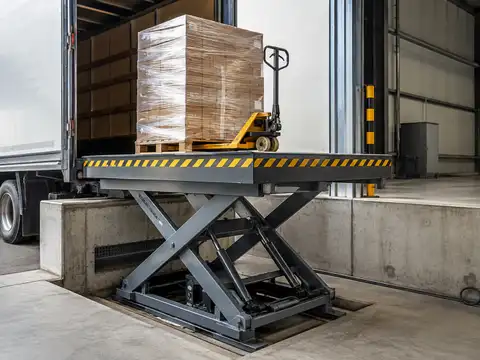
A current 5,000-lb truck scissor dock lift is listed at $12,599. The installed project can be much more once access ramps, bridge equipment, power, concrete and installation are included.
Dock lifts solve a different problem from dock levelers. They raise and lower an entire material-handling platform between ground level and trailer height, making them useful where a permanent elevated loading dock is unavailable or where trailer heights cannot be served by a simple bridge from a fixed dock.
What is a loading dock lift?
MHI's LIFT industry group classifies dock lifts within industrial scissor lifts covered by ANSI MH29.1-2020.
Vestil describes its current truck scissor dock lifts as equipment for:
- loading and unloading semi-trailers where traditional loading docks are not available;
- ground-level loading;
- pallet-jack handling;
- trailer servicing.
A dock lift is therefore not the same as:
- a dock plate;
- an edge-of-dock leveler;
- a pit leveler;
- a small workstation lift table.
Current 5,000-lb dock lift product price
Global Industrial currently lists the Vestil WL-100-5-68 at:
$12,599.
| Public price | $12,599 | Product price before project-specific installation/freight. |
|---|---|---|
| Capacity | 5,000 lb | Uniform platform capacity listed by retailer/manufacturer. |
| Platform | 72 × 96 in | 6×8-ft nominal platform. |
| Lowered / raised height | 8 / 68 in | 60 in of vertical travel between published minimum and maximum height. |
| Power | 460V · 3-phase | 6.5-HP hydraulic system on the current retailer listing. |
| Shipping weight | 2,902 lb | Important for delivery/unloading and installation planning. |
| Mounting | surface or pit | Manufacturer/retailer says the lift can be surface or pit mounted. |
A surface-mounted dock lift needs an approach strategy
The 5,000-lb example lowers to:
8 inches above the surrounding surface.
A pallet jack or other transfer method therefore needs:
- an approach ramp;
- a pit-mounted arrangement;
- another engineered access configuration.
Global Industrial currently lists the Vestil WL-AR8 approach ramp at:
$1,287.
The listing says the ramp:
- is intended for an 8-in-lowered-height truck scissor dock lift;
- must be anchored to the floor for ideal operation;
- is 66 in wide and 65 in long.
This gives a current visible equipment example of:
A bridge/transition to the trailer can be additional depending on configuration.
Dock lift project budget
Loading Dock Lift Cost Calculator
Build the project from the lift outward. Keep the equipment, approach/bridge accessories, concrete, electrical, installation and freight visible so a public product price is never mistaken for a turnkey installed cost.
Lift + selected ramp + bridge + non-duplicated options.
Per-lift equipment package × quantity.
Concrete + electrical + installation + freight + other entered scope.
Equipment + project/site scope + user-selected contingency.
Replace them with the exact lift/accessory configuration and contractor quotes. Capacity, travel, platform size, power and mounting must be validated before procurement.
How to use the dock lift calculator
The default equipment inputs use the current public:
- WL-100-5-68 dock lift: $12,599;
- WL-AR8 approach ramp: $1,287.
Every project-specific input defaults to:
$0.
Enter actual quotes for:
- bridge/transition equipment;
- extra gates/rails/options;
- pit/concrete/structural work;
- electrical/controls;
- installation/rigging;
- freight/unloading;
- other project costs;
- contingency.
This makes the calculator useful for quote normalization without pretending the installed cost can be derived from a universal percentage.
Dock lift capacities are much broader than one 5,000-lb model
Vestil's current WL-100 family includes configurations at:
- 5,000 lb;
- 6,000 lb;
- 8,000 lb;
- 10,000 lb;
- 12,000 lb.
The family also spans multiple:
- platform widths;
- platform lengths;
- lowered heights;
- raised heights.
Higher capacity often changes:
- lift structure;
- shipping weight;
- minimum platform height;
- approach-ramp geometry;
- power/site requirements;
- product price.
Do not choose capacity from pallet weight alone
The platform may carry:
- palletized load;
- pallet jack;
- powered pallet truck where approved by the lift manufacturer;
- operator/personnel where allowed by the specific design;
- other handling equipment.
OSHA 1910.22(b) requires a walking-working surface to support its:
maximum intended load.
OSHA's current walking-working-surface FAQ defines that concept as the total weight/force of:
- employees;
- equipment;
- vehicles;
- tools;
- materials;
- other reasonably anticipated loads.
Determine the complete load placed on the lift and use the lift manufacturer's application/rating method. Do not compare a 5,000-lb platform rating only with the pallet's product weight while ignoring the material-handling equipment and other intended loads.
ANSI MH29.1-2020 specifically includes dock lifts
MHI's current LIFT standards page identifies:
ANSI MH29.1-2020 — Safety Requirements for Industrial Scissors Lifts.
MHI says the standard applies to industrial scissor lifts raised/lowered by:
- hydraulic;
- pneumatic;
- mechanical actuation.
It expressly says the category includes:
- dock lifts;
- work access lifts;
- lift tables.
Request the manufacturer's current:
- ANSI MH29.1 conformity basis;
- installation instructions;
- capacity data;
- inspection/maintenance requirements.
Current Vestil safety features show what belongs in the specification
Vestil's current WL-100 family describes:
- velocity fuses;
- overload relief valves;
- upper travel limit switch;
- full-perimeter electric toe guard;
- non-slip diamond plate platform;
- removable handrails;
- fixed toe boards.
Global Industrial's current 5,000-lb listing also states that the unit includes:
- 24V AC push-button hand control;
- pre-wired control box;
- magnetic starter;
- overload fuse.
These are model-specific features.
Do not assume another dock lift includes the same safety/control package.
Dock lift vs dock leveler
Moves the whole platform vertically.
Can bridge ground-level operations to trailer height where a fixed-height loading dock is unavailable.
Bridges a smaller elevation difference from an existing elevated dock.
Pit and edge-of-dock levelers assume the building already provides a dock platform near trailer-bed height.
Use the Dock Leveler Cost guide if the facility already has an elevated dock and only needs to bridge the dock-to-trailer gap.
Dock lift vs portable dockboard
A portable dockboard is a much simpler bridge.
It does not provide:
- powered vertical travel from ground to trailer height;
- large platform area;
- hydraulic elevation control.
If ground level and trailer bed are separated by several feet, a dockboard alone cannot perform the dock lift's function.
Dock lift vs standard lift table
Standard stationary lift tables can be much smaller and less expensive.
But a truck dock lift is designed around:
- trailer loading/unloading;
- large platforms;
- ground-to-trailer travel;
- material-handling access;
- dock-specific guarding/transition needs.
Do not use the price of a workstation lift table as a dock-lift benchmark.
Surface mount vs pit mount
Avoids a full recessed pit but creates a raised approach.
The lift remains above the surrounding floor at its minimum height, so material-handling equipment needs a ramp or other access solution.
Can create a flush or more integrated approach.
The civil scope can include excavation, concrete, drainage/water management, embedded items and safe access for service.
A $1,287 ramp can prevent a larger civil project—but it consumes floor/yard length
The current WL-AR8 approach ramp is:
- 66 in wide;
- 65 in long;
- 397 lb;
- designed for an 8-in lowered-height dock lift.
The current 10-in-height WL-AR10 is:
- 66 in wide;
- 82 in long;
- 517 lb;
- currently priced at $1,606.
This illustrates a design trade-off:
avoiding a pit can require a longer approach ramp as the lift's lowered height increases.
Platform size affects more than equipment price
Platform size determines whether the lift can accommodate:
- load footprint;
- pallet jack;
- operator position;
- safe turning/transfer;
- rail/gate clearances.
A larger platform can also increase:
- equipment mass;
- freight;
- pit footprint;
- civil work;
- required clear area around the lift.
Raised height must cover the actual trailer envelope
The current 5,000-lb example rises to:
68 in.
Current higher-capacity WL-100 configurations commonly reach:
70–72 in depending on model.
Verify:
- lowest trailer deck;
- highest trailer deck;
- loaded/unloaded trailer movement;
- approach grade;
- required transition/bridge geometry.
Electrical cost can be material
The current WL-100-5-68 retailer listing specifies:
- 460V;
- 3-phase;
- 6.5 HP motor;
- 24V AC hand control.
If the site does not already have suitable service near the dock:
- panel capacity;
- feeder;
- disconnect;
- conduit;
- starter/control location;
- weatherproofing
can become a meaningful project cost.
Do not use a generic electrician allowance without checking the available site power.
Freight is not trivial
The current 5,000-lb 6×8-ft example weighs:
2,902 lb.
Vestil's family includes still heavier higher-capacity configurations.
Delivery planning can require:
- freight quote;
- delivery appointment;
- unloading equipment;
- rigging;
- temporary storage;
- site access.
Vestil's catalog also notes that some 96-in-wide units cannot ship LTL and need flat-bed transport.
That is exactly why freight should remain a separate calculator input.
Dock lift project cost drivers
Size the complete intended platform load, not only the palletized product.
Match load, handling device, trailer envelope and required clear platform area.
One option consumes approach length; the other can add excavation/concrete/drainage.
Verify voltage, phase, feeder distance, control location and environmental rating.
Specify how people and material-handling equipment move onto/off the platform at each elevation.
Equipment price is not the delivered-and-operational project price.
Guarding and fall exposure need a project-specific review
Dock lifts create changing edge conditions as the platform moves.
Relevant safety questions include:
- where exposed platform edges exist;
- how personnel enter/exit;
- whether gates/rails open during transfer;
- what happens when the lift is below an elevated landing;
- how a pit/opening is protected;
- how the trailer-side transition is controlled.
OSHA 1910.28 contains general-industry fall-protection requirements for walking-working surfaces, including guardrail requirements in several 4-ft-or-more exposure conditions.
OSHA 1910.29 defines criteria for guardrail systems.
The exact arrangement should be reviewed against:
- the applicable OSHA rules;
- ANSI MH29.1;
- manufacturer instructions;
- the actual transfer operation.
A dock lift is an industrial scissor lift, not an aerial work platform merely because it uses a scissor mechanism. Use the standards and manufacturer instructions applicable to the specific industrial dock-lift application rather than copying requirements from unrelated mobile elevating-work-platform guidance.
Pinch, crush and under-platform hazards belong in the design
Vestil's current design includes:
- full-perimeter electric toe guard during descent;
- hydraulic velocity fuse;
- upper travel limit;
- overload relief.
OSHA's warehousing guidance separately emphasizes:
control of hazardous energy during equipment maintenance/service.
A dock-lift project should establish:
- inspection procedure;
- maintenance procedure;
- lockout/tagout or other hazardous-energy controls where applicable;
- safe blocking/support for service according to manufacturer procedure;
- authorized service access.
Do not put a pallet truck on the lift just because the platform is large enough
Verify:
- lift model's approved use;
- combined weight;
- point/wheel loading;
- platform dimensions;
- transition geometry;
- manufacturer loading instructions.
Vestil markets its WL-100 line for pallet-jack handling and trailer servicing, but the exact permitted handling equipment should still be checked for the selected configuration.
Dock lift vs building a conventional loading dock
A dock lift can be attractive where:
- the building floor is at grade;
- adding a full elevated dock position is difficult;
- volume does not justify major building reconstruction;
- trailer heights vary substantially;
- the lift can support the required throughput.
A conventional dock can be more attractive where:
- trailer volume is high;
- multiple simultaneous dock positions are required;
- fast forklift transfer is essential;
- yard/building geometry supports permanent dock construction.
The warehouse-space planning guide explains why dock count and staging belong in the facility-capacity decision.
Throughput can matter more than equipment CAPEX
A scissor dock lift introduces a vertical cycle.
A typical operating sequence can include:
- Load/pallet enters the platform.
- Gate/rail condition is confirmed.
- Lift travels to trailer height.
- Bridge/transition is deployed or engaged.
- Load transfers to/from the trailer.
- Transition stores.
- Lift returns to ground or dock level.
Compare expected:
- loads/hour;
- lift travel time;
- loading/unloading time;
- number of dock positions;
- peak trailer arrival rate.
A $13,000–$20,000-class equipment solution can be poor value if one platform cannot support the required hourly flow.
Do not use the dock lift as staging
The platform is transfer equipment.
If loads queue on it while:
- waiting for a trailer;
- waiting for paperwork;
- waiting for putaway
the lift loses throughput.
Provide adjacent:
- inbound staging;
- outbound staging;
- clear access paths.
The Warehouse Layout Mistakes That Reduce Capacity guide explains why using flow space as storage creates false capacity.
Trailer restraint still matters
A dock lift does not eliminate:
- trailer movement;
- premature departure;
- vehicle-control procedures;
- transition hazards between platform and trailer.
The Vehicle Restraint System Cost guide covers:
- wheel chocks;
- RIG restraints;
- wheel-based restraints;
- controls/interlocks;
- fallback procedures.
Dock door and enclosure may still be part of the project
Exterior dock lifts can interface with:
- warehouse door opening;
- weather enclosure;
- fencing/gates;
- canopy;
- seal/shelter design.
See:
Do not double-count options already included in the base lift
The current 5,000-lb Global Industrial listing already describes:
- handrails;
- toe boards;
- toe guard;
- travel limit switch;
- hydraulic safety components;
- control box.
Therefore, in the calculator:
only add separate gate/rail/control allowances when:
they are genuinely extra to the equipment quote.
Installed dock lift cost
This is the number to compare with:
- building a permanent dock;
- adding an exterior ramp;
- using a different dock position;
- outsourcing/relocating the loading operation.
How many dock lifts do you need?
Do not divide daily loads by 24 hours.
Use the peak shipping/receiving window.
Round up and test:
- downtime;
- operator availability;
- mixed inbound/outbound demand;
- truck appointment peaks;
- staging capacity.
Do not use a generic loads/hour benchmark.
Validate actual cycle time for:
- selected lift travel;
- load type;
- operator;
- bridge deployment;
- trailer handling.
Multi-lift projects can have shared infrastructure
Several dock lifts may share:
- electrical distribution upgrade;
- civil mobilization;
- fencing/yard modification;
- installation crane/rigging mobilization;
- control architecture.
Therefore:
cost per lift may not scale linearly with quantity.
Model:
- per-unit equipment;
- shared project cost
separately.
Maintenance should be budgeted from day one
A dock lift combines:
- hydraulic components;
- electrical controls;
- moving scissor mechanism;
- platform/rails/gates;
- transition equipment.
Plan:
- inspection frequency;
- preventive service;
- hydraulic leak inspection;
- safety-device testing;
- structural inspection;
- control inspection;
- parts/service response.
The loading-dock maintenance cost guide covers that recurring maintenance scope separately.
Loading dock lift procurement audit
- Loading location / dock ID.
- Ground/floor elevation.
- Trailer deck-height envelope.
- Approach grade.
- Maximum intended platform load.
- Pallet/load dimensions.
- Handling equipment on the lift.
- Required platform width/length.
- Required lowered height.
- Required raised height / travel.
- Target loads/hour.
- Surface vs pit mount.
- Approach-ramp requirement.
- Bridge/transition requirement.
- Guardrail/gate/toe-protection configuration.
- Trailer vehicle-control method.
- Available electrical voltage/phase.
- Feeder/disconnect/control location.
- Concrete/pit/structural work.
- Drainage/weather exposure.
- Freight and unloading.
- Rigging/installation access.
- Commissioning/testing.
- ANSI MH29.1 documentation.
- Manufacturer installation instructions.
- Fall/edge protection review.
- Maintenance access / hazardous-energy procedure.
- Preventive-maintenance plan.
- Equipment price.
- Total installed project price.
What the dock-lift calculator models
The loading-dock equipment calculator models:
- leveler;
- restraint;
- seal/shelter;
- lights;
- small dock hardware.
A dock lift is different.
It can require:
- a large hydraulic lifting platform;
- approach ramp or pit;
- bridge/transition;
- industrial electrical service;
- large freight/rigging;
- site-specific guarding/access.
The dedicated calculator therefore models a genuinely different project rather than duplicating the arithmetic in the loading-dock equipment cost guide.
The decision rule
Start with the loading problem, not the equipment catalog. If a fixed elevated dock already exists and the trailer-height gap is modest, a leveler may be the simpler solution. If the facility must move loads from ground level to trailer height, a truck scissor dock lift can create a functional loading position without a conventional raised dock. Budget the entire installed system: lift, approach/bridge, civil work, electrical, freight, installation, guarding, vehicle control and maintenance. Then verify that its capacity and cycle rate support the peak operation.
Frequently asked questions
How much does a loading dock lift cost?
One current U.S. public product example, a Vestil 5,000-lb 6×8-ft truck scissor dock lift, is listed at $12,599 before freight, site work and installation.
How much does a dock lift ramp cost?
Current Global Industrial examples include $1,287 for Vestil's 8-in-height approach ramp and $1,606 for its 10-in-height approach ramp before installation.
How much does a loading dock lift cost installed?
Installed cost is project-specific. Add the selected lift and accessories to freight, rigging, installation, concrete/pit work, electrical/controls and other site scope.
What capacity loading dock lift do I need?
Use the complete maximum intended load that will be on the platform, including material, handling equipment and other intended loads. Then apply the selected manufacturer's rating/application rules.
What capacities are available for truck scissor dock lifts?
Vestil's current WL-100 family includes 5,000-, 6,000-, 8,000-, 10,000- and 12,000-lb configurations.
What is the difference between a dock lift and a dock leveler?
A dock lift raises/lowers an entire platform over a large vertical range. A dock leveler bridges the smaller height difference between an existing elevated dock and a trailer.
Can a dock lift be surface mounted?
Yes. The current Vestil/Global Industrial 5,000-lb example can be surface or pit mounted. A surface-mounted lift needs an access strategy such as a compatible approach ramp.
Can a dock lift be pit mounted?
Yes for models/configurations designed for it. Pit mounting can improve access geometry but adds civil/structural scope that should be priced separately.
What electrical service does a dock lift need?
It is model-specific. The current Vestil WL-100-5-68 retailer listing uses a 6.5-HP 460V three-phase motor with 24V AC hand control. Verify the selected model and available site power.
Does ANSI MH29.1 apply to dock lifts?
MHI's current LIFT standards page says ANSI MH29.1-2020 applies to industrial scissor lifts and expressly includes dock lifts among the equipment categories.
Can I use a pallet jack on a dock lift?
Vestil markets its WL-100 family for pallet-jack handling. Still verify the exact lift configuration, combined load, platform dimensions and manufacturer operating instructions before use.
How many dock lifts do I need?
Base the count on peak loads per hour divided by a validated loads-per-lift-per-hour rate, then add operational allowance for downtime and arrival variability. Do not use an unverified generic throughput rate.
Sources and methodology
Warehouse Fieldbook separates current equipment pricing from installed dock-lift project cost. Current public U.S. price anchors observed in August 2026 come from Global Industrial's Vestil WL-100-5-68 listing at $12,599, its WL-AR8 approach ramp at $1,287 and WL-AR10 approach ramp at $1,606. Vestil's current WL-100 manufacturer page supplies application, capacity/configuration and safety-feature context. MHI/LIFT's current standards page supplies ANSI MH29.1-2020 and explicitly includes dock lifts within industrial scissor lifts. OSHA 1910.22 supplies the maximum-intended-load walking-working-surface requirement; OSHA 1910.28/1910.29 supply general fall-protection and guardrail criteria used as project-review boundaries; OSHA warehouse guidance supplies hazardous-energy maintenance context. Product prices are point-in-time examples, not national installed averages.
- Vestil — current WL-100 Premium Truck Scissor Dock Lift family
- Global Industrial — current $12,599 Vestil WL-100-5-68 product example
- Global Industrial — current $1,287 WL-AR8 approach-ramp example
- Global Industrial — current $1,606 WL-AR10 approach-ramp example
- MHI / LIFT — ANSI MH29.1-2020 Safety Requirements for Industrial Scissors Lifts
- MHI / LIFT — industrial scissor lift industry group and current standard context
- OSHA — 29 CFR 1910.22 walking-working surfaces, loads and maintenance
- OSHA — 29 CFR 1910.28 duty to have fall protection
- OSHA — 29 CFR 1910.29 guardrail/fall-protection criteria
- OSHA — Warehousing hazards, loading docks and hazardous-energy maintenance context