
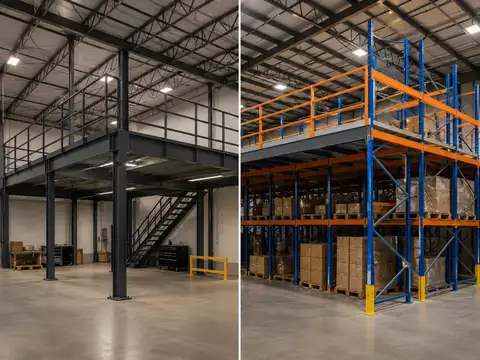
Mezzanine ROI is the return on usable capacity—not the return on steel.
The project earns a return only when it produces measurable cash value: avoided overflow or occupancy cost, additional profitable throughput, labor savings or another verified benefit. Those gains must exceed the complete project investment plus the ongoing cost of operating the new level.
First calculate the complete investment
Do not start ROI with:
the structural steel quote.
Use:
- structure;
- deck;
- stairs;
- guardrails / material gates;
- engineering;
- permits;
- slab / footing work;
- fire protection;
- electrical / lighting;
- freight;
- installation;
- VRC / conveyor / material-handling integration;
- other required project work.
Cogan's current cost guide identifies:
footprint/height, design load, flooring, access/safety, engineering/permits, concrete slab and installation/freight
as the main mezzanine cost drivers.
Use the Warehouse Mezzanine Cost Per Square Foot calculator to normalize the full project before building ROI.
Cash-benefit model
Warehouse Mezzanine ROI & Payback Calculator
Build ROI from verified project cash flows. The calculator does not preload a mezzanine price, rent, labor saving, revenue uplift or discount rate. Enter values from your own quotes, operating data and finance assumptions.
All-in project cost minus only verified one-time costs avoided.
Recurring benefits minus recurring added operating/maintenance costs.
Net upfront outlay ÷ annual net benefit. No time value of money.
Benefit-start delay + simple payback after go-live.
Annual net recurring benefit ÷ effective net upfront outlay.
Undiscounted recurring benefit over entered horizon minus net upfront outlay.
Net present value of constant annual modeled benefits after the entered go-live delay.
Cash flows are modeled as constant annual amounts. For material projects, hand the assumptions to finance for tax, depreciation, financing, working-capital, residual-value and scenario treatment.
What counts as a real mezzanine benefit?
Space cost that genuinely disappears.
Examples can include verified overflow warehouse rent, 3PL storage charges, temporary satellite-space cost or incremental leased area that the mezzanine makes unnecessary.
Profitable throughput that the current capacity constraint prevents.
If the mezzanine allows additional orders to be fulfilled, monetize the incremental contribution margin—not total sales revenue.
Cost that is actually removed or avoided.
Shorter travel, consolidated operations or better flow count only when the time reduction translates into lower labor cost, avoided future hiring or another measurable operating benefit.
A real alternative cash outflow eliminated by the project.
Examples might include a documented facility move, temporary overflow setup or duplicate fit-out that is no longer required.
What does not automatically count as ROI?
Useful only if it replaces a real rental/overflow requirement. Internal floor area is not automatically cash income.
Sales contain product, freight, payment and other variable costs. Use incremental contribution margin.
Inventory is an asset tied up in working capital—not annual operating benefit simply because the mezzanine can hold it.
Avoided alternatives must be economically comparable and genuinely planned; otherwise the model manufactures a return.
Simple payback
If:
- all-in project cost = $400,000;
- verified one-time cost avoided = $25,000;
- annual recurring benefits = $180,000;
- annual added operating/maintenance cost = $55,000;
then:
- effective net upfront outlay = $375,000;
- annual net recurring benefit = $125,000;
- simple payback = 3.0 years.
Calendar payback is more useful than go-live payback
A project can show 24-month payback after go-live.
But if engineering, permit, fabrication and installation take 4 months, then cash payback from today's decision is closer to 28 months.
The calculator therefore reports:
- payback after benefits begin;
- calendar payback including entered delay.
Current vendor timeline claims can inform scenarios—but should not be calculator defaults
Cogan's March 2, 2026 comparison guide currently states:
- 2–6 weeks from engineering through installation for a typical mezzanine;
- 2–5 days of on-site erection for a standard project;
- 6–18 months from design through occupancy for a building expansion.
Those are manufacturer/vendor timeline claims. They are useful for scenario design, but they are not loaded into the calculator because permitting, engineering, fabrication, shutdown windows and site conditions can produce very different schedules.
Simple ROI
Simple ROI is useful:
as a quick capital-screen metric.
It does not include:
- time value of money;
- tax;
- depreciation;
- financing;
- cash-flow timing within each year;
- residual value.
That is why:
the calculator also reports:
NPV.
NPV asks a different question
Payback asks:
how long until the modeled investment is recovered?
NPV asks:
what are those future net benefits worth today at the company's entered hurdle rate?
The calculator:
- uses the user-entered discount rate;
- shifts benefits by the entered go-live delay;
- assumes constant annual benefit;
- does not model tax/depreciation/financing.
For a major capital request finance should replace the simplified annual cash-flow series with the company's approved model.
Why vendor “high ROI” language is not enough
FCP currently describes free-standing mezzanines as:
high-ROI/cost-effective alternatives to building extensions or moving.
Cogan's current materials similarly position:
vertical expansion
as a way to avoid some new-building costs.
Those are:
supplier value propositions.
They do not establish:
- your project CAPEX;
- your annual savings;
- your contribution margin;
- your payback period;
- your NPV.
The calculator deliberately:
preloads none of them.
Cogan's current “50–70% less than expansion” claim belongs in a scenario—not the base case
Cogan's March 2026 comparison says:
a mezzanine typically costs:
50–70% less than a building expansion
when accounting for:
- foundation;
- roofing;
- HVAC;
- electrical;
- permitting;
- lost productivity during construction.
Warehouse Fieldbook treats this as a current manufacturer claim, not an independent national construction benchmark.
Use actual:
- mezzanine quote;
- expansion quote;
- schedule;
- disruption estimate
in the business case.
Avoided expansion CAPEX is not automatically a mezzanine “benefit”
Suppose a mezzanine costs $500,000 and a hypothetical expansion would cost $2 million.
It is tempting to enter $1.5 million as immediate ROI benefit.
That can be wrong.
Why?
- the expansion may create more cubic volume;
- it may add loading docks / truck court;
- it may have a longer useful life;
- it may solve future growth the mezzanine cannot;
- it may never have been an approved cash outflow.
Use the Warehouse Mezzanine vs Building Expansion decision framework first.
Only treat:
a one-time alternative cost as avoided
when:
the alternatives deliver economically comparable required capacity and the cash outflow is genuinely avoided.
Contribution margin is the correct throughput bridge
If added warehouse capacity enables $2 million of extra annual sales, that does not mean annual ROI benefit = $2 million.
First subtract:
- product cost;
- variable fulfillment cost;
- variable freight where applicable;
- payment/marketplace fees;
- returns/allowances;
- other variable costs tied to those incremental sales.
The remaining contribution margin is a much more defensible project benefit.
If your incremental contribution margin already reflects labor or fulfillment costs, do not add those same savings again in another calculator field. Each economic benefit should appear once.
Labor savings need a cash mechanism
Example:
a mezzanine/process redesign saves:
4,000 walking/handling hours per year.
Ask:
- Does headcount decrease?
- Does overtime decrease?
- Is planned hiring avoided?
- Does capacity increase with the same workforce?
If the same employees simply spend the saved time on: more productive work, the value may appear as throughput contribution margin rather than direct labor-cost savings.
Do not count both.
Vertical handling can reduce mezzanine ROI
A mezzanine creates:
another level.
Product may now need:
- VRC travel;
- conveyor travel;
- pallet-gate handling;
- additional touches;
- vertical replenishment;
- extra operator coordination.
If the mezzanine adds $60,000/year of vertical-handling labor while saving $100,000/year of external overflow storage, the recurring space benefit is not $100,000.
Before other effects it is $40,000.
Maintenance and inspection belong in recurring cost
Depending on the installed system:
recurring costs can include:
- guard/gate maintenance;
- floor repairs;
- VRC/conveyor maintenance;
- inspection;
- lighting/electrical;
- housekeeping;
- impact-damage repair;
- periodic operational training.
Use actual maintenance/service expectations rather than assuming zero because the structure is new.
Operational disruption can belong either in initial cost or delayed benefit
Avoid counting disruption twice. You can model direct one-time disruption cost inside all-in project cost.
Separately benefits should begin only when the mezzanine is operational/ramped.
That is why the calculator has months until benefits begin.
Installation cost belongs in CAPEX—not in the annual benefit equation
The Warehouse Mezzanine Installation Cost article separates:
- unloading;
- staging;
- erection;
- anchoring;
- decking;
- stairs/guards;
- trade coordination;
- closeout.
Include that actual install scope in project cost.
Do not amortize it into annual “savings” merely to improve the ROI presentation.
Structural system choice can change future-value assumptions
The Structural vs Rack-Supported Mezzanine guide distinguishes:
- free-standing structural platform;
- rack-supported platform/pick module.
Why does this matter financially?
Because:
- a free-standing system can preserve more rack-layout independence;
- a rack-supported system can integrate storage and elevated picking very efficiently;
- future reconfiguration cost can differ;
- future rack damage/changes can have different structural consequences.
Do not assign a speculative residual value merely because a mezzanine is theoretically relocatable.
If residual value matters finance should model:
- disassembly;
- freight;
- re-engineering;
- reinstallation;
- remaining compatible components.
Current 2026 MHI case material illustrates the right sequence
MHI currently carries a March 4, 2026 Cornerstone Specialty Wood Products case study describing a global sneaker/streetwear retailer's Philadelphia distribution center. The existing workspace was approximately 220,000 ft². The project team first determined that the existing building could support forecasted growth and desired throughput, then recommended a 70,000-ft² mezzanine together with a shelf-to-person AMR system.
The useful lesson is not:
“70,000 ft² creates X% ROI.”
The useful lesson is:
mezzanine ROI can be a system-level result involving:
- capacity;
- workflow;
- automation;
- throughput.
Do not credit the mezzanine for automation benefits it did not create alone
In the MHI case mezzanine + AMR were part of one integrated fulfillment design.
If your project similarly includes:
- mezzanine;
- conveyor;
- AMRs;
- WMS/WES changes;
- new shelving;
- new pick methods
calculate:
either:
- ROI for the complete integrated project;
- or incremental ROI for each separable investment using a defensible attribution method.
Do not assign all throughput improvement to the mezzanine steel.
Run three scenarios instead of one “business case”
Stress slab/fire/permit changes, ramp delay, lower demand and higher vertical-handling cost.
Signed/credible quotes, measured operations and finance-approved margin/rate assumptions should dominate.
Do not let the optimistic case become the only case shown to capital approvers.
Variables worth stress-testing
Change:
- project cost +10% / +20%;
- go-live delay;
- annual volume;
- contribution margin;
- avoided occupancy cost;
- vertical-handling labor;
- maintenance;
- analysis horizon;
- discount rate.
Watch which variable flips:
- NPV from positive to negative;
- payback beyond the company's capital threshold.
That variable is:
a key due-diligence assumption.
Capacity must exist before you monetize it
Before entering incremental margin, prove the facility can physically process the added volume.
Use:
to validate:
- effective current capacity;
- future requirement;
- the amount of capacity the mezzanine actually closes.
Do not monetize a bottleneck shift as growth
A mezzanine can add picking/storage floor while the facility remains constrained by:
- loading docks;
- staging;
- yard;
- pack stations;
- sortation;
- labor;
- carrier cutoff capacity.
If the mezzanine only moves the bottleneck, do not forecast full theoretical throughput growth.
Compare mezzanine ROI with optimization before construction
The Warehouse Expansion vs Space Optimization guide asks whether:
the capacity gap can first be reduced through:
- slotting;
- clear-height use;
- rack redesign;
- reserve/forward planning;
- staging discipline.
A $100,000 optimization project that delivers the same required capacity can dominate a $500,000 mezzanine even if the mezzanine has a positive ROI.
Positive ROI is not enough. The project should also be better than the credible alternatives.
Payback threshold should come from your company—not the internet
Some businesses accept long-lived infrastructure with longer paybacks.
Others require rapid payback for operational CAPEX. Warehouse Fieldbook does not set a universal “good mezzanine payback = X years.”
Use:
- company capital policy;
- project risk;
- lease horizon;
- asset useful life;
- strategic need;
- alternative projects competing for capital.
Lease horizon can cap the economic life
If the warehouse lease ends in 3 years, do not casually model 10 years of benefits.
Unless there is:
- reasonably secure renewal;
- or a defensible relocation/reuse plan.
FCP and Cogan both market modular/free-standing mezzanines as: reconfigurable / relocatable.
But relocation itself has:
- disassembly;
- freight;
- engineering;
- permit;
- reinstallation costs.
Model those costs before extending the benefit horizon beyond the lease.
What finance should review after the operational model is built
The calculator is a pre-tax planning screen. For approval finance may need to add:
- capitalization policy;
- tax depreciation;
- tax rate;
- financing / lease structure;
- working-capital effects;
- inflation / benefit escalation;
- residual/salvage value;
- probability-weighted scenarios;
- corporate hurdle rate;
- IRR if required by policy.
The operational team should own:
the evidence behind:
- capacity;
- labor;
- throughput;
- occupancy cost;
- process cost.
Finance should own:
the capital-model treatment.
Mezzanine ROI audit
- Verified capacity gap.
- Mezzanine net usable capacity delivered.
- Alternative solutions considered.
- All-in mezzanine project cost.
- Structural/deck quote.
- Access/guard/gate cost.
- Engineering/permit cost.
- Slab/foundation cost.
- Fire-protection cost.
- Electrical/lighting cost.
- Installation/freight cost.
- Vertical material-handling CAPEX.
- Other disruption/project cost.
- Verified one-time costs avoided.
- Avoided overflow/occupancy cost.
- Incremental units/orders enabled.
- Incremental contribution margin per unit/order.
- Annual contribution-margin benefit.
- Measured labor/process hours affected.
- Cash mechanism for labor savings.
- Added vertical-handling operating cost.
- Added maintenance/inspection cost.
- Other recurring benefits/costs.
- Double-count check.
- Months until benefits begin.
- Lease/occupancy horizon.
- Analysis horizon.
- Finance-approved discount/hurdle rate.
- Simple payback.
- Calendar payback.
- Simple annual ROI.
- NPV.
- Downside scenario.
- Base scenario.
- Upside scenario.
- Key sensitivity / break-even assumption.
- Finance review.
What the mezzanine ROI calculator measures
The warehouse mezzanine cost guide answers what does the complete mezzanine project cost?
The mezzanine-versus-expansion guide answers should the warehouse build up or build out?
The warehouse mezzanine installation cost guide answers what does installation scope contain?
This article answers does the finished project generate enough economic benefit to justify the investment?
That requires actual arithmetic. The calculator therefore adds:
- simple payback;
- calendar payback;
- simple annual ROI;
- horizon cumulative return;
- NPV.
It avoids:
- preset mezzanine cost;
- preset warehouse rent;
- preset labor savings;
- preset sales growth;
- preset hurdle rate.
The decision rule
A warehouse mezzanine has a strong economic case when the complete project cost is supported by recurring cash benefits that are measurable, incremental and durable. Use actual all-in CAPEX. Count avoided occupancy only when it truly disappears. Convert added throughput to contribution margin, not sales. Subtract vertical-handling and maintenance cost. Include the delay before benefits start, test downside/base/upside scenarios and compare the result with credible optimization or expansion alternatives. Payback is useful; NPV and finance review make the capital case more complete.
Frequently asked questions
How do you calculate warehouse mezzanine ROI?
Start with the all-in project cost. Add recurring benefits such as verified avoided occupancy cost, incremental contribution margin and real labor/process savings. Subtract added operating and maintenance costs. Divide annual net benefit by effective net investment for simple annual ROI.
How do you calculate mezzanine payback?
Simple payback equals effective net upfront outlay divided by annual net recurring benefit. The calculator also adds project/go-live delay to show calendar payback from the current decision date.
What is a good payback period for a mezzanine?
There is no universal threshold. Use your company's capital policy, hurdle rate, lease horizon, asset life, project risk and competing investment opportunities.
Should sales revenue be used in mezzanine ROI?
Not directly. If extra capacity enables profitable sales, use incremental contribution margin after variable costs rather than gross revenue.
Can warehouse rent savings be included?
Yes when the mezzanine genuinely eliminates a documented overflow, satellite or additional lease cost. Do not assign market rent to internal space if no external cash cost is actually avoided.
Should labor savings be included?
Yes when a measurable operational improvement reduces overtime, headcount or planned hiring, or creates a separately modeled throughput benefit. Avoid counting the same labor value twice.
Should the cost of an avoided building expansion count as ROI?
Only with care. The alternatives must deliver economically comparable required capacity and the expansion must represent a real cash outflow the company would otherwise incur. Do not enter the full price of a hypothetical building simply to make the mezzanine ROI positive.
What recurring costs should be included?
Include added vertical material-handling labor/equipment cost, energy where material, maintenance, inspection and any other operating expense created by the two-level process.
What is the difference between payback and NPV?
Payback measures how long it takes modeled benefits to recover the investment. NPV discounts future benefits to present value using the entered hurdle/discount rate and analysis horizon.
Does the calculator include taxes and depreciation?
No. It is a pre-tax planning model. Finance should add tax, depreciation, financing, working capital, residual value and company-specific capital rules.
Can a mezzanine improve warehouse throughput?
It can when added floor enables a better process and the next bottleneck has sufficient capacity. MHI currently carries a 2026 case where a 70,000-ft² mezzanine was combined with shelf-to-person AMRs after the project team verified the existing facility could support forecasted growth and throughput.
Are vendor mezzanine ROI claims reliable?
They can describe legitimate value drivers, but they are not your business case. Current suppliers market mezzanines as high-ROI/cost-effective alternatives to expansion or moving. Calculate your own return from actual project and operating data.
Sources and methodology
Warehouse Fieldbook's ROI calculator is an original pre-tax planning model. It uses user-entered cash flows to calculate effective net upfront outlay, annual net recurring benefit, simple payback, calendar payback, simple annual ROI, cumulative horizon net return and NPV. No vendor cost, warehouse rent, revenue growth, labor saving or hurdle rate is preloaded. Cogan's current mezzanine cost guide supplies the all-in cost-driver framework. Cogan's March 2, 2026 mezzanine-vs-expansion guide supplies the current vendor-reported 50–70% cost advantage and timeline claims; these are explicitly treated as manufacturer claims, not national benchmarks. FCP's current free-standing mezzanine pages supply the vendor high-ROI/cost-effective-expansion positioning, also treated as marketing value propositions rather than a return assumption. MHI's March 4, 2026 Cornerstone case supplies the current 70,000-ft² mezzanine + AMR example and, importantly, the sequence of first validating forecasted growth/throughput against the existing facility. The financial formulas and contribution-margin/double-counting guardrails are Warehouse Fieldbook analytical methodology rather than supplier formulas.
- Cogan — current mezzanine cost-driver guide
- Cogan — March 2, 2026 mezzanine vs warehouse expansion / vendor ROI context
- FCP — current free-standing mezzanine ROI / expansion positioning
- FCP — current single-level mezzanine cost-effective expansion guidance
- MHI / SMA — March 4, 2026 Cornerstone mezzanine + AMR distribution-center case study
- MHI — Cornerstone Specialty Wood Products member / mezzanine-flooring context