
The fixture is often the easiest part of the quote
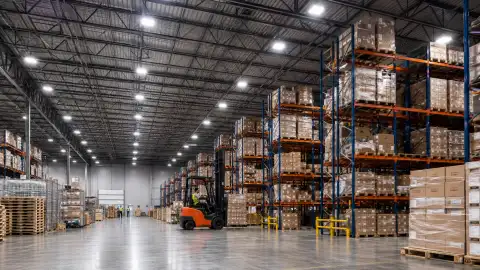
Imagine two contractors quoting the same 250-light warehouse. One proposes a simple one-for-one replacement. The other wants to remove fixtures, alter the layout, add occupancy controls, perform a photometric study and install the work at night from rented lifts. The second quote can be materially higher even when its luminaires cost less.
That is why I would not use a generic price per square foot as the first warehouse-lighting number. Square footage does not tell you how many existing fixtures there are, how high they are mounted, whether the branch circuits need work, whether the rack layout creates dark vertical faces, or whether the operation can tolerate blocked aisles during installation.
Start with the ceiling, not the catalog
A useful lighting budget starts with an inventory of what is actually installed: fixture count, fixture type, measured or documented input wattage, mounting height, operating hours, control zones and the areas each fixture serves. In a warehouse, I would also record the aisle orientation, rack height, open staging areas, dock zones and any spaces that are intermittently occupied.
The existing system matters because an LED project can mean several very different things. DOE's retrofit guidance distinguishes between replacement lamps, retrofit kits and complete new luminaires, and specifically warns that installation labor for some retrofit kits can approach or even exceed the labor required for a new LED luminaire when rewiring or other modifications are necessary.
Potentially lower material disruption, but compatibility, certification, ballast or driver configuration, wiring and remaining-fixture condition all need to be checked rather than assumed.
The bid becomes easier to normalize around a known LED luminaire, but access, removal, electrical connection, controls and disposal still sit outside the fixture price.
A photometric redesign may change fixture quantity, spacing, optics and control zones. DOE explicitly recommends considering redesign instead of assuming a remove-and-replace approach.
What actually moves the installed budget
The most useful way to read a lighting proposal is to separate the equipment from the work required to make that equipment function in the real warehouse. A quote that hides those elements inside one lump-sum number is harder to compare than a more expensive-looking quote that exposes them.
Confirm the exact manufacturer and model, wattage, lumen output, optics, voltage, dimming capability, warranty and any field-adjustable settings.
High-bay work can require scissor lifts, boom lifts, trained operators, barricading and aisle closures. Rack geometry can make some fixtures much slower to reach than others.
Existing junction boxes, conductors, disconnects, voltage, damaged wiring and previous modifications can turn a nominal fixture replacement into additional electrical scope.
Sensors, gateways, commissioning and control zoning add project cost, but intermittently occupied aisles and daylighted areas can also create savings beyond the fixture-wattage reduction.
A proper comparison considers delivered light, distribution, glare, vertical illumination, work-plane needs and the actual rack configuration rather than assuming that lower wattage automatically means a better project.
Night work, weekend work, phased installation, escorts, restricted work windows, housekeeping and protection around active operations belong in the budget if the facility cannot simply shut down.
Disposal also deserves its own line. Existing fluorescent and HID systems can create lamp, ballast and fixture disposal requirements. DOE's guidance notes that older equipment may introduce additional handling issues, including older ballasts containing PCBs. The correct disposal path therefore depends on what is actually being removed, not merely on the fact that LEDs are going in.
Build the energy case from watts and hours
The basic energy calculation is intentionally simple. What matters is that the input values come from the warehouse rather than from a sales presentation.
Existing annual kWh = fixture count × existing input watts ÷ 1,000 × annual operating hoursProposed annual kWh = fixture count × proposed input watts ÷ 1,000 × annual operating hoursAnnual energy-dollar savings = annual kWh reduction × electricity priceIf controls are included, model them separately rather than quietly multiplying the original system by a large savings percentage. Occupancy controls act on the new connected load, so the savings calculation should show what proportion of the LED operating hours or output is expected to disappear after control.
Electricity price also needs care. The U.S. Energy Information Administration reported a national commercial-sector average of 13.54 cents per kWh for May 2026 and 13.79 cents per kWh year-to-date through May. Those numbers are useful context, not a warehouse tariff. A particular facility may be classified differently and may also pay demand charges or time-dependent rates that a simple cents-per-kWh calculation does not capture.
Assume a warehouse has 250 existing fixtures drawing 430 W each. A proposed LED solution draws 180 W per fixture. The lights operate 4,000 hours per year. To keep the example readable, use $0.14/kWh. These are deliberately round planning assumptions, not Warehouse Fieldbook claims about what every warehouse currently has installed.
Now suppose the project team models an additional 12% reduction in the new LED energy use from occupancy and scheduling controls. That assumption removes another 21,600 kWh, worth $3,024 at the example electricity price.
If the warehouse also estimates $7,500 per year of genuinely avoidable lamp, ballast, lift and maintenance labor, the modeled recurring benefit becomes $45,524 per year before any demand-charge effect.
Finally, assume the complete installed project costs $145,000 and an approved utility incentive contributes $20,000. Net project cost is then $125,000 and simple payback is roughly 2.7 years.
None of those cost inputs is presented as a national benchmark. The point of the model is to show exactly which assumptions must be replaced with site numbers before the payback means anything.
If the utility tariff includes a demand charge, the reduction in coincident peak lighting kW can add value. Model that line from the actual tariff and billing history. EIA publishes average electricity prices but states that it does not publish utility tariff or demand-charge data.
The number I would normalize across bids
Once the scope is technically comparable, I would calculate the installed cost per existing light point and then keep the major exceptions visible. That metric is more useful than fixture price because it forces equipment and installation onto the same page, but it still should not hide layout differences.
For example, a contractor proposing 220 newly designed luminaires should not be penalized simply because another bidder proposes 250 one-for-one replacements. Compare total installed cost, resulting connected load, calculated light levels, annual kWh, controls strategy, warranty and the areas covered by each proposal.
I would also separate base scope from risk allowances. Unknown branch-circuit repair, after-hours access or fixture relocation should not quietly inflate the fixture number. When the assumptions are visible, the buyer can understand why two bids differ rather than assuming the lower unit price represents the better design.
Real warehouse projects show why one universal cost range is weak
Public Better Buildings case studies are useful because they show actual project scale, but they also show why converting one building's project into a universal “warehouse LED cost per square foot” would be misleading.
Havertys reported a $351,800 LED high-bay project in bulk storage in 2015 and a $248,200 rack-and-aisle LED project in 2016. Better Buildings reports a 3.5-year ROI for the overall LED projects. A later prep-and-recycle lighting phase cost $200,000 and carried a 2.7-year ROI estimate. The facility reported $158,000 in annual net avoided cost after accounting for an increase in gas use.
Lennox's Better Buildings case is not a retrofit: LED was specified in a new Houston warehouse instead of the originally specified T5 lighting. The project is reported at $106,000, with approximately $35,000 per year in lighting energy savings, roughly 55% savings versus the T5 design and a three-year simple payback. It is useful evidence for LED economics, but not a retrofit-price benchmark.
DOE's wider Interior Lighting Campaign adds another useful boundary. Across more than 3,500 reported retrofit projects, the typical energy saving from replacing fluorescent or HID fixtures with LED fixtures was 53% before control savings. Many projects that supplied cost-effectiveness information reported simple payback periods of three to five years, while some exceeded ten years. That spread is a better warning than a single headline payback figure.
Rebates belong in the model only after eligibility is checked
A rebate can materially change net project cost, but I would not build the project case around an assumed incentive until the utility or program administrator confirms the measure, product and application rules.
DesignLights Consortium qualified-product lists are widely used by North American energy-efficiency programs to validate eligible lighting and control products. That makes qualification worth checking during procurement, particularly before a contractor substitutes a different model after the incentive application has been prepared.
The clean comparison is therefore gross installed project cost, confirmed incentive and net owner cost as three separate numbers. A bid that only shows the post-rebate number makes it unnecessarily difficult to understand what happens if the incentive is reduced, delayed or rejected.
When one-for-one replacement is the wrong project
Replacing every existing fixture with one LED fixture is easy to count, but it can preserve an old layout that was designed around a different light source. DOE's industrial lighting guidance explicitly recommends considering redesign rather than simply removing and replacing equipment.
In a high-bay warehouse that can mean testing whether new optics and lumen output allow fewer luminaires, whether rack aisles need a different distribution than open floor, whether controls should be zoned aisle by aisle, and whether the proposed design maintains useful illumination on the surfaces where people actually work.
This is one reason a photometric layout can be economically relevant rather than cosmetic. Removing unnecessary fixtures can reduce equipment, installation, connected load and future maintenance simultaneously. Conversely, a design that saves watts by simply delivering less useful light is not an efficiency win.
What I would ask every bidder to return on one page
- existing fixture count, type and input wattage used in the calculation;
- proposed manufacturer, exact model, wattage, lumen output and optics;
- final fixture quantity rather than an assumption of one-for-one replacement;
- mounting height and major access assumptions;
- photometric criteria and the layout used to test them;
- controls by area, including occupancy, daylighting or scheduling;
- annual operating hours used in the savings model;
- electricity price and any demand-rate assumption;
- fixture/equipment price separated from installation where practical;
- lift, electrical modification, commissioning and disposal scope;
- planned outage, aisle-closure and after-hours assumptions;
- warranty terms for luminaires, drivers and controls;
- gross project cost, confirmed incentive and net project cost;
- annual kWh savings, maintenance savings and simple-payback calculation.
That page does more for bid comparison than a long catalog of LED features. It exposes the assumptions that drive the economics and makes it possible to trace a low price back to a real design choice instead of guessing what a contractor left out.
Sources and methodology
Warehouse Fieldbook does not publish a universal warehouse LED price per square foot or installed fixture because the public evidence does not support one number that is defensible across different mounting heights, existing systems, controls, access conditions and electrical scope. The worked 250-fixture example above is a Warehouse Fieldbook planning model: fixture count, watts, hours, project cost, maintenance savings, control savings and incentive are explicitly hypothetical. Its $0.14/kWh electricity assumption is rounded from current national commercial electricity-price context and should be replaced with the facility's actual bill and tariff.
DOE Better Buildings material supplies the retrofit-option, installation-labor, lighting-redesign and controls methodology. Its Interior Lighting Campaign supplies the reported 53% typical fixture energy reduction and the observed range of project paybacks. The Havertys and Lennox Better Buildings projects are used as real-world calibration points and are kept in their original context rather than converted into a national cost benchmark. EIA supplies current U.S. electricity-price data and the limitation that its data do not provide individual utility tariffs or demand charges. DesignLights Consortium supplies the current role of qualified product lists in efficiency-program eligibility.
- U.S. Department of Energy Better Buildings — LED retrofit and controls best practices
- DOE Better Buildings — Interior Lighting Campaign retrofit outcomes
- DOE Better Plants — industrial lighting assessment and redesign guidance
- DOE Better Buildings — Havertys Eastern Distribution Center
- DOE Better Buildings — Lennox distribution warehouse LED project
- U.S. Energy Information Administration — average electricity prices by end-use sector
- U.S. Energy Information Administration — tariff and demand-charge data limitation
- DesignLights Consortium — qualified networked lighting control systems